Skip to main content
Anatomy & Physiology
My Course
Learn
Exam Prep
AI Tutor
Study Guides
Textbook Solutions
Flashcards
Explore
Try the app
My Course
Learn
Exam Prep
AI Tutor
Study Guides
Textbook Solutions
Flashcards
Explore
Try the app
Back
Anatomy & Physiology: Integumentary System
You can tap to flip the card.
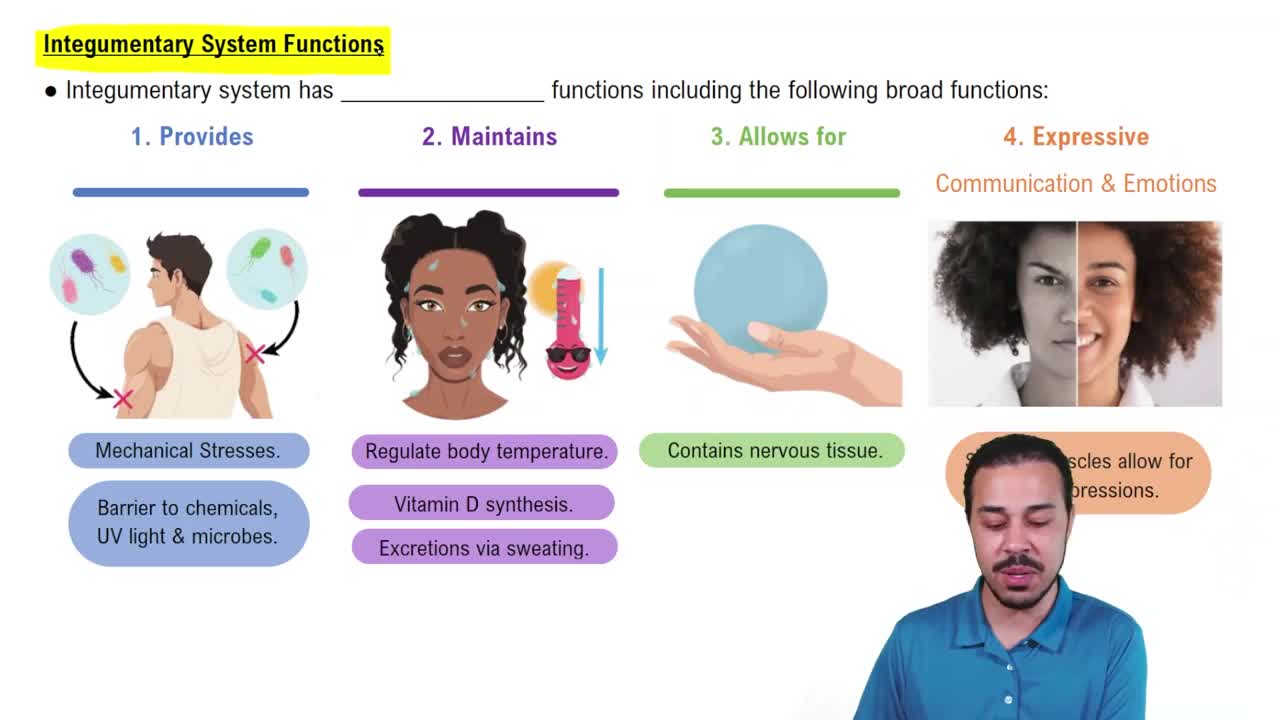
What are the main functions of the skin?
You can tap to flip the card.
👆
What are the main functions of the skin?
Protection
,
thermoregulation
,
sensation
,
synthesis
, and
excretion
.
Track progress
Control buttons has been changed to "navigation" mode.
1/20
Recommended videos
Guided course
06:54
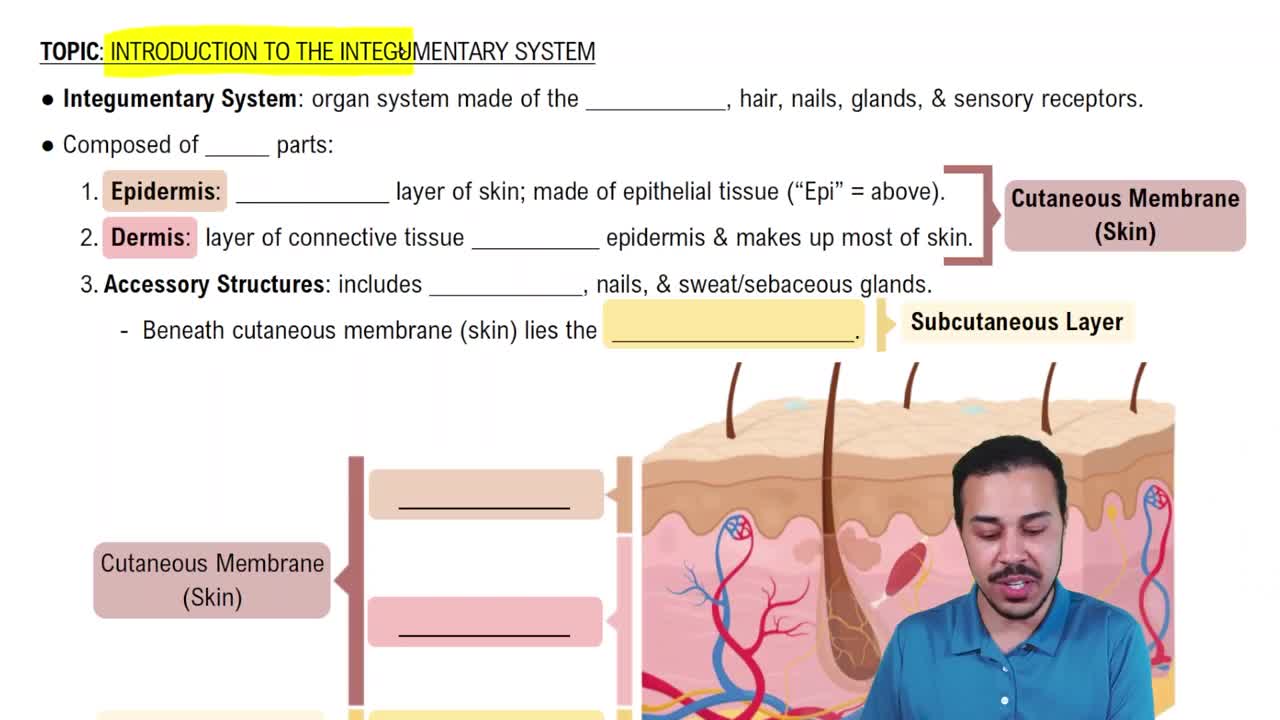
Introduction to the Integumentary System
24079
views
820
rank
3
comments
Guided course
03:40
Integumentary System Functions
15633
views
394
rank
1
comments
Guided course
02:47
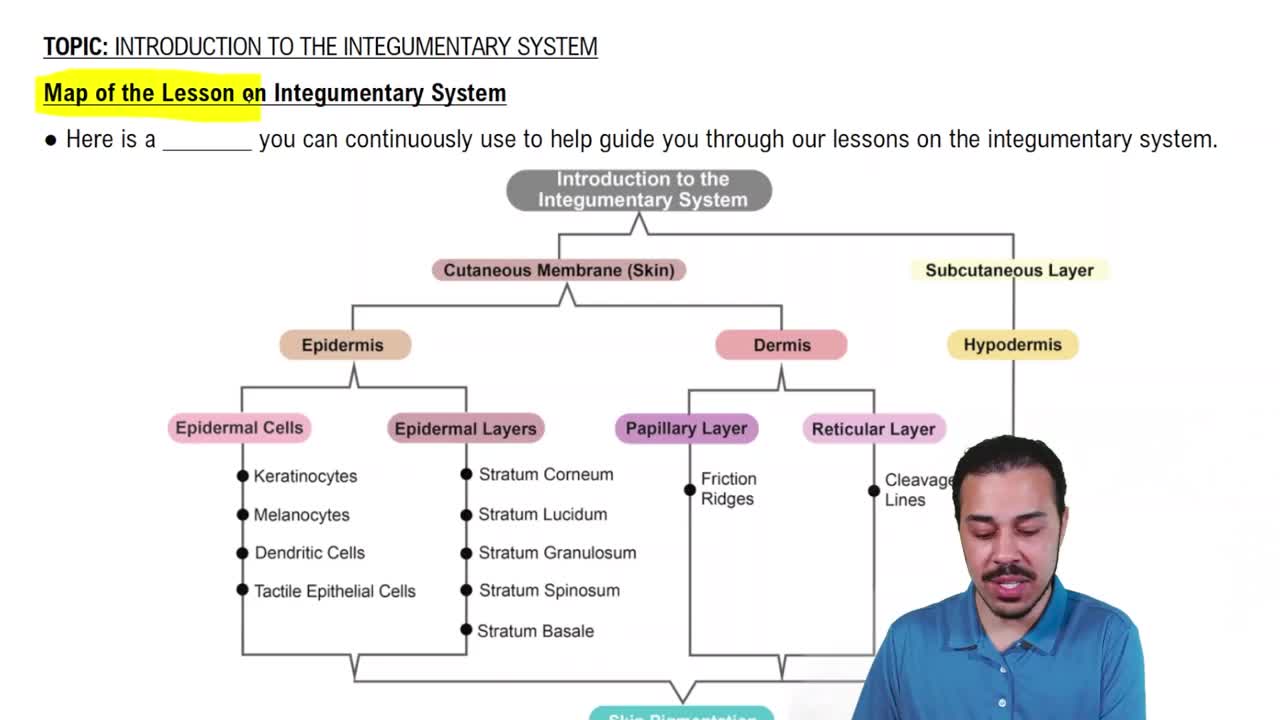
Map of the Lesson on Integumentary System
13780
views
649
rank
6
comments
Terms in this set (20)
Hide definitions
What are the main functions of the skin?
Protection
,
thermoregulation
,
sensation
,
synthesis
, and
excretion
.
What are the two main regions of the skin?
Epidermis
(superficial) and
dermis
(beneath epidermis). The hypodermis is not part of the skin.
What type of tissue composes the epidermis?
Keratinized stratified squamous epithelium
primarily made of keratinocytes.
Name the five layers of the epidermis from deepest to most superficial.
Stratum
basale
,
spinosum
,
granulosum
,
lucidum
(only in thick skin), and
corneum
.
What cells are found in the epidermis besides keratinocytes?
Melanocytes
(produce melanin) and
tactile cells
(sensory receptors).
What are the two layers of the dermis?
Papillary layer
(loose connective tissue) and
reticular layer
(dense irregular connective tissue).
What structures are found in the papillary layer of the dermis?
Dermal papillae
containing capillaries and tactile corpuscles.
What type of connective tissue is found in the reticular layer of the dermis?
Dense irregular connective tissue
with elastic fibers and collagen bundles.
What are the main accessory structures of the skin?
Hairs
,
nails
,
sudoriferous (sweat) glands
, and
sebaceous (oil) glands
.
What are the parts of a hair?
Hair shaft
(above skin),
hair root
(embedded in follicle),
hair matrix
, and
hair papilla
.
What are the main parts of a nail?
Nail plate
,
nail body
,
nail root
, and
nail matrix
.
What are the two main types of sudoriferous (sweat) glands?
Eccrine sweat glands
and
apocrine sweat glands
.
Where do sebaceous (oil) glands secrete sebum?
Into
hair follicles
to lubricate hair and skin.
What is the role of melanocytes in the epidermis?
They
synthesize melanin
, which protects keratinocyte nuclei from UV radiation.
What is the function of the stratum basale?
It contains
stem cells
that divide to produce new keratinocytes.
What happens in the stratum granulosum?
Keratinocytes begin to
die and become keratinized
, forming a waterproof barrier.
What sensory receptors are found in the dermis?
Tactile corpuscles
(light touch) and
lamellated corpuscles
(pressure and vibration).
What is the hypodermis composed of and its function?
Composed of
adipose tissue
and connective tissue; it anchors skin to underlying structures and provides insulation.
How does the integumentary system regulate body temperature?
Through
sweat gland secretion
and
blood vessel dilation or constriction
in the dermis.
What is the role of the arrector pili muscle?
It contracts to cause
hair to stand up
(goosebumps) and helps trap heat.
 BackBack
 06:54