 Back
Anatomy & Physiology: Integumentary System and Glandular Epithelium
 06:54

Terms in this set (29)
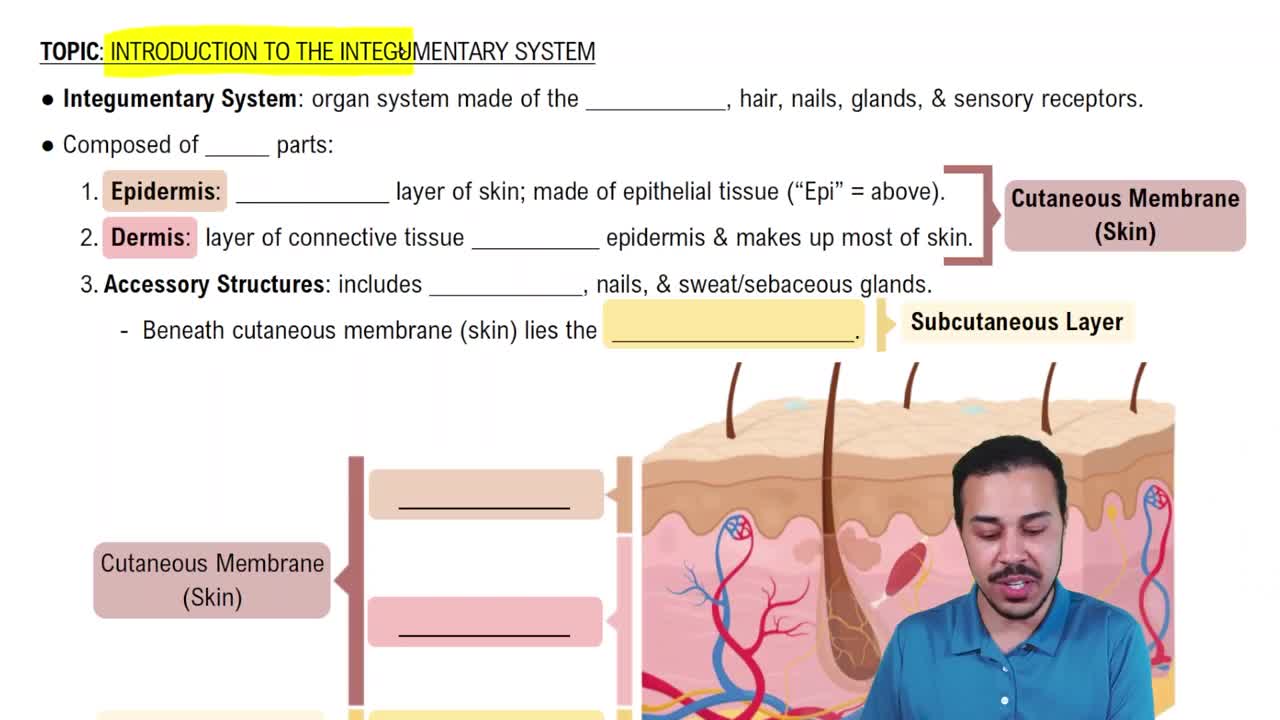
1. Cutaneous membranes (skin)
2. Mucous membranes (line body cavities open to exterior)
3. Serous membranes (line closed ventral body cavities)
A gland is one or more cells that make and secrete an aqueous fluid called a secretion. Classified by site of product release (endocrine or exocrine) and number of cells (unicellular or multicellular).
Endocrine glands are ductless and secrete hormones into interstitial fluid picked up by blood. Exocrine glands secrete products onto body surfaces or cavities via ducts.
Unicellular exocrine glands include goblet cells and mucous cells, which produce mucin that dissolves in water to form mucus for protection and lubrication.
By duct branching: simple (unbranched ducts) or compound (branched ducts). By secretory unit shape: tubular (tube-shaped), alveolar (sac-shaped), or tubuloalveolar (both).
Merocrine: secretion by exocytosis (e.g., sweat glands). Holocrine: entire cell ruptures releasing secretion (e.g., sebaceous glands). Apocrine: apex of cell pinches off (controversial in humans).
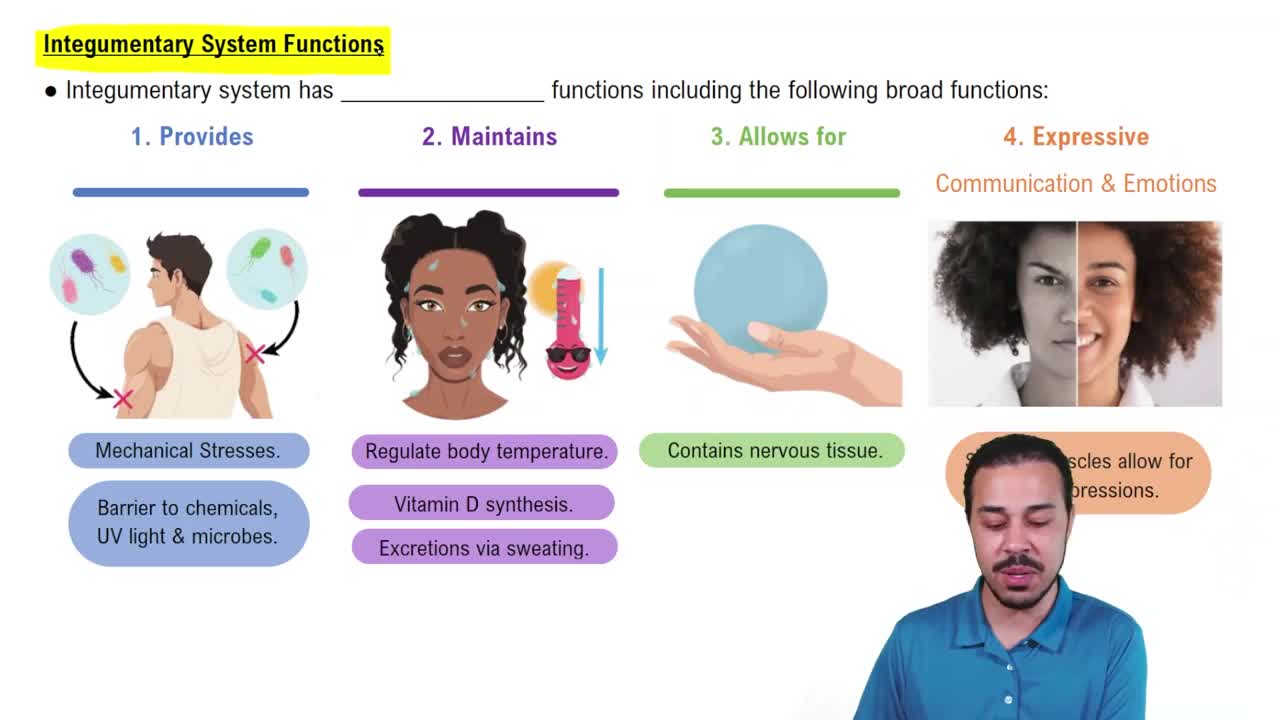
Skin acts as a chemical barrier (antimicrobial proteins, acid mantle, melanin), physical barrier (keratinized cells, lipids), and biological barrier (immune cells like dendritic cells and macrophages).
By producing insensible perspiration at rest and sensible perspiration (sweat) when hot. Dermal blood vessels dilate to increase heat loss or constrict to conserve heat.
Skin contains sensory receptors: exteroceptors respond to external stimuli like touch and temperature; free nerve endings sense pain.
Skin synthesizes vitamin D needed for calcium absorption, activates some hormones, produces collagenase to prevent wrinkles, and can detoxify some carcinogens.
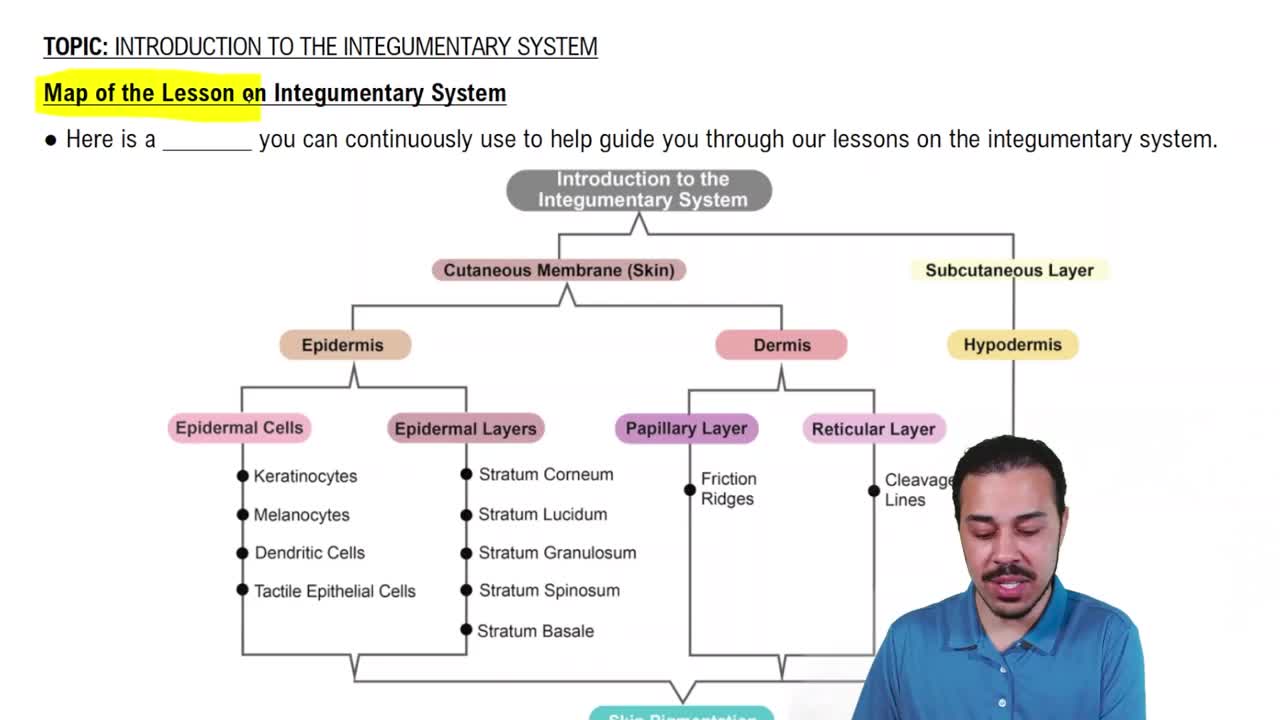
Epidermis: superficial, avascular, keratinized stratified squamous epithelium.
Dermis: underlying connective tissue, vascular, contains glands and follicles.
Also called superficial fascia, it is a subcutaneous layer of mostly adipose tissue that absorbs shock, insulates, and anchors skin to muscles.
Keratinocytes: produce keratin.
Melanocytes: produce melanin.
Dendritic (Langerhans) cells: immune defense.
Tactile (Merkel) cells: sensory touch receptors.
From deep to superficial: Stratum basale, Stratum spinosum, Stratum granulosum, Stratum lucidum, Stratum corneum.
It is the deepest layer with stem cells that divide to produce new keratinocytes; also contains melanocytes and Merkel cells.
Cells begin keratinization, accumulate keratohyaline and lamellar granules, become water-resistant, and cells above die due to lack of nutrients.
They are fingerlike projections that increase surface area for nutrient exchange and contain capillaries and sensory receptors; form friction ridges for grip and fingerprints.
Dense irregular connective tissue with collagen and elastic fibers providing strength, resiliency, and hydration.
Parallel collagen fibers in the reticular dermis create cleavage lines; important for surgeons because incisions along these lines heal better.
Melanin (made by melanocytes), carotene (yellow-orange pigment), and hemoglobin (red from blood vessels).
A: Asymmetry, B: Border irregularity, C: Color variation, D: Diameter larger than 6 mm.
Basal cell carcinoma: most common, least malignant.
Squamous cell carcinoma: can metastasize.
Melanoma: most dangerous, highly metastatic.
First-degree: epidermal damage only.
Second-degree: epidermis and upper dermis, blisters.
Third-degree: full thickness, no pain, requires grafting.
Body divided into 11 areas each representing 9% of total body surface area, plus 1% for genitals; used to estimate burn severity and fluid loss.
Regeneration: replacement with same tissue, restoring function.
Fibrosis: replacement with scar tissue, function lost.
1. Inflammation: blood vessel dilation and clotting.
2. Organization: blood clot replaced by granulation tissue.
3. Regeneration and fibrosis: scab detaches, tissue matures.
High: epithelial, bone, areolar, dense irregular, blood-forming.
Moderate: smooth muscle, dense regular connective.
Low: cardiac muscle, nervous tissue.
Eccrine glands: abundant, thermoregulation, secrete watery sweat.
Apocrine glands: axillary and anogenital areas, secrete milky sweat, begin at puberty.
Oil glands associated with hair follicles, secrete sebum (holocrine), which softens skin and hair and has bactericidal properties.