 Back
Anatomy & Physiology: Integumentary System and Skin Disorders
 06:54


Terms in this set (31)
Apocrine glands are sweat glands found mainly in the armpits and groin that secrete a thicker, milky sweat often associated with body odor.
Arrector pili muscles are small muscles attached to hair follicles that contract to cause hair to stand up, producing goosebumps.
Carotene is a yellow-orange pigment found in the skin that contributes to skin color and can be converted to vitamin A.
Ceruminous glands are modified sweat glands in the ear canal that produce cerumen (earwax) to protect the ear.
Collagen fibers provide strength and structural support to the dermis, making skin resilient and flexible.
Cutaneous sensory receptors detect stimuli such as touch, pressure, pain, and temperature in the skin.
The cuticle is the thin layer of dead skin at the base of the nail that protects the nail matrix from infection.
Dermal papillae are fingerlike projections of the dermis that increase surface area and help anchor the epidermis.
Dermal ridges form the basis of fingerprints and enhance grip by increasing friction on the skin surface.
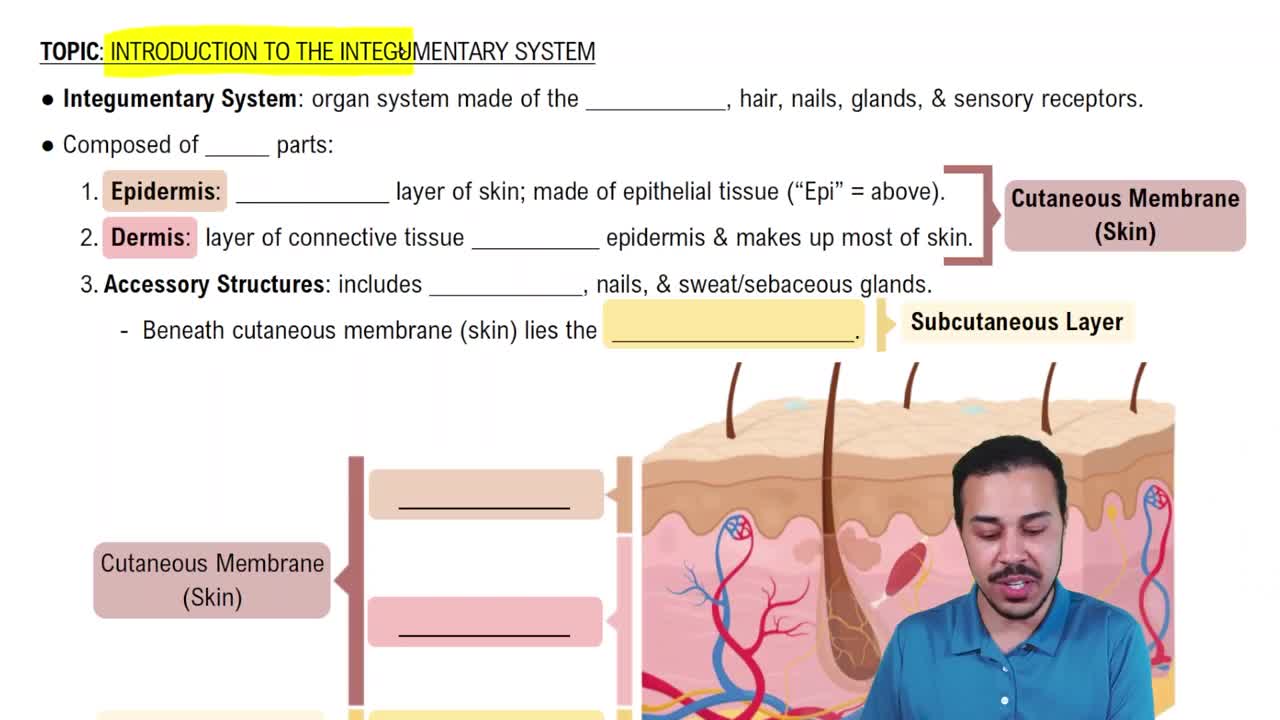
The dermis is the thick layer of skin beneath the epidermis containing blood vessels, nerves, hair follicles, and glands.
Eccrine glands are sweat glands distributed over most of the body that produce watery sweat for temperature regulation.
Elastin fibers provide elasticity to the skin, allowing it to stretch and return to its original shape.
Epidermal ridges are downward projections of the epidermis that interlock with dermal ridges to strengthen skin attachment.
The epidermis is the outermost layer of skin composed mainly of keratinocytes that provide a protective barrier.
Fibroblasts are cells in the dermis that produce collagen and elastin fibers essential for skin structure.
First degree burns affect only the epidermis, causing redness and pain without blistering.
The hair follicle is a sheath of cells and connective tissue that surrounds the hair root and anchors it in the skin.
Keratinocytes are the primary cells of the epidermis that produce keratin, a protein that strengthens skin.
Langerhans cells are immune cells in the epidermis that detect and fight pathogens.
Melanocytes produce melanin pigment, which protects skin from UV radiation and determines skin color.
Merkel cells are sensory cells in the epidermis involved in the sensation of touch.
The papillary layer is the upper layer of the dermis composed of loose connective tissue and dermal papillae.
The reticular layer is the deeper, thicker layer of the dermis made of dense irregular connective tissue.
Sebaceous glands secrete sebum, an oily substance that lubricates and waterproofs the skin and hair.
The stratum basale is the deepest epidermal layer where new keratinocytes are produced by mitosis.
The stratum corneum is the outermost epidermal layer composed of dead, flattened keratinocytes that form a tough protective layer.
Sudoriferous glands produce sweat to help regulate body temperature and excrete waste.
Albinism is a genetic condition characterized by a lack of melanin production, resulting in very pale skin and hair.
Basal cell carcinoma is a common skin cancer originating from basal cells in the epidermis, usually caused by UV exposure.
Second degree burns damage both the epidermis and part of the dermis, causing blisters and severe pain.
Third degree burns destroy the epidermis and dermis, often damaging underlying tissues and causing numbness.