Skip to main content
Anatomy & Physiology
My Course
Learn
Exam Prep
AI Tutor
Study Guides
Textbook Solutions
Flashcards
Explore
Try the app
My Course
Learn
Exam Prep
AI Tutor
Study Guides
Textbook Solutions
Flashcards
Explore
Try the app
Back
Anatomy & Physiology: Integumentary System High-Yield Flashcards
You can tap to flip the card.
What is the integument?
You can tap to flip the card.
👆
What is the integument?
The
skin
, which is the largest organ of the body.
Track progress
Control buttons has been changed to "navigation" mode.
1/49
Recommended videos
Guided course
06:54
Introduction to the Integumentary System
22213
views
753
rank
3
comments
Guided course
03:40
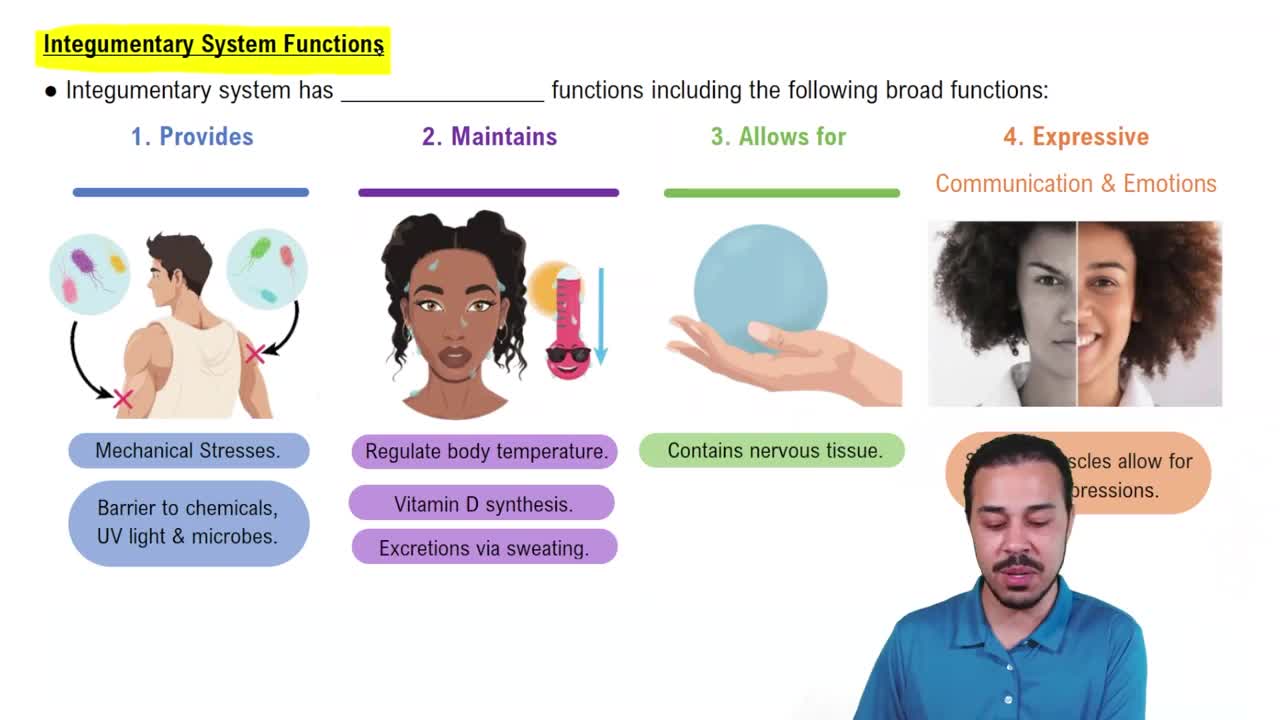
Integumentary System Functions
14426
views
369
rank
1
comments
Guided course
02:47
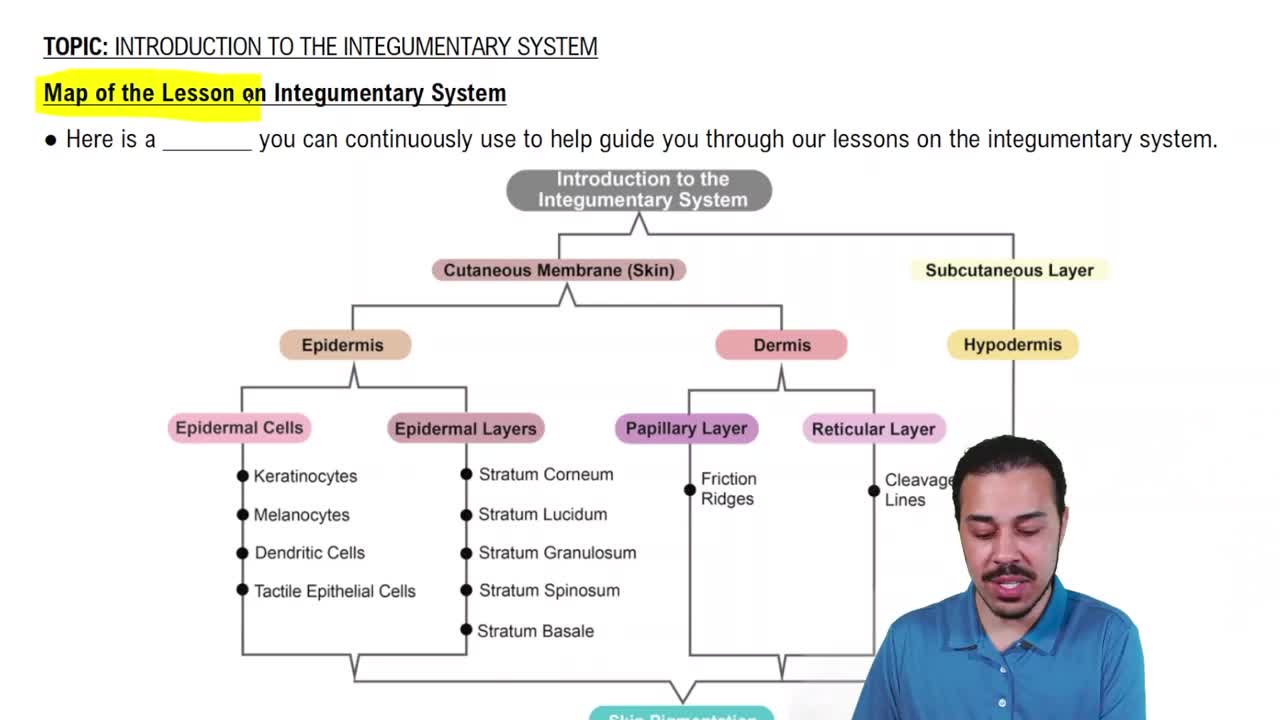
Map of the Lesson on Integumentary System
12656
views
597
rank
5
comments
Terms in this set (49)
Hide definitions
What is the integument?
The
skin
, which is the largest organ of the body.
What percentage of body weight does the skin represent?
Approximately
16%
of total body weight.
What are the two main parts of the integument?
Cutaneous membrane
(skin) and
accessory structures
(hair, nails, glands).
List the primary functions of the skin.
Protection, temperature regulation, excretion, vitamin D production, sensation, and lipid storage.
What are the three main layers of the skin?
Epidermis
,
dermis
, and
hypodermis
.
What tissue type composes the epidermis?
Keratinized stratified squamous epithelium
.
Is the epidermis vascular or avascular?
The epidermis is
avascular
(no blood vessels).
What is the main cell type in the epidermis?
Keratinocytes
, making up about 90% of epidermal cells.
How many layers does thin skin have?
Thin skin has
4 layers
.
How many layers does thick skin have and where is it found?
Thick skin has
5 layers
and is found on the palms and soles; it has no hair.
Name the epidermal layers from deep to superficial.
Stratum basale
→
stratum spinosum
→
stratum granulosum
→
stratum lucidum
→
stratum corneum
.
What is the function of the stratum basale?
It is the site of
mitosis
(cell division) producing new skin cells.
Which special cells are found in the stratum basale?
Melanocytes
(pigment-producing) and
Merkel cells
(touch receptors).
What is a key feature of the stratum spinosum?
Presence of
desmosomes
that create a spiny appearance.
Which immune cells are located in the stratum spinosum?
Dendritic (Langerhans) cells
that help with immune defense.
What happens in the stratum granulosum?
Cells begin to
die
and start producing
keratin
.
Where is the stratum lucidum found?
Only in
thick skin
such as palms and soles.
What composes the stratum corneum?
Layers of
dead keratinized cells
that provide protection.
What is keratinization?
The process of forming
dead, keratin-filled protective cells
in the epidermis.
What are the main pigments affecting skin color?
Melanin
,
carotene
, and
hemoglobin
.
What is the function of melanin?
Provides
UV protection
by absorbing ultraviolet radiation.
What determines skin color?
The amount of
melanin production
, not the number of melanocytes.
What is cyanosis?
A condition where the skin appears
blue
due to low oxygen levels.
What causes jaundice?
Yellowing of the skin caused by
liver issues
.
What is vitiligo?
Loss of
melanocytes
leading to white patches on the skin.
Where is vitamin D produced in the body?
In the
skin
upon exposure to UV radiation.
What is the function of vitamin D?
Helps with
calcium absorption
in the intestines.
What are the two layers of the dermis?
Papillary layer
(areolar connective tissue) and
reticular layer
(dense irregular connective tissue).
What is the role of collagen fibers in the dermis?
Provide
strength
to the skin.
What is the role of elastic fibers in the dermis?
Allow the skin to
stretch and recoil
.
What do Meissner corpuscles detect?
They detect
light touch
sensations.
What do Pacinian corpuscles detect?
They detect
deep pressure
and
vibration
.
What is the function of the hypodermis?
Stores
fat
and provides
insulation
.
Why is the hypodermis a common injection site?
Because it is
subcutaneous
and has good blood supply.
What is the function of hair?
Provides
protection
and
insulation
.
What does the arrector pili muscle do?
Causes
goosebumps
by contracting and pulling hair upright.
What is the function of sebaceous glands?
Produce
sebum
which lubricates skin and has antibacterial properties.
Where are apocrine sweat glands found and what do they do?
Located in armpits and groin; they produce sweat that causes
body odor
.
What is the role of merocrine (eccrine) sweat glands?
Found all over the body; they regulate
body temperature
by cooling through sweat.
What are nails made of?
Composed of
keratin
.
Where do nails grow from?
From the
nail matrix
.
What are the four phases of wound healing?
Inflammation
,
migration
,
proliferation
, and
scarring
.
What characterizes a 1st degree burn?
Damage limited to the
epidermis
only.
What characterizes a 2nd degree burn?
Damage to the
epidermis and dermis
with blisters.
What characterizes a 3rd degree burn?
Destruction of
all skin layers
.
Which epidermal layer sheds dandruff?
The
stratum corneum
.
Which epidermal layer is only found in thick skin?
The
stratum lucidum
.
What effects can UV radiation have on skin?
It can cause
cancer
and
wrinkles
.
Which glands control body temperature via sweat?
The
merocrine (eccrine) glands
.
 BackBack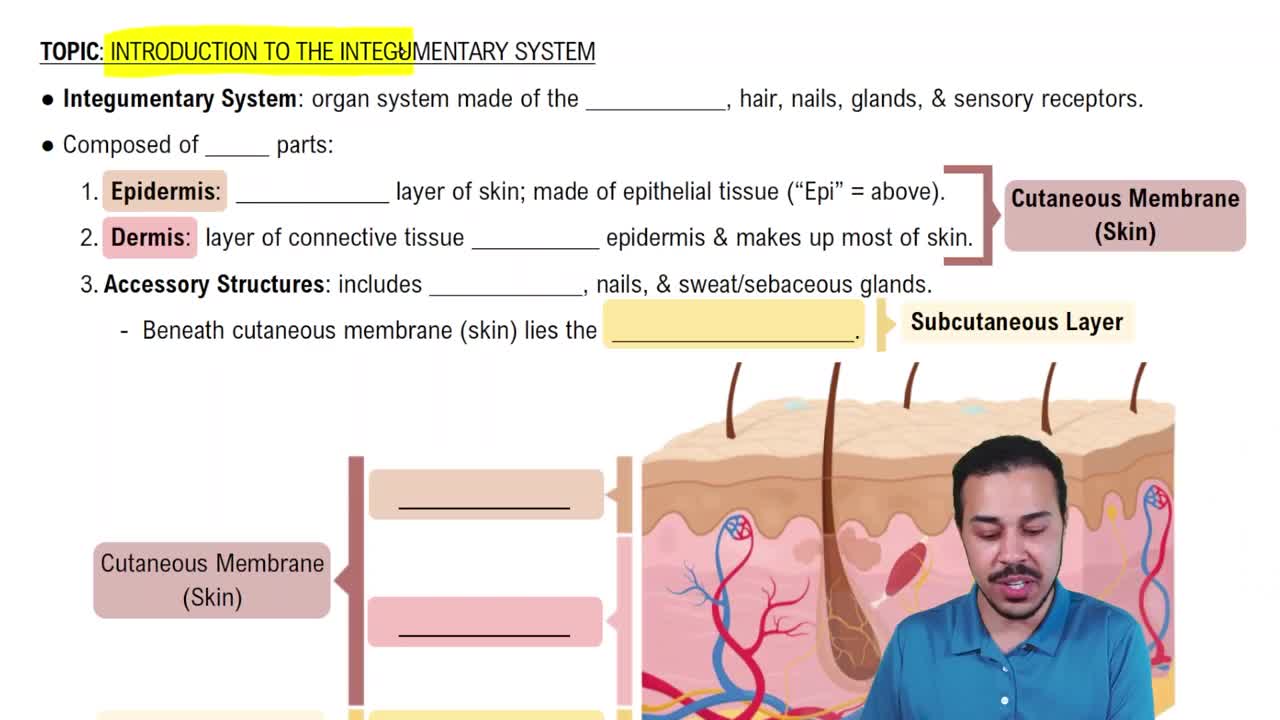
 06:54
06:54