 Back
Anatomy & Physiology: Introduction to Physiology and Molecular Interactions
 05:04

Terms in this set (23)
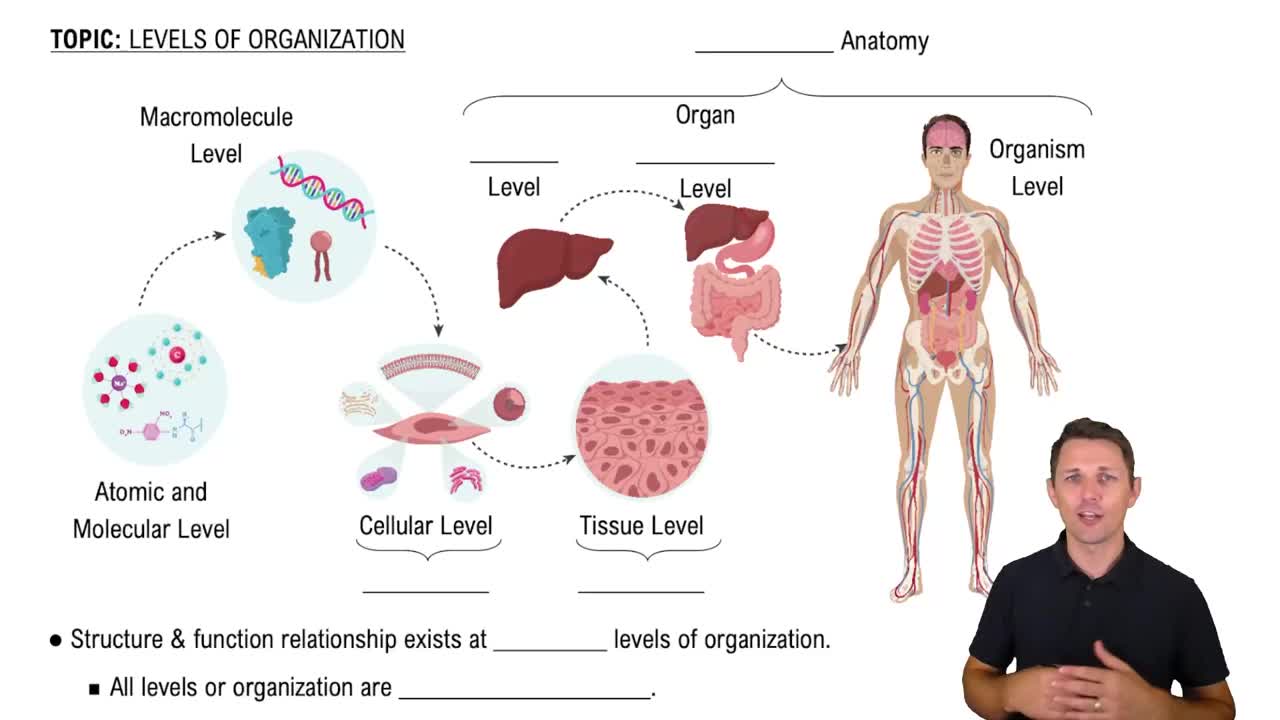
Physiology is the study of the normal functioning of a living organism and its component parts, including all chemical and physical processes.
Homeostasis is the maintenance of a relatively stable internal environment within an organism.
Intracellular fluid (ICF) is the fluid within cells, and extracellular fluid (ECF) is the watery internal environment surrounding cells.
The law of mass balance states that the amount of a substance remains constant if any gain is offset by an equal loss, requiring input to equal output in an open system.
Homeostasis maintains a dynamic steady state with constant movement but no net change, whereas equilibrium means identical composition between compartments.
A sensor monitors a variable, an integrating center establishes the set point, and an effector produces a response to adjust the variable.
Local control is restricted to a tissue or cell, while reflex control uses long-distance signaling via nervous or endocrine systems.
A negative feedback loop stabilizes a variable by turning off the response once the set point is reached, maintaining homeostasis.
A positive feedback loop amplifies the stimulus and is not homeostatic, such as uterine contractions during childbirth.
Elements are pure substances made of atoms, which consist of protons, neutrons, and electrons.
The atomic number is the number of protons, and the mass number is the total number of protons and neutrons in the nucleus.
Isotopes are forms of the same element with the same number of protons but different numbers of neutrons; some are radioactive.
Electrons are involved in chemical bond formation, electrical signaling as ions, energy transfer, and formation of free radicals.
Covalent bonds share electron pairs strongly, while noncovalent bonds like ionic, hydrogen, and Van der Waals forces are weaker and reversible.
Hydrophilic molecules are polar or ionic and soluble in water; hydrophobic molecules are nonpolar and insoluble in water.
Water dissociates into H+ and OH– ions; pH measures the concentration of H+, with acidic solutions having more H+ and basic solutions more OH–.
Blood pH is normally maintained between 7.35 and 7.45; values below cause acidosis, and above cause alkalosis.
The four major groups are carbohydrates, lipids, nucleic acids, and proteins.
Carbohydrates serve as the primary energy source, existing as monosaccharides, disaccharides, and polysaccharides like glycogen.
Lipids include triglycerides (energy storage), eicosanoids (regulatory), steroids (cholesterol), and phospholipids (membrane structure).
DNA stores genetic information as a double helix; RNA is single-stranded and directs protein synthesis.
Protein function depends on its structure, which has four levels: primary (amino acid sequence), secondary (folds/coils), tertiary (3D shape), and quaternary (multiple polypeptides).
Denaturation is an irreversible change in protein shape caused by extreme heat or pH, disrupting secondary or tertiary structure.