Skip to main content
Anatomy & Physiology
My Course
Learn
Exam Prep
AI Tutor
Study Guides
Textbook Solutions
Flashcards
Explore
Try the app
My Course
Learn
Exam Prep
AI Tutor
Study Guides
Textbook Solutions
Flashcards
Explore
Try the app
Back
Anatomy & Physiology: Joint Types and Movements
You can tap to flip the card.
What is an articulation or joint?
You can tap to flip the card.
👆
What is an articulation or joint?
A
joint
or
articulation
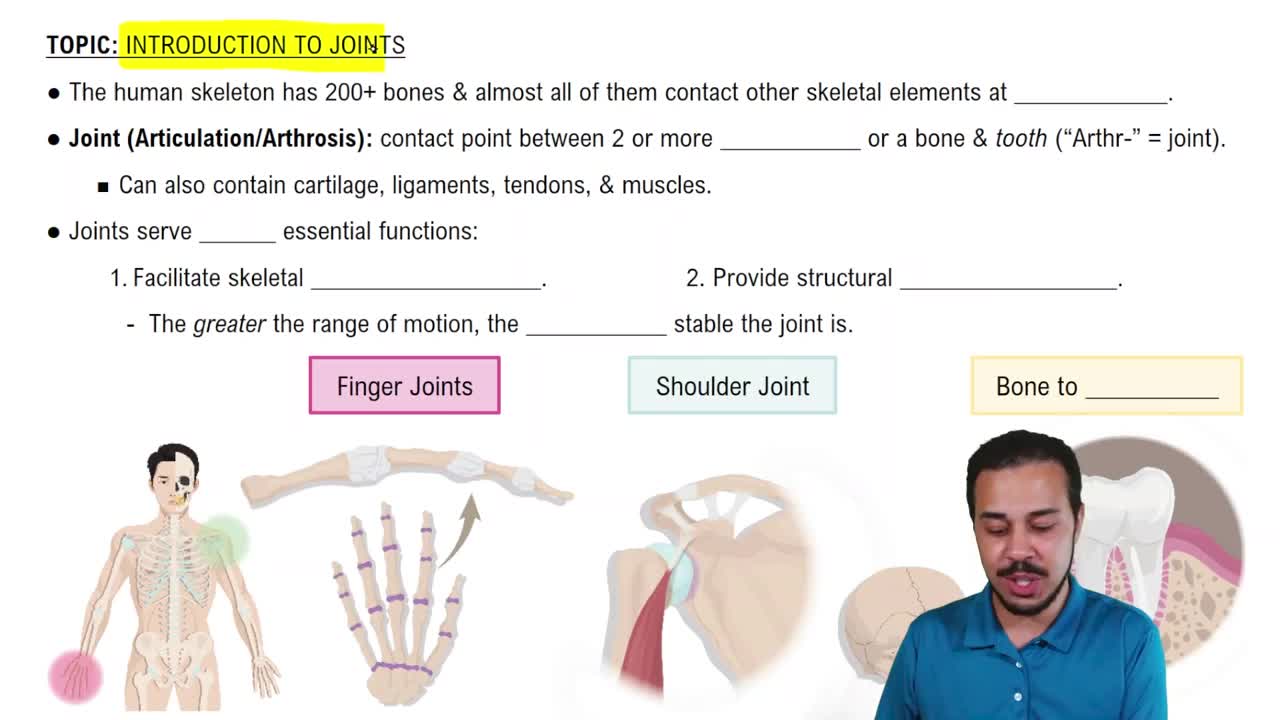
is the connection between two bones that allows for movement and provides mechanical support.
Track progress
Control buttons has been changed to "navigation" mode.
1/28
Recommended videos
Guided course
04:06
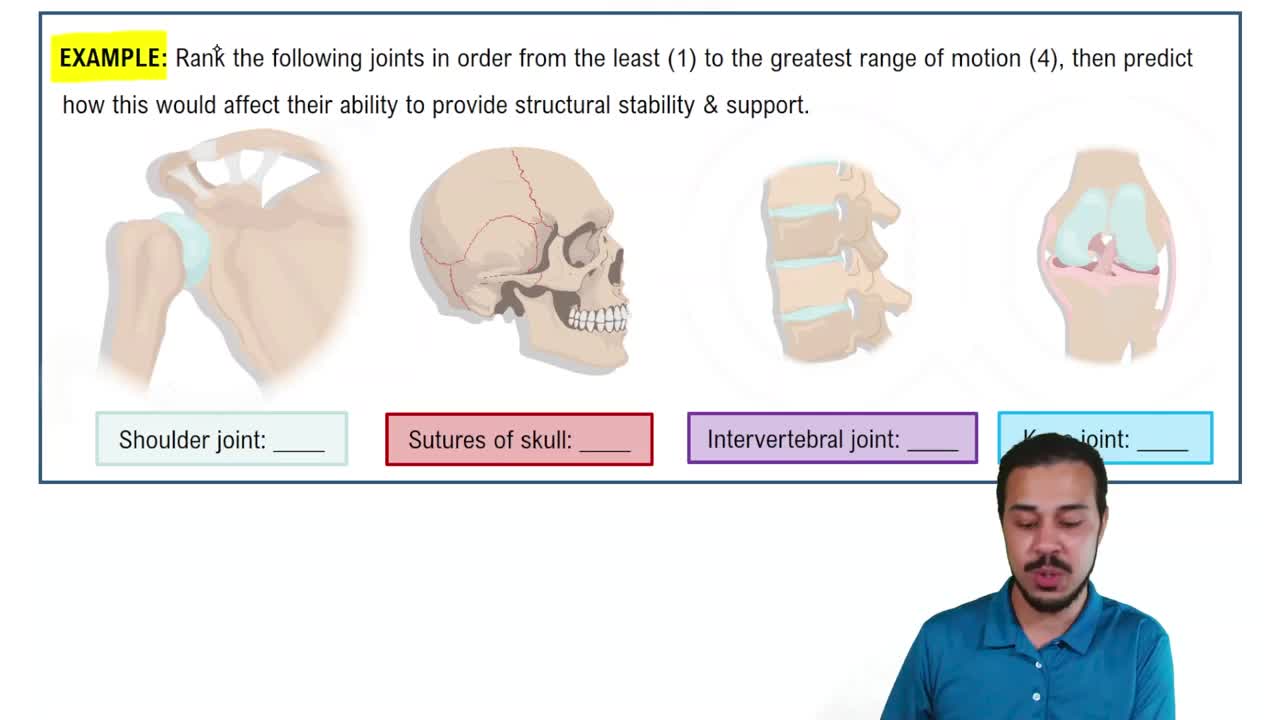
Introduction to Joints Example 1
11834
views
268
rank
Guided course
05:29
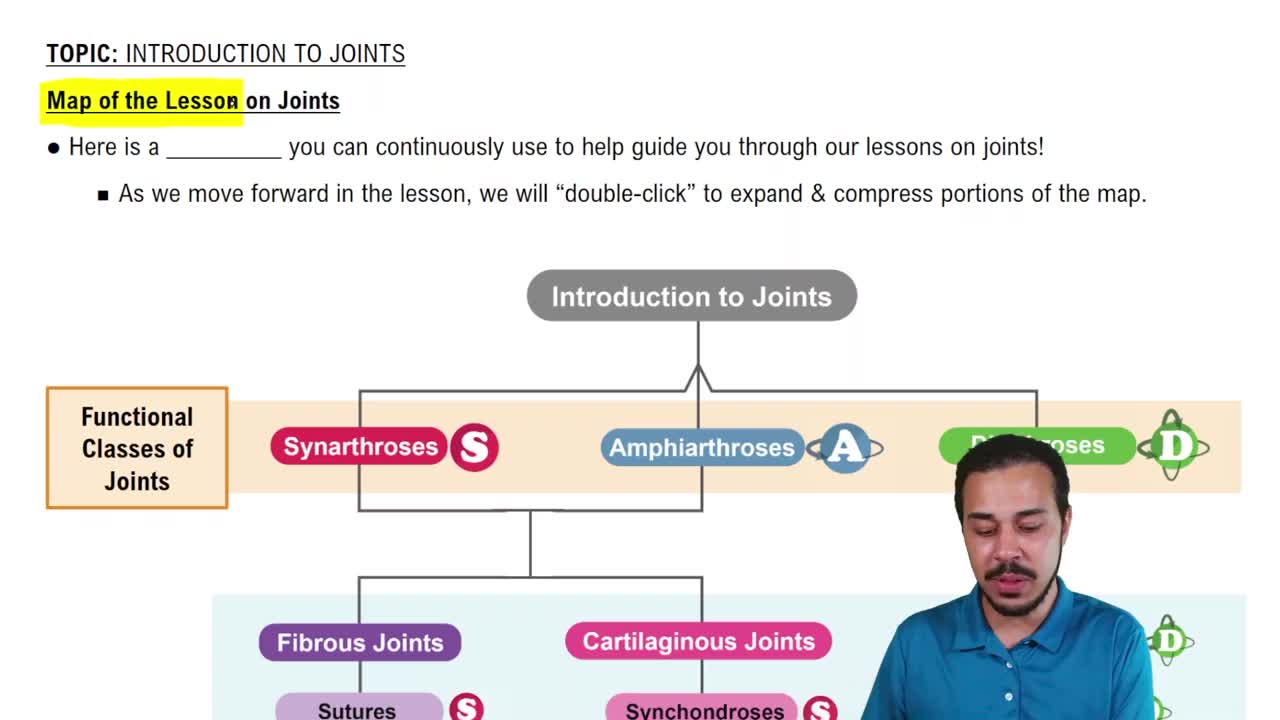
Map of the Lesson on Joints
12355
views
261
rank
1
comments
Guided course
05:39
Introduction to Joints
16588
views
426
rank
Terms in this set (28)
Hide definitions
What is an articulation or joint?
A
joint
or
articulation
is the connection between two bones that allows for movement and provides mechanical support.
Define synarthroses.
Synarthroses
are immovable joints where bones are tightly connected, such as sutures in the skull.
What are amphiarthroses?
Amphiarthroses
are slightly movable joints, like the pubic symphysis or intervertebral discs.
Describe diarthroses.
Diarthroses
are freely movable synovial joints, such as the shoulder or knee joints.
What is a synchondrosis?
A
synchondrosis
is a cartilaginous joint where bones are joined by hyaline cartilage, often temporary like the epiphyseal plate.
Define symphyses.
Symphyses
are cartilaginous joints where bones are joined by fibrocartilage, providing strength and flexibility, e.g., the pubic symphysis.
What characterizes synovial joints?
Synovial joints
have a fluid-filled joint cavity allowing free movement, lined by a synovial membrane.
What are menisci in joints?
Menisci
are crescent-shaped fibrocartilage pads in some synovial joints that improve fit and absorb shock.
Define bursae.
Bursae
are fluid-filled sacs that reduce friction between tendons, ligaments, and bones near joints.
What are tendon sheaths?
Tendon sheaths
are tubular bursae that wrap around tendons to reduce friction during movement.
What is the origin of a muscle?
The
origin
is the fixed attachment point of a muscle, usually proximal or on a less movable bone.
Define insertion in muscle anatomy.
The
insertion
is the movable attachment point of a muscle, typically distal or on the bone that moves.
What is extension?
Extension
is a movement that increases the angle between two bones, straightening a joint.
Define flexion.
Flexion
is a movement that decreases the angle between two bones, bending a joint.
What is abduction?
Abduction
is the movement of a limb away from the midline of the body.
Define adduction.
Adduction
is the movement of a limb toward the midline of the body.
What is rotation in joint movement?
Rotation
is the turning of a bone around its own longitudinal axis.
Explain eversion.
Eversion
is the movement of the sole of the foot away from the midline, turning outward.
What is inversion?
Inversion
is the movement of the sole of the foot toward the midline, turning inward.
Define pronation.
Pronation
is the rotation of the forearm so the palm faces downward or backward.
What is supination?
Supination
is the rotation of the forearm so the palm faces upward or forward.
Explain dorsiflexion.
Dorsiflexion
is the movement that decreases the angle between the dorsum (top) of the foot and the leg.
What is plantar flexion?
Plantar flexion
is the movement that increases the angle between the dorsum of the foot and the leg, pointing the toes downward.
Define protraction.
Protraction
is the anterior movement of a body part in the transverse plane.
What is retraction?
Retraction
is the posterior movement of a body part in the transverse plane.
Explain elevation.
Elevation
is the upward movement of a body part.
What is depression in anatomy?
Depression
is the downward movement of a body part.
Define opposition.
Opposition
is the movement of the thumb to touch the fingertips, enabling grasping.
 BackBack
 04:06