 Back
Anatomy & Physiology: Joints
 04:06

Terms in this set (20)
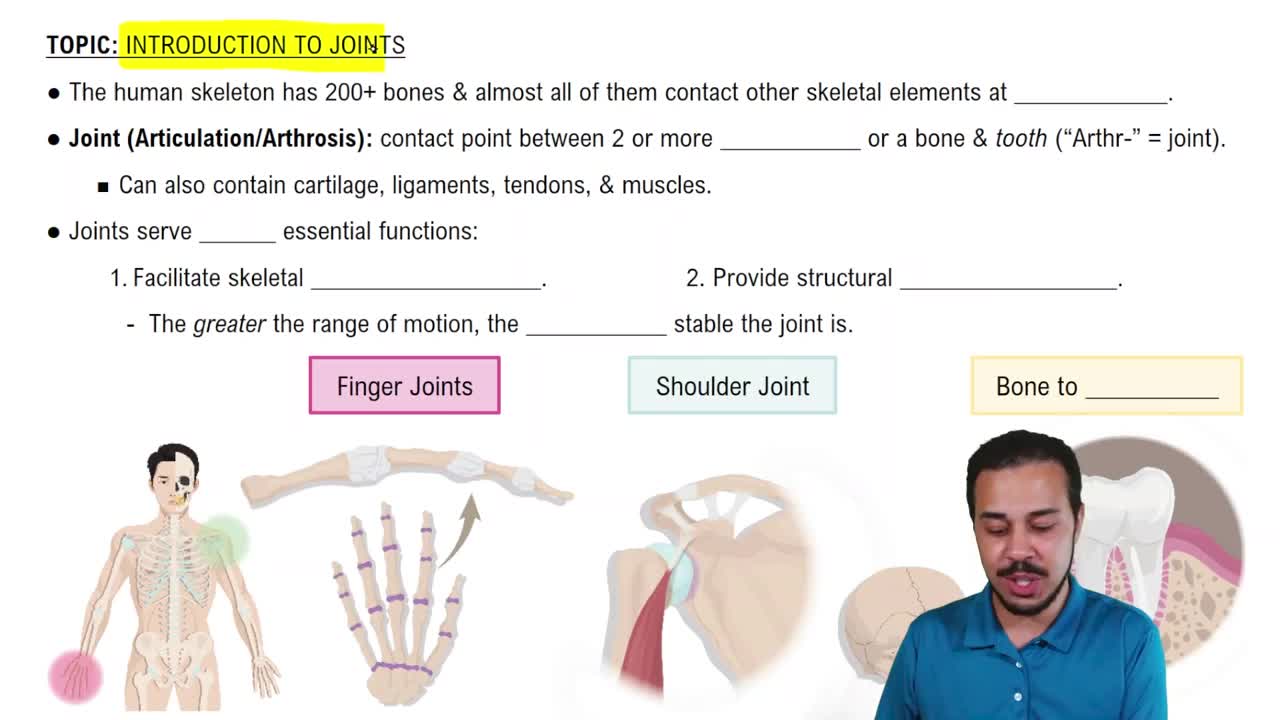
A joint is a connection between two or more bones that allows for movement and provides mechanical support.
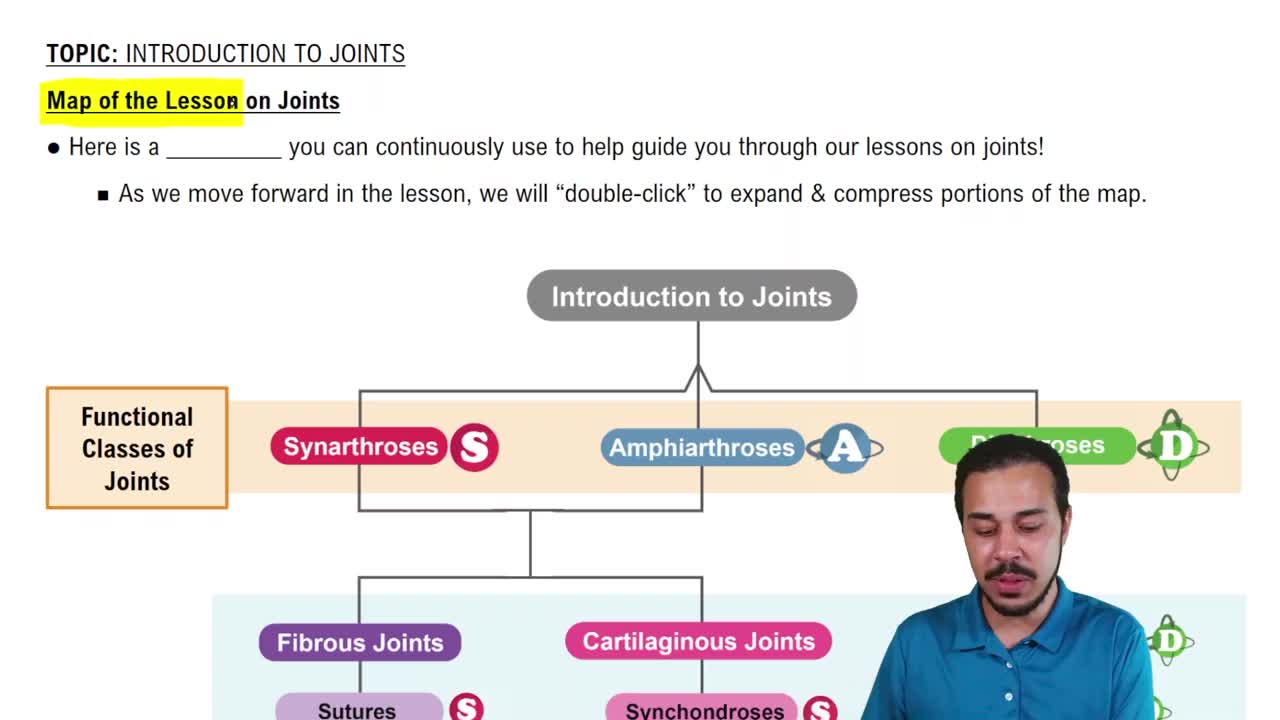
Fibrous (immovable), cartilaginous (slightly movable), and synovial (freely movable) joints.
Fibrous joints are immovable and connected by dense connective tissue.
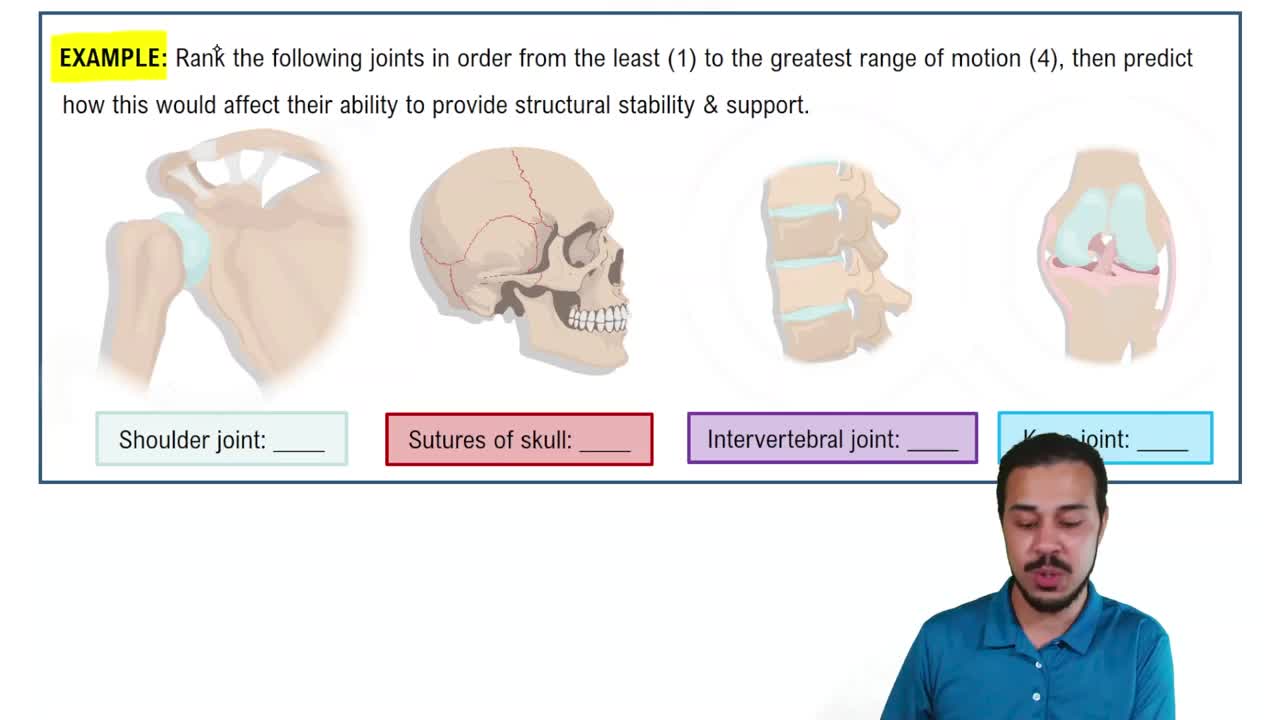
Sutures in the skull are examples of fibrous joints.
Cartilaginous joints are connected by cartilage and allow limited movement.
The intervertebral discs between vertebrae are cartilaginous joints.
A synovial joint has a fluid-filled cavity allowing free movement between bones.
Articular cartilage, synovial membrane, joint cavity, synovial fluid, and ligaments.
Synovial fluid lubricates the joint, reducing friction and nourishing cartilage.
A hinge joint allows movement in one plane, like the elbow.
The shoulder and hip joints are ball-and-socket joints allowing multi-directional movement.
Ligaments connect bone to bone and provide joint stability.
A saddle joint allows movement back and forth and side to side; example: the thumb joint.
A pivot joint allows rotational movement around a single axis, like the joint between the first and second cervical vertebrae.
Ligaments connect bone to bone; tendons connect muscle to bone.
Joints between the carpal bones of the wrist are plane joints allowing sliding movements.
They provide a lubricated cavity and flexible structure enabling a wide range of motion.
Articular cartilage covers bone ends in synovial joints to reduce friction and absorb shock.
The joint capsule encloses the joint cavity and is lined by the synovial membrane.
Joints enable movement, provide mechanical support, and absorb shock between bones.