Skip to main content
Anatomy & Physiology
My Course
Learn
Exam Prep
AI Tutor
Study Guides
Textbook Solutions
Flashcards
Explore
Try the app
My Course
Learn
Exam Prep
AI Tutor
Study Guides
Textbook Solutions
Flashcards
Explore
Try the app
Back
Anatomy & Physiology: Joints and Movements
You can tap to flip the card.
What are joints (articulations)?
You can tap to flip the card.
👆
What are joints (articulations)?
Sites where two or more bones meet, providing skeleton mobility and holding it together.
Track progress
Control buttons has been changed to "navigation" mode.
1/25
Recommended videos
Guided course
04:06
Introduction to Joints Example 1
10787
views
253
rank
Guided course
05:29
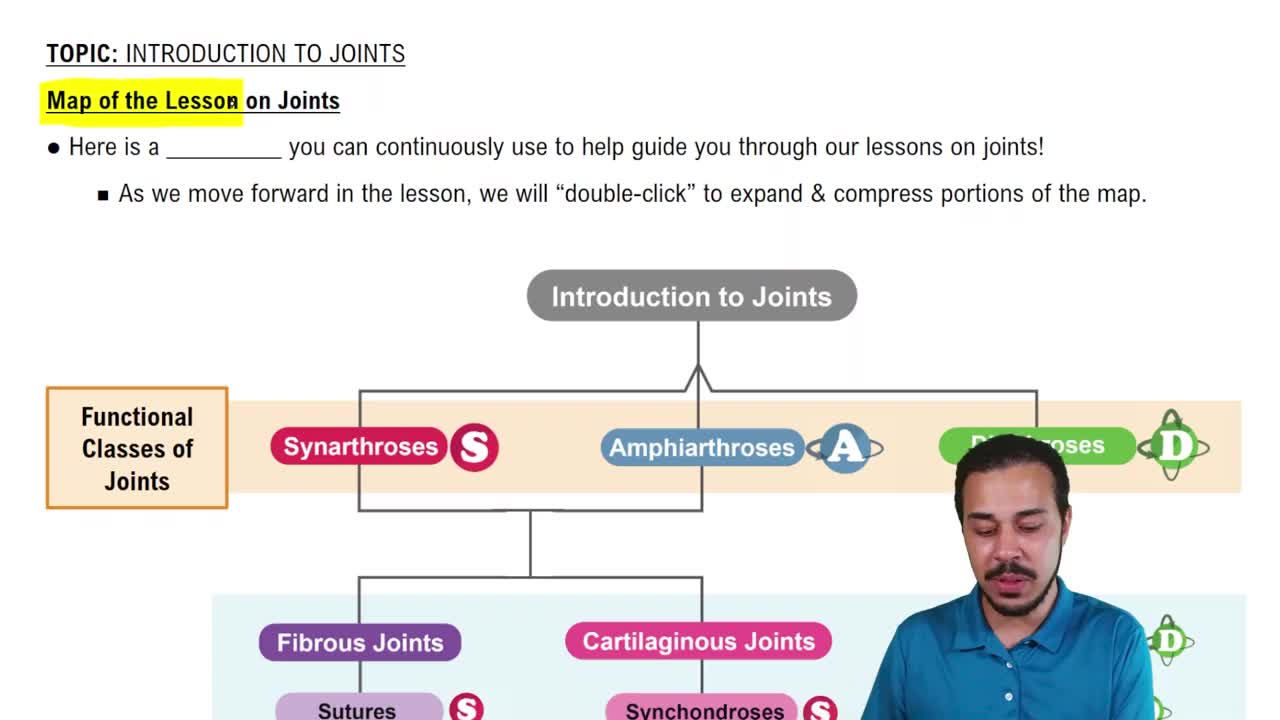
Map of the Lesson on Joints
11279
views
245
rank
1
comments
Guided course
05:39
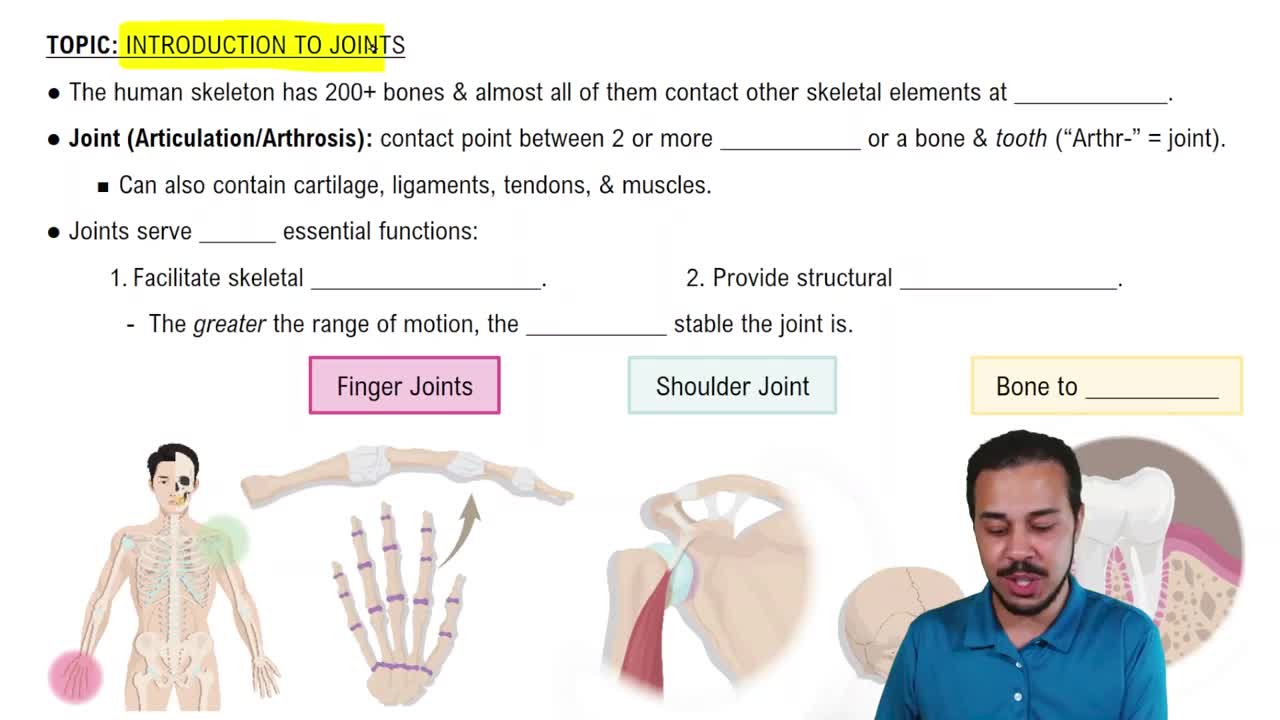
Introduction to Joints
15250
views
394
rank
Terms in this set (25)
Hide definitions
What are joints (articulations)?
Sites where two or more bones meet, providing skeleton mobility and holding it together.
What are the two main classifications of joints?
Structural (fibrous, cartilaginous, synovial) and functional (synarthroses, amphiarthroses, diarthroses).
Describe fibrous joints.
Bones joined by dense fibrous connective tissue, no joint cavity, mostly immovable.
What are sutures?
Rigid, interlocking fibrous joints of the skull that allow growth during youth and fuse in middle age.
What are syndesmoses?
Fibrous joints where bones are connected by ligaments; movement varies with fiber length.
What is a gomphosis?
A peg-in-socket fibrous joint; example is teeth held in alveolar sockets by periodontal ligament.
Describe cartilaginous joints.
Bones united by cartilage, no joint cavity, not highly movable; includes synchondroses and symphyses.
What are synchondroses?
Bones united by hyaline cartilage, mostly immovable; examples include epiphyseal plates and 1st rib-sternum joint.
What are symphyses?
Bones united by fibrocartilage, slightly movable; examples include intervertebral discs and pubic symphysis.
What defines synovial joints?
Bones separated by fluid-filled joint cavity, all diarthrotic (freely movable), mostly limb joints.
List the six general features of synovial joints.
Articular cartilage, joint cavity, articular capsule, synovial fluid, reinforcing ligaments, nerves and blood vessels.
What is the function of synovial fluid?
Lubricates and nourishes articular cartilage and contains phagocytic cells to remove debris.
What are bursae and tendon sheaths?
Fluid-filled sacs reducing friction; bursae cushion ligaments and tendons, tendon sheaths wrap tendons.
What factors influence synovial joint stability?
Shape of articular surface, number/location of ligaments, and muscle tone (most important).
Define origin and insertion in muscle attachment.
Origin: attachment to immovable bone; insertion: attachment to movable bone.
What are the types of synovial joint movements by range of motion?
Nonaxial (slipping), uniaxial (one plane), biaxial (two planes), multiaxial (all three planes).
Describe gliding movements.
Sliding of flat bone surfaces over each other; examples include intercarpal and intertarsal joints.
What are angular movements?
Movements that increase or decrease the angle between bones, including flexion, extension, hyperextension, abduction, adduction, and circumduction.
Explain rotation movements.
Turning of a bone around its long axis; medial rotation toward midline, lateral rotation away from midline.
What are special movements of synovial joints?
Supination/pronation, dorsiflexion/plantar flexion, inversion/eversion, protraction/retraction, elevation/depression, and opposition.
Name the six types of synovial joints.
Plane, hinge, pivot, condylar, saddle, and ball-and-socket joints.
What is osteoarthritis?
Most common degenerative arthritis caused by cartilage breakdown; symptoms include joint stiffness and crepitus.
Describe rheumatoid arthritis.
Chronic autoimmune inflammatory disease causing joint pain, swelling, and destruction of cartilage and bone.
What is gouty arthritis?
Inflammation caused by uric acid crystal deposition in joints, often affecting the great toe.
What is the role of exercise in joint health?
Full-range-of-motion exercise helps maintain joint flexibility and postpones joint problems.
 BackBack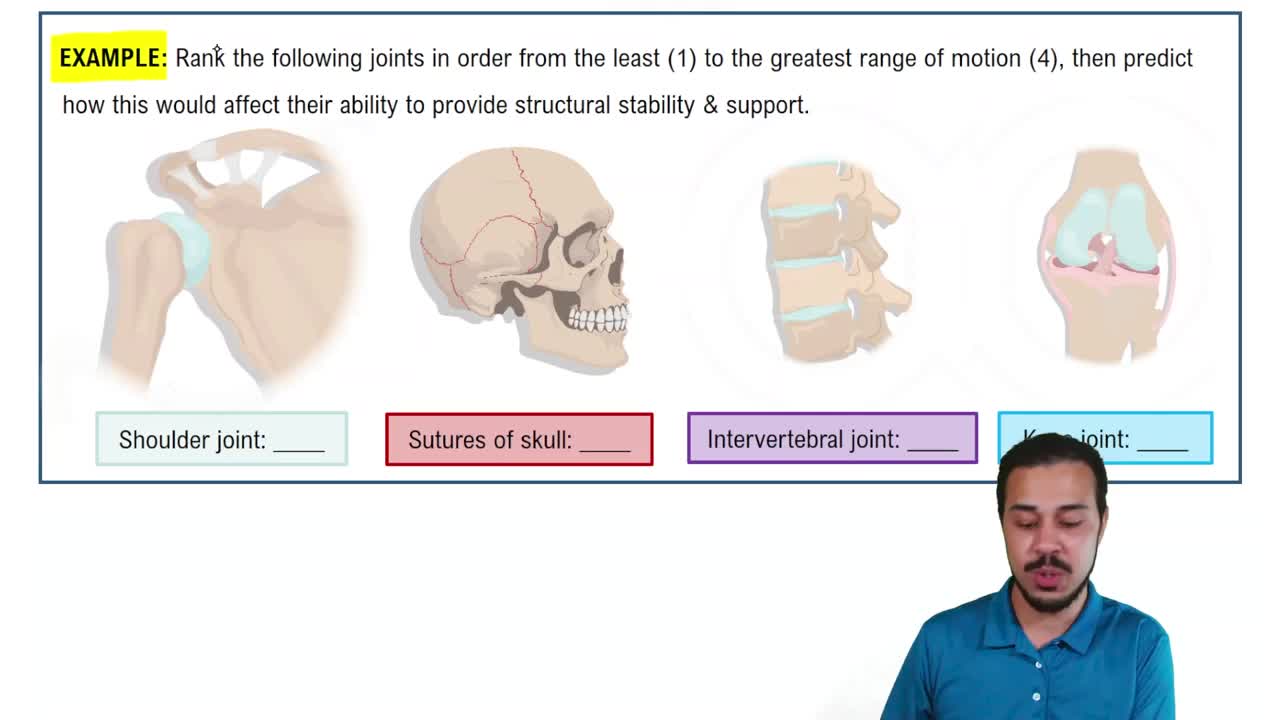
 04:06
04:06