Back

Anatomy & Physiology: Joints and Movements
Control buttons has been changed to "navigation" mode.
1/41
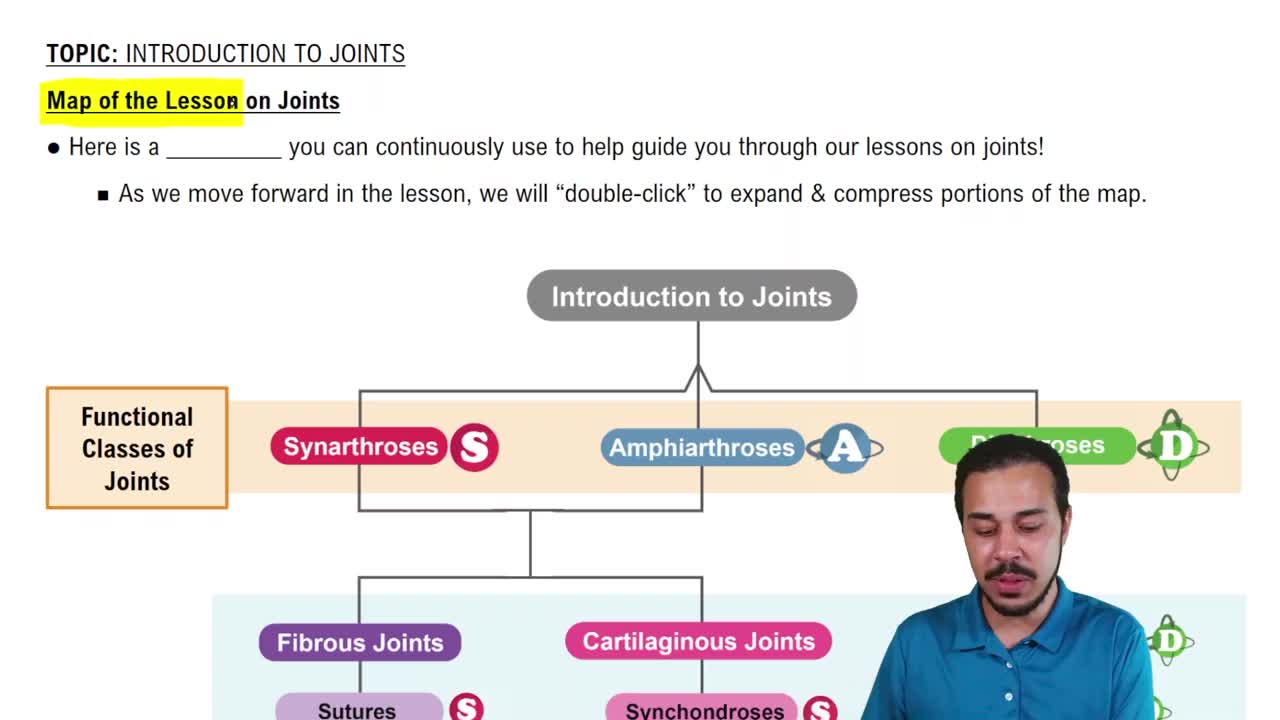
  • What are the two main classifications of joints?

    Structural (fibrous, cartilaginous, synovial) and functional (synarthroses, amphiarthroses, diarthroses).
  • Define synarthroses, amphiarthroses, and diarthroses.

    Synarthroses: immovable joints; Amphiarthroses: slightly movable joints; Diarthroses: freely movable joints.
  • What characterizes fibrous joints?

    Bones joined by dense fibrous connective tissue with no joint cavity; mostly immovable.
  • Name the three types of fibrous joints.

    Sutures, syndesmoses, and gomphoses.
  • What is a suture joint?

    A rigid, interlocking fibrous joint found only in the skull; immovable in adults.
  • Describe syndesmoses joints.

    Bones connected by ligaments; fiber length varies, allowing variable movement.
  • What is a gomphosis joint?

    A peg-in-socket fibrous joint; example is the tooth held in its alveolar socket by the periodontal ligament.
  • What defines cartilaginous joints?

    Bones united by cartilage with no joint cavity; limited movement.
  • Differentiate synchondroses and symphyses.

    Synchondroses: bones united by hyaline cartilage, mostly immovable. Symphyses: bones united by fibrocartilage, slightly movable.
  • What are synovial joints?

    Joints with a fluid-filled cavity separating bones; all are freely movable (diarthrotic).
  • List the six general features of synovial joints.

    Articular cartilage, joint cavity, articular capsule, synovial fluid, reinforcing ligaments, nerves and blood vessels.
  • What is the function of synovial fluid?

    Lubricates and nourishes articular cartilage and contains phagocytic cells to remove debris.
  • What are bursae and tendon sheaths?

    Bursae are fluid-filled sacs reducing friction; tendon sheaths are elongated bursae wrapping tendons.
  • Name the three factors influencing synovial joint stability.

    Shape of articular surfaces, ligament number and location, and muscle tone (most important).
  • Define gliding movement in synovial joints.

    Sliding of flat bone surfaces across each other, e.g., intercarpal joints.
  • What are angular movements? Give examples.

    Movements changing the angle between bones: flexion, extension, hyperextension, abduction, adduction, circumduction.
  • Explain rotation movements.

    Turning a bone around its own long axis; medial rotation toward midline, lateral rotation away.
  • What special movements are allowed by synovial joints?

    Supination, pronation, opposition, dorsiflexion, plantar flexion, inversion, eversion, elevation, depression, protraction, retraction.
  • List the six types of synovial joints.

    Plane, hinge, pivot, condylar (ellipsoid), saddle, ball-and-socket.
  • What is the 'unhappy triad' in knee injuries?

    Tears of the tibial collateral ligament, medial meniscus, and anterior cruciate ligament caused by lateral blows.
  • Describe osteoarthritis.

    Degenerative arthritis caused by cartilage breakdown; common with aging; symptoms include joint stiffness and crepitus.
  • What is rheumatoid arthritis?

    Chronic autoimmune inflammatory disease causing joint pain, swelling, and deformity; involves synovial membrane inflammation.
  • What causes gouty arthritis?

    Deposition of uric acid crystals in joints causing inflammation, often affecting the big toe.
  • What is the cause and treatment of Lyme disease related to joints?

    Caused by bacteria from tick bites; symptoms include joint pain; treated with long courses of antibiotics.
  • How do joints change with aging?

    Ligaments and tendons shorten and weaken; intervertebral discs may herniate; osteoarthritis is common.
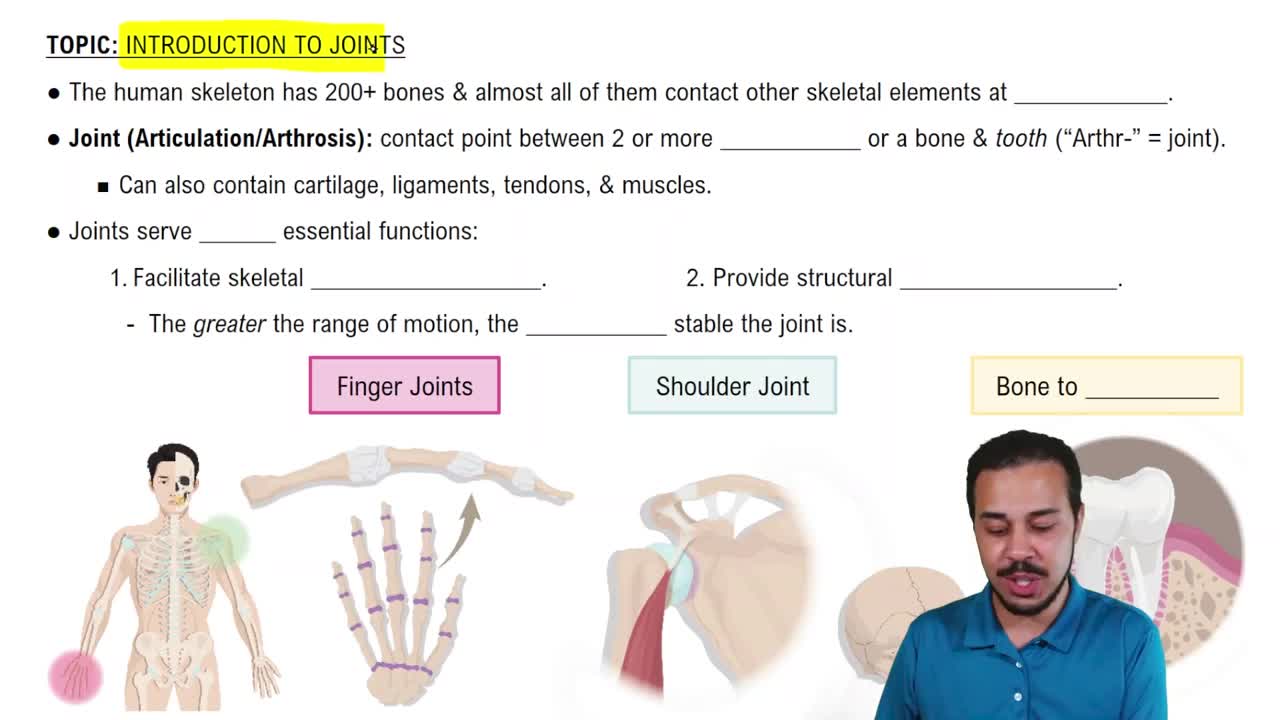
  • What are joints (articulations)?


    Sites where two or more bones meet

  • What are the functions of joints?


    give skeleton mobility and hold skeleton together

  • Fibrous joints are joined by what?


    dense fibrous connective tissue

  • List the three types of fibrous joints


    Sutures, syndesmoses, gomphoses

  • Closed, immoveable sutures referred to as _____


    synostoses

  • ________ are bones connected by ligaments, bands of fibrous tissue


    syndesmoses

  • _______ are peg-in-socket joints


    gomphoses

  • What is an example of a gomphoses?


    teeth in alveolar sockets

  • Fibrous connection is the __________ which holds tooth in socket


    periodontal ligament

  • List the two types of cartilaginous joints


    synchondroses, symphyses

  • What are syncondroses?


    unite bons with a bar or plate of hyaline cartilage

  • Almost all synchronous joints are ________


    Synarthrotic (immovable)

  • What are examples of synchondroses?


    Temporary epiphyseal plate joints (become synostoses after plate closure) and cartilage of first rib with manubrium of sternum

  • What are symphyses?


    Unites bone with fibrocartilage.

  • Symphyses are slightly movable, immovable, or freely movable?


    slightly movable, amphiarthrotic

  • What are some examples of symphyses joints?


    intervertebral joints, and pubic symphysis