Back

Anatomy & Physiology: Joints and Movements

Control buttons has been changed to "navigation" mode.
1/30
  • What is an articulation (joint)?

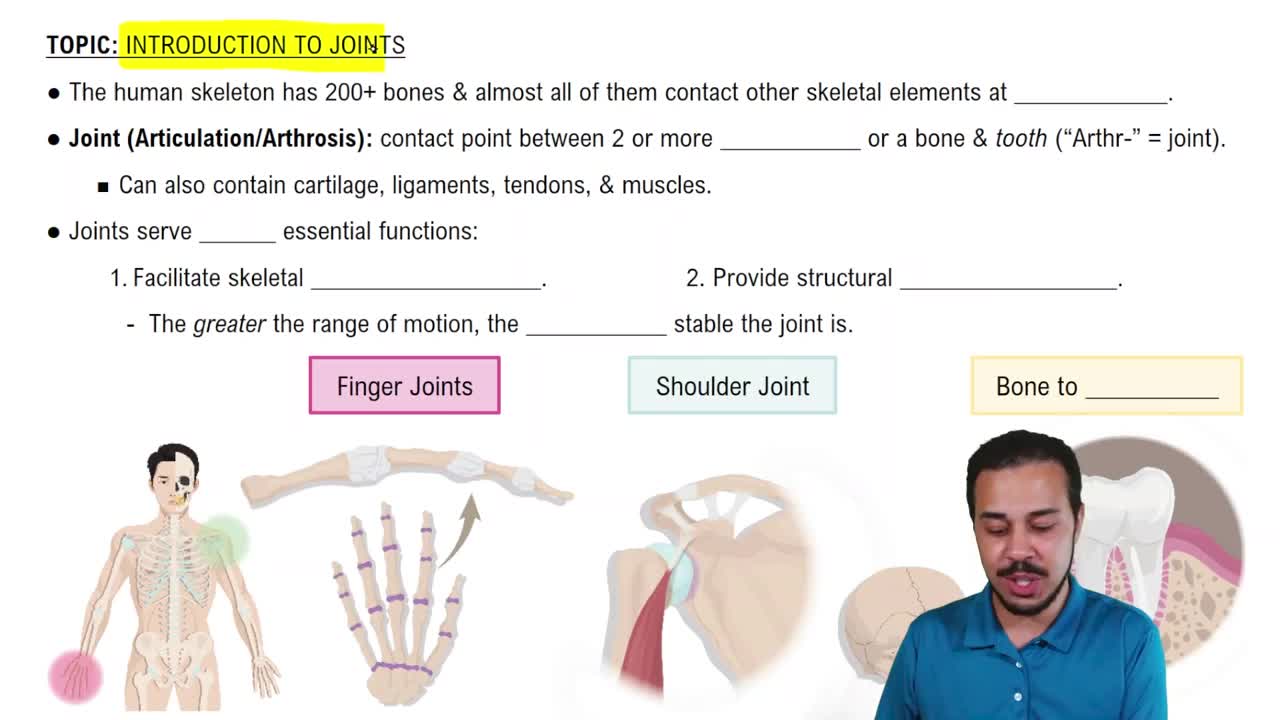
    A site where two or more bones meet, allowing skeleton mobility and holding the skeleton together.
  • What are the three functional classifications of joints?

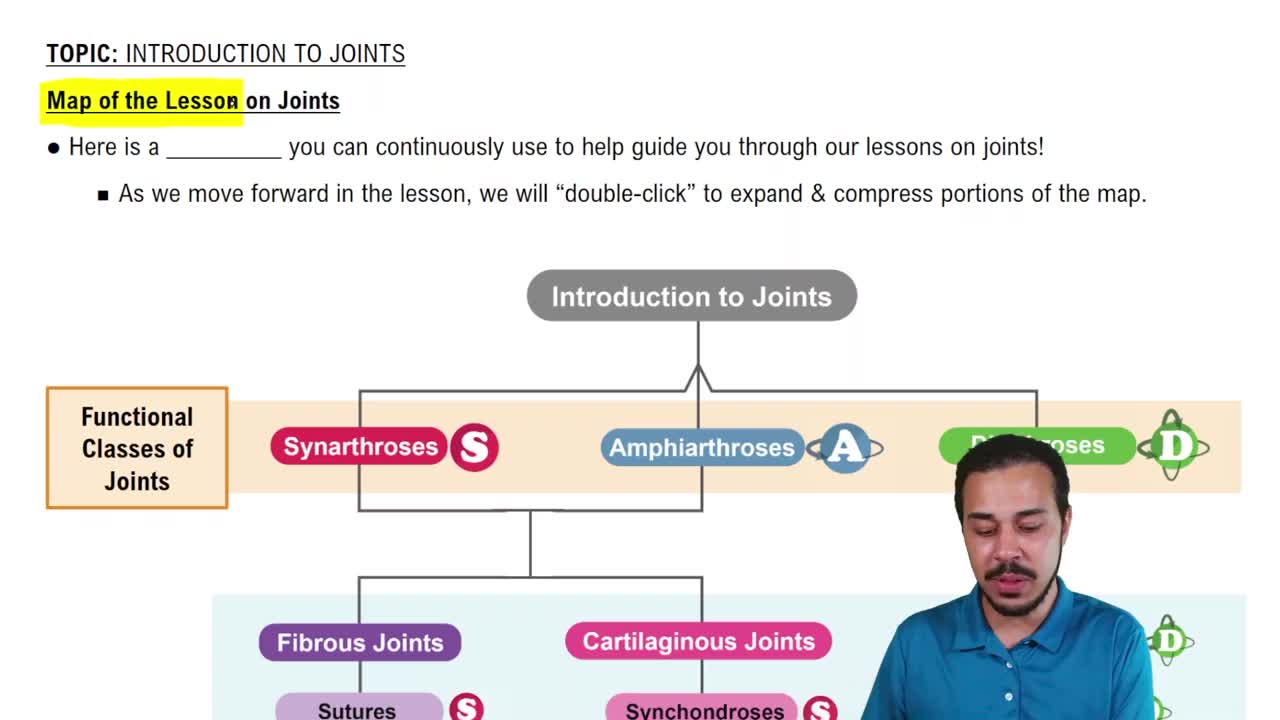
    Synarthroses (immovable), Amphiarthroses (slightly movable), and Diarthroses (freely movable).
  • What are the three structural classifications of joints?

    Based on material binding bones and presence of joint cavity: Fibrous joints, Cartilaginous joints, and Synovial joints.
  • Describe fibrous joints and their types.

    Bones joined by dense fibrous connective tissue with no joint cavity. Types: Sutures, Syndesmoses, and Gomphoses.
  • What are sutures in fibrous joints?

    Rigid, interlocking, immovable joints with short connective tissue fibers found only in the skull; ossify and fuse in middle age.
  • What are syndesmoses?

    Fibrous joints where bones are connected by ligaments; fiber length varies allowing variable movement.
  • What are gomphoses?

    Peg-in-socket fibrous joints of teeth in alveolar sockets, connected by the periodontal ligament.
  • Describe cartilaginous joints and their types.

    Bones united by cartilage with no joint cavity; not highly movable. Types: Synchondroses and Symphyses.
  • What are synchondroses?

    Bones united by hyaline cartilage, e.g., epiphyseal plates and 1st rib-sternum joint; mostly immovable (synarthrotic).
  • What are symphyses?

    Bones united by fibrocartilage with some hyaline cartilage; strong, flexible, and slightly movable (amphiarthroses).
  • What defines synovial joints?

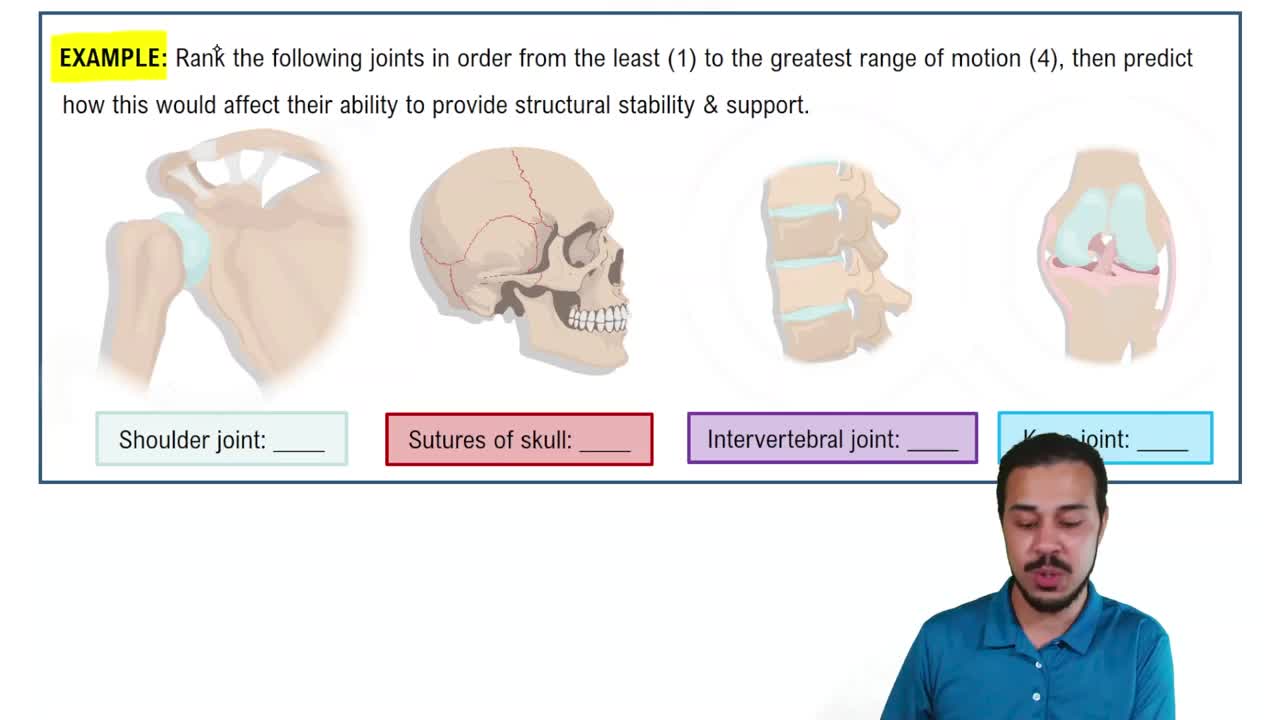
    Bones separated by a fluid-filled joint cavity; all are freely movable (diarthrotic) and include most limb joints.
  • Name the six distinguishing features of synovial joints.

    1. Articular cartilage, 2. Joint cavity, 3. Articular capsule, 4. Synovial fluid, 5. Reinforcing ligaments, 6. Nerves and blood vessels.
  • What is the function of synovial fluid?

    Lubricates and nourishes articular cartilage; contains phagocytic cells to remove microbes and debris.
  • What are bursae and tendon sheaths?

    Bursae are synovial fluid-filled sacs reducing friction; tendon sheaths are elongated bursae wrapped around tendons.
  • What are the three stabilizing factors at synovial joints?

    1. Shapes of articular surfaces (minor), 2. Ligament number and location (limited), 3. Muscle tendons crossing joint (most important).
  • Define origin and insertion in muscle attachment.

    Origin is attachment to immovable bone; insertion is attachment to movable bone; muscle contraction moves insertion toward origin.
  • What are the four types of synovial joint range of motion?

    Nonaxial (slipping), Uniaxial (one plane), Biaxial (two planes), and Multiaxial (all three planes).
  • List the three general types of movements at synovial joints.

    1. Gliding, 2. Angular movements (flexion, extension, abduction, adduction, circumduction), 3. Rotation (medial and lateral).
  • What is circumduction?

    A movement involving flexion, abduction, extension, and adduction, where the limb describes a cone in space.
  • What are special movements at synovial joints?

    Include supination/pronation, dorsiflexion/plantar flexion, inversion/eversion, protraction/retraction, elevation/depression, and opposition of thumb.
  • Name the six types of synovial joints based on articular surface shape.

    Plane, Hinge, Pivot, Condylar, Saddle, and Ball-and-socket joints.
  • Describe the knee joint structure.

    Largest, most complex joint; includes femoropatellar (plane) and tibiofemoral (hinge) joints; stabilized by menisci, ligaments, and tendons.
  • What ligaments stabilize the knee joint?

    Capsular and extracapsular ligaments (fibular and tibial collateral, oblique and arcuate popliteal) and intracapsular ligaments (anterior and posterior cruciate).
  • What is the shoulder (glenohumeral) joint?

    A ball-and-socket joint between humerus head and glenoid cavity; most freely moving but less stable; reinforced by ligaments and rotator cuff tendons.
  • What are the main ligaments and tendons reinforcing the shoulder joint?

    Coracohumeral ligament, glenohumeral ligaments, tendon of long head of biceps brachii, and four rotator cuff tendons (subscapularis, supraspinatus, infraspinatus, teres minor).
  • Describe the elbow joint and its ligaments.

    Hinge joint between trochlear notch of ulna and trochlea of humerus; stabilized by anular ligament and collateral ligaments restricting side-to-side movement.
  • What is the hip (coxal) joint?

    Ball-and-socket joint between femur head and acetabulum; deep socket with acetabular labrum enhances stability; reinforced by iliofemoral, pubofemoral, ischiofemoral ligaments.
  • What is the temporomandibular joint (TMJ)?

    Joint between mandibular condyle and temporal bone; allows hinge (elevation/depression) and gliding (side-to-side) movements; most easily dislocated joint.
  • What are common joint injuries?

    Cartilage tears, sprains (ligament tears), dislocations (luxations), and subluxations (partial dislocations).
  • What are common inflammatory and degenerative joint conditions?

    Bursitis, tendonitis, osteoarthritis, rheumatoid arthritis, gouty arthritis, and Lyme disease.