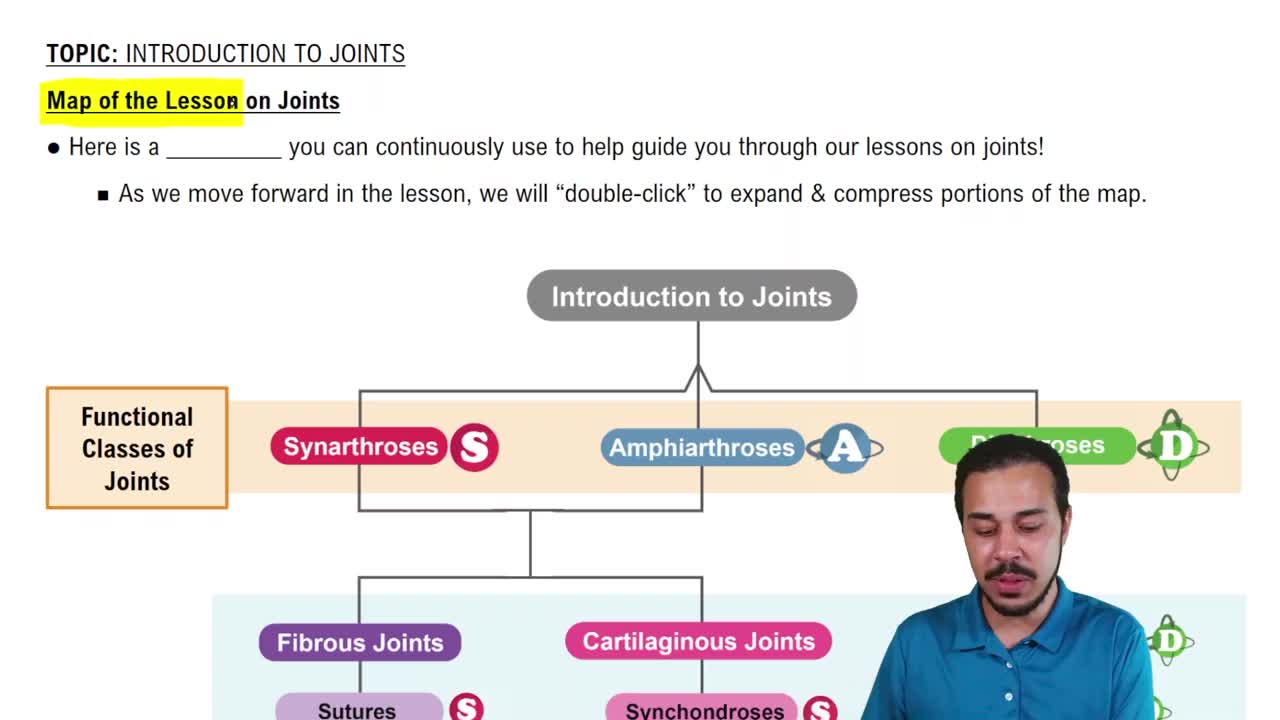
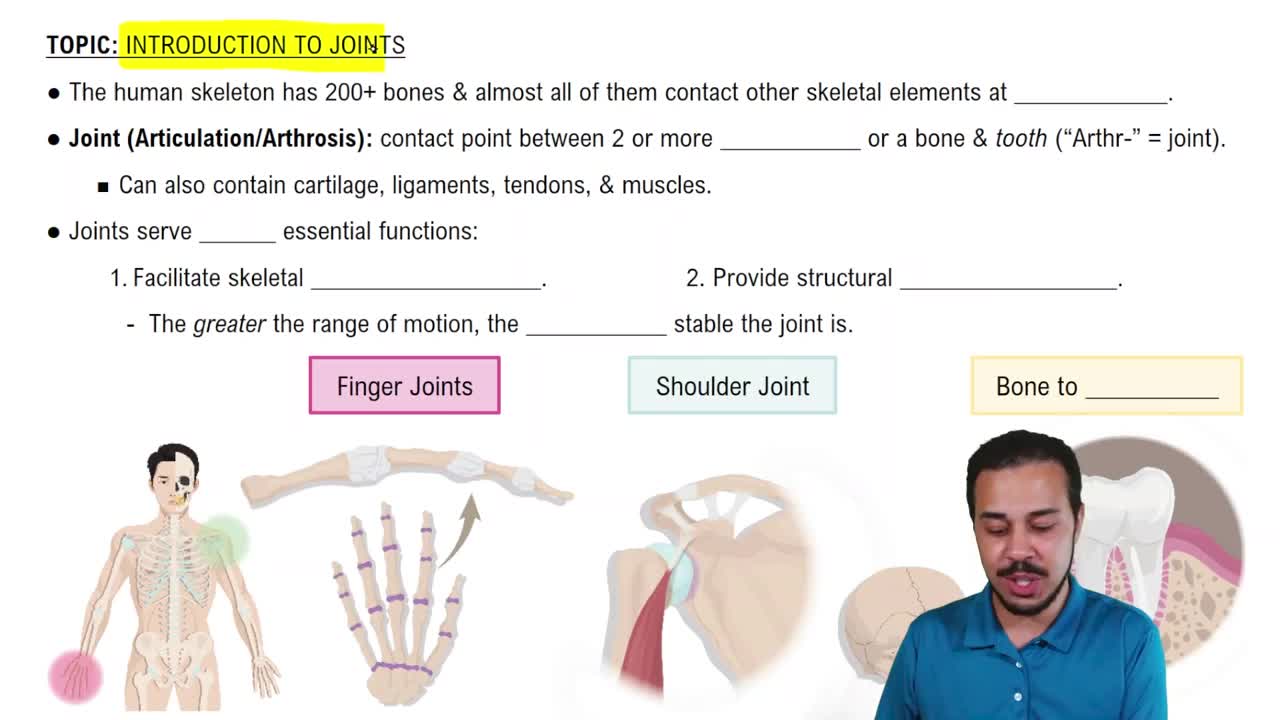
Structural (fibrous, cartilaginous, synovial) based on material and cavity presence, and Functional (synarthroses, amphiarthroses, diarthroses) based on movement allowed.
What defines fibrous joints and their types?
Bones joined by dense fibrous connective tissue with no joint cavity. Types: sutures, syndesmoses, and gomphoses.
What are sutures and their function?
Rigid, interlocking joints of the skull with short connective tissue fibers allowing growth in youth; become immovable synostoses in middle age.
Describe syndesmoses joints.
Bones connected by ligaments with variable fiber length, allowing limited to moderate movement, e.g., inferior tibiofibular joint.
What are gomphoses?
Peg-in-socket fibrous joints; only example is teeth in alveolar sockets held by periodontal ligament.
What characterizes cartilaginous joints?
Bones united by cartilage, no joint cavity, and limited movement. Types: synchondroses and symphyses.
Define synchondroses joints with examples.
Bones united by hyaline cartilage, mostly immovable (synarthrotic). Examples: epiphyseal plates, 1st rib to sternum.
What are symphyses joints?
Bones united by fibrocartilage with hyaline cartilage on surfaces; strong, slightly movable (amphiarthrotic). Examples: intervertebral discs, pubic symphysis.
What are the six general features of synovial joints?
Articular cartilage, joint cavity, articular capsule (fibrous layer and synovial membrane), synovial fluid, reinforcing ligaments, nerves and blood vessels.
What is the function of synovial fluid?
Lubricates and nourishes articular cartilage; contains phagocytic cells to remove debris.
Name the three types of reinforcing ligaments in synovial joints.
Capsular (thickened fibrous layer), extracapsular (outside capsule), and intracapsular (inside capsule, covered by synovial membrane).
What are bursae and tendon sheaths?
Bursae are fluid-filled sacs reducing friction between structures; tendon sheaths are elongated bursae wrapping tendons under friction.
What factors influence synovial joint stability?
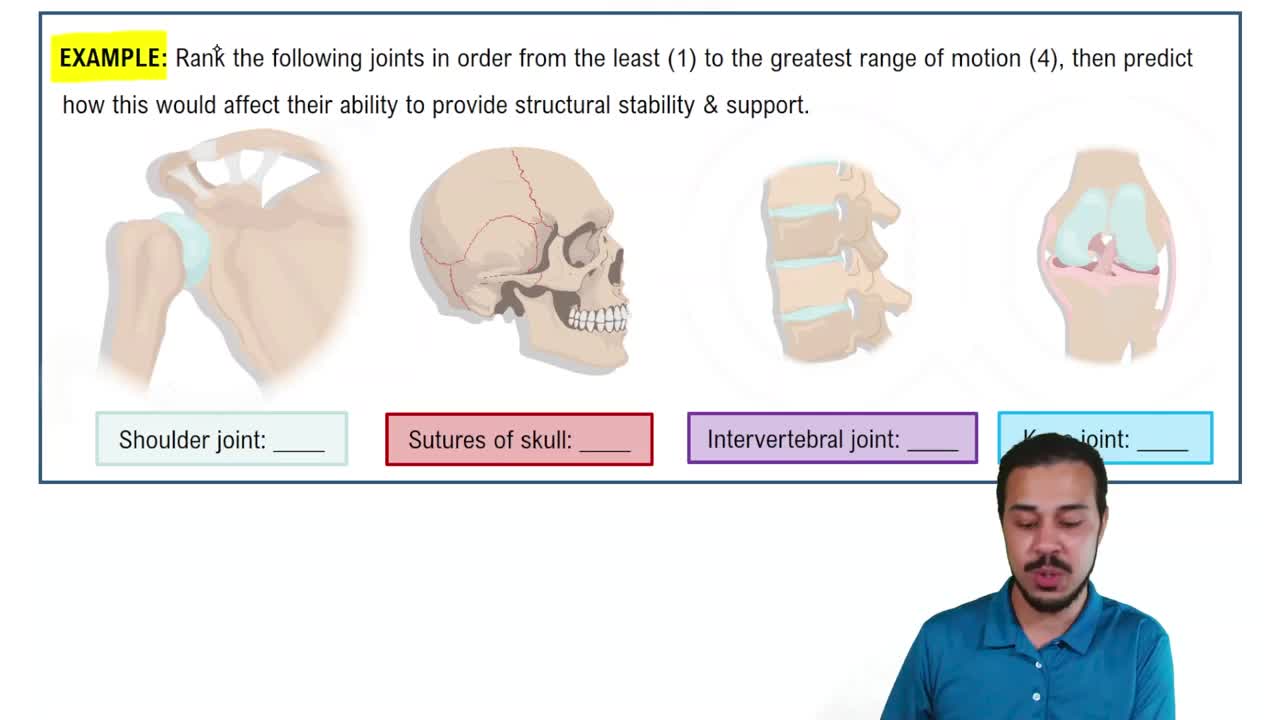
Shape of articular surface (minor), number/location of ligaments (limited), and muscle tone keeping tendons taut (most important).
Define the three functional classifications of joints by movement.
Abduction moves limb away from midline, adduction toward midline, circumduction is a circular movement combining flexion, abduction, extension, and adduction.
What is rotation in joint movement?
Turning of a bone around its long axis; medial rotation toward midline, lateral rotation away from midline.
Define supination and pronation.
Supination: palms face anteriorly, radius and ulna parallel. Pronation: palms face posteriorly, radius crosses over ulna.
 Back
 04:06