Back

Anatomy & Physiology: Joints and Skeletal Tissues

Control buttons has been changed to "navigation" mode.
1/28
  • What is a joint (articulation)?

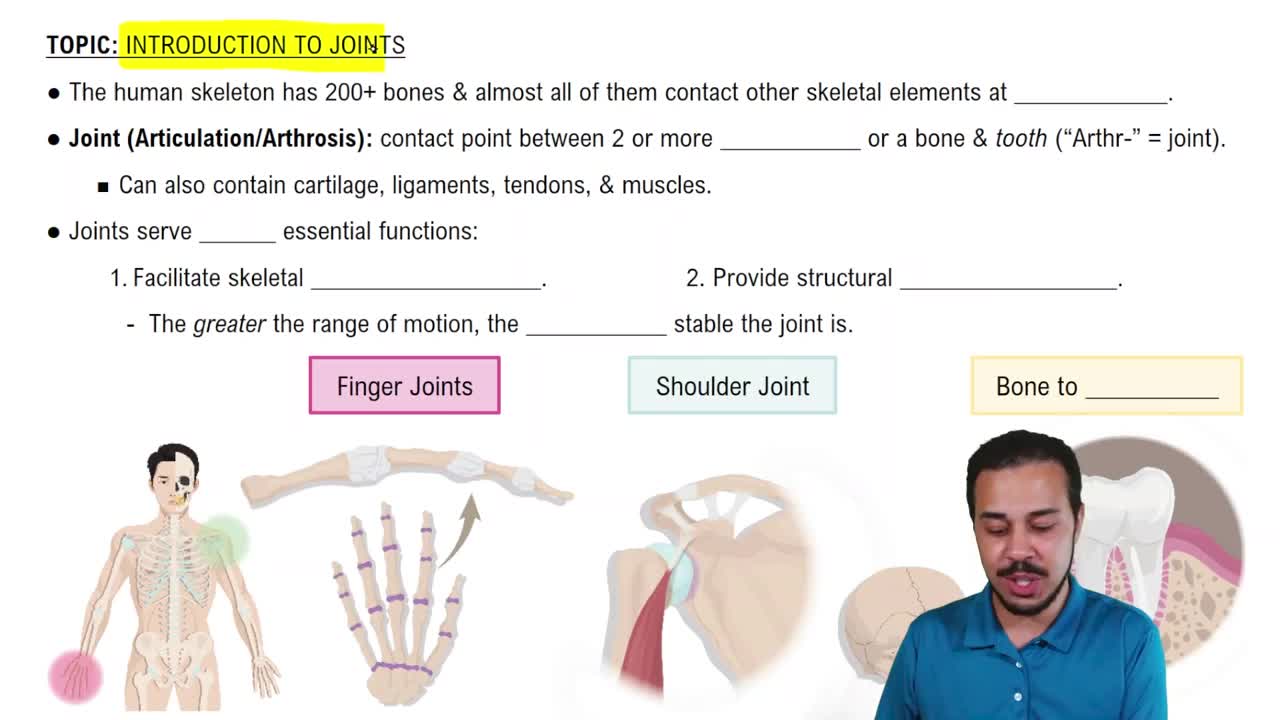
    A joint is where two or more bones meet, providing movement and holding the skeleton together.
  • What are the two main classifications of joints?

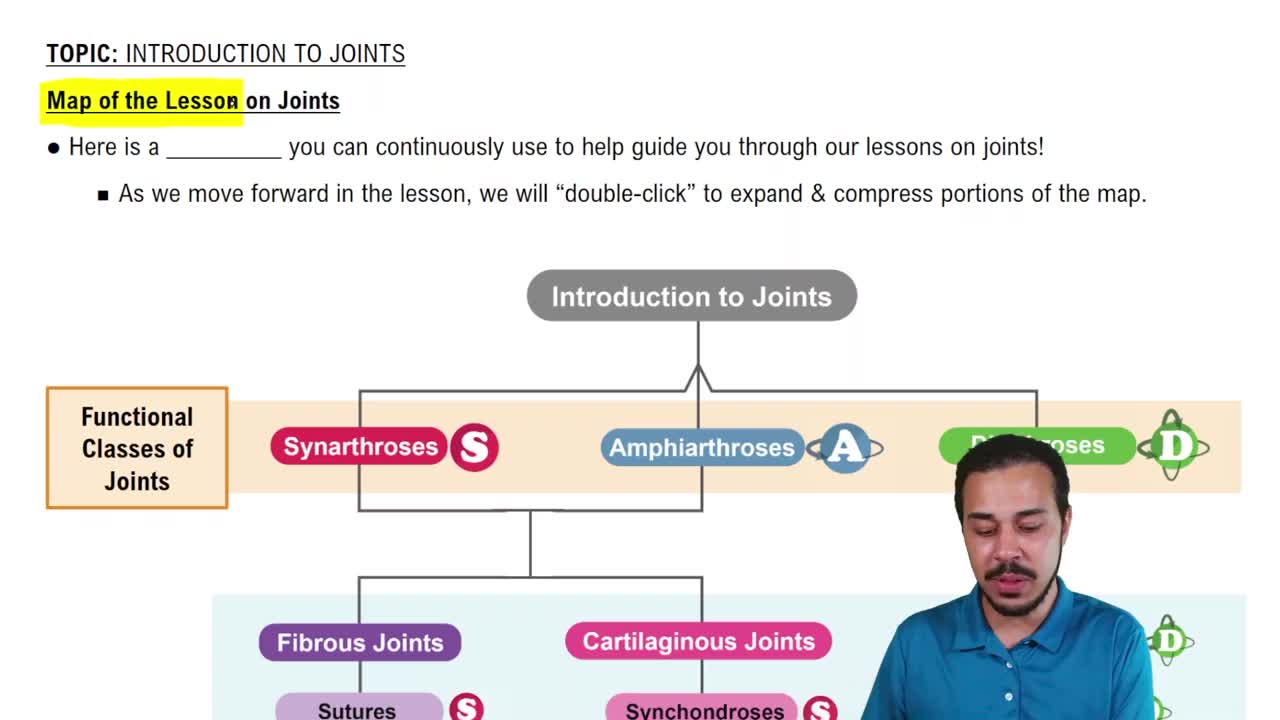
    Joints are classified structurally as fibrous, cartilaginous, or synovial, and functionally as synarthroses (immovable), amphiarthroses (slightly movable), or diarthroses (freely movable).
  • What characterizes fibrous joints?

    Fibrous joints have dense fibrous connective tissue, no joint cavity, and allow little to no movement.
  • Name the three types of fibrous joints.

    The three types are sutures (skull joints), syndesmoses (bones connected by ligaments), and gomphoses (tooth in socket).
  • What defines cartilaginous joints?

    Cartilaginous joints have bones united by cartilage, no joint cavity, and allow limited movement.
  • What are the two types of cartilaginous joints?

    Synchondroses (hyaline cartilage, immovable) and symphyses (fibrocartilage, slightly movable).
  • What are the key features of synovial joints?

    Synovial joints have a fluid-filled joint cavity, are freely movable, and include structures like articular cartilage, synovial fluid, and ligaments.
  • List the main structures of a synovial joint.

    Articular cartilage, joint (synovial) cavity, articular capsule (fibrous and synovial layers), synovial fluid, ligaments, nerves, and blood vessels.
  • What additional structures may be found in synovial joints?

    Bursae and tendon sheaths help reduce friction around synovial joints.
  • What factors contribute to the stability of synovial joints?

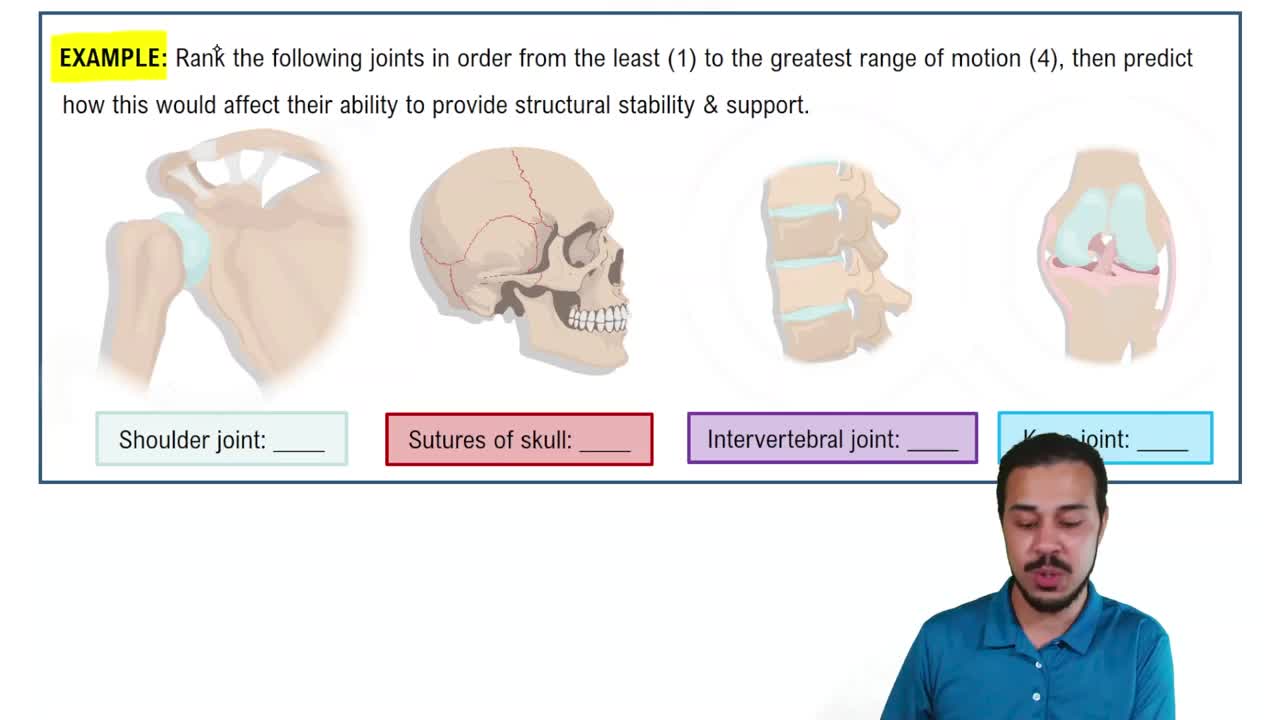
    Stability depends on the shape of articular surfaces, ligament strength, and especially muscle tone.
  • Name the types of motion at synovial joints.

    Nonaxial, uniaxial, biaxial, and multiaxial motions.
  • What are the main categories of movement at synovial joints?

    Gliding, angular movements (flexion, extension, hyperextension, abduction, adduction, circumduction), rotation (medial, lateral), and special movements (supination, pronation, dorsiflexion, plantar flexion, inversion, eversion, protraction, retraction, elevation, depression, opposition).
  • List the six types of synovial joints.

    Plane, hinge, pivot, condylar, saddle, and ball-and-socket joints.
  • What type of joint is the temporomandibular joint (TMJ)?

    The TMJ is a modified hinge joint and is easily dislocated.
  • Describe the shoulder (glenohumeral) joint.

    A ball-and-socket joint that is highly mobile but less stable.
  • What type of joint is the elbow?

    The elbow is a hinge joint allowing flexion and extension.
  • Describe the hip joint.

    A ball-and-socket joint with a deep socket, providing high stability.
  • What are key features of the knee joint?

    The knee is the largest and most complex joint, combining hinge and gliding functions.
  • Name common joint injuries.

    Cartilage tears, sprains, and dislocations (luxations).
  • What are common inflammatory and degenerative joint conditions?

    Bursitis, tendonitis, and arthritis.
  • What is osteoarthritis?

    A wear-and-tear degeneration of joints.
  • What characterizes rheumatoid arthritis?

    An autoimmune disease causing joint inflammation.
  • What causes gouty arthritis?

    Deposition of uric acid crystals in joints.
  • What is skeletal cartilage?

    A flexible, water-rich tissue without blood vessels or nerves, containing chondrocytes in lacunae.
  • Name the three types of skeletal cartilage.

    Hyaline cartilage (most common), elastic cartilage, and fibrocartilage.
  • What are the main functions of bones?

    Support, protection, movement, mineral storage, blood cell formation, fat storage, and hormone production.
  • What are the two main types of bone ossification?

    Endochondral ossification (from cartilage) and intramembranous ossification (from membrane).
  • What regulates bone remodeling?

    Hormones like PTH, calcitonin, vitamin D and mechanical stress following Wolff's Law.