 Back
BackAnatomy & Physiology: Joints and Synovial Joint Function
 04:06
04:06
Terms in this set (28)
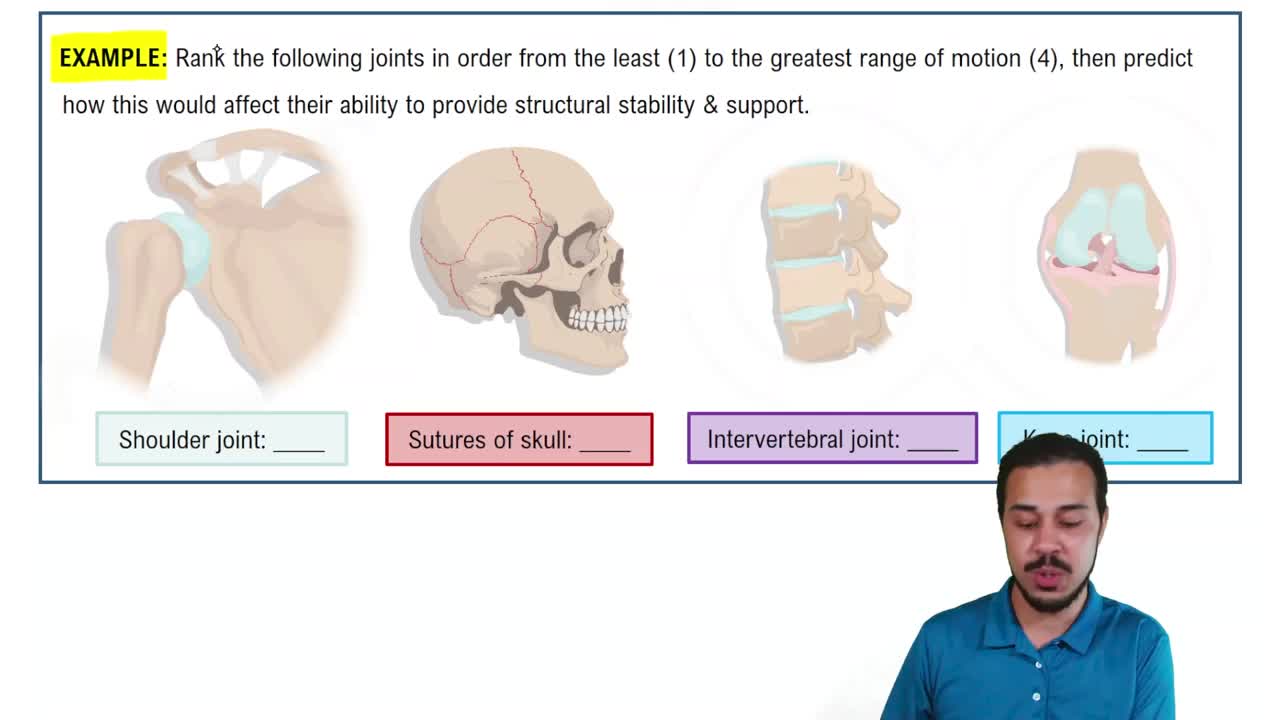
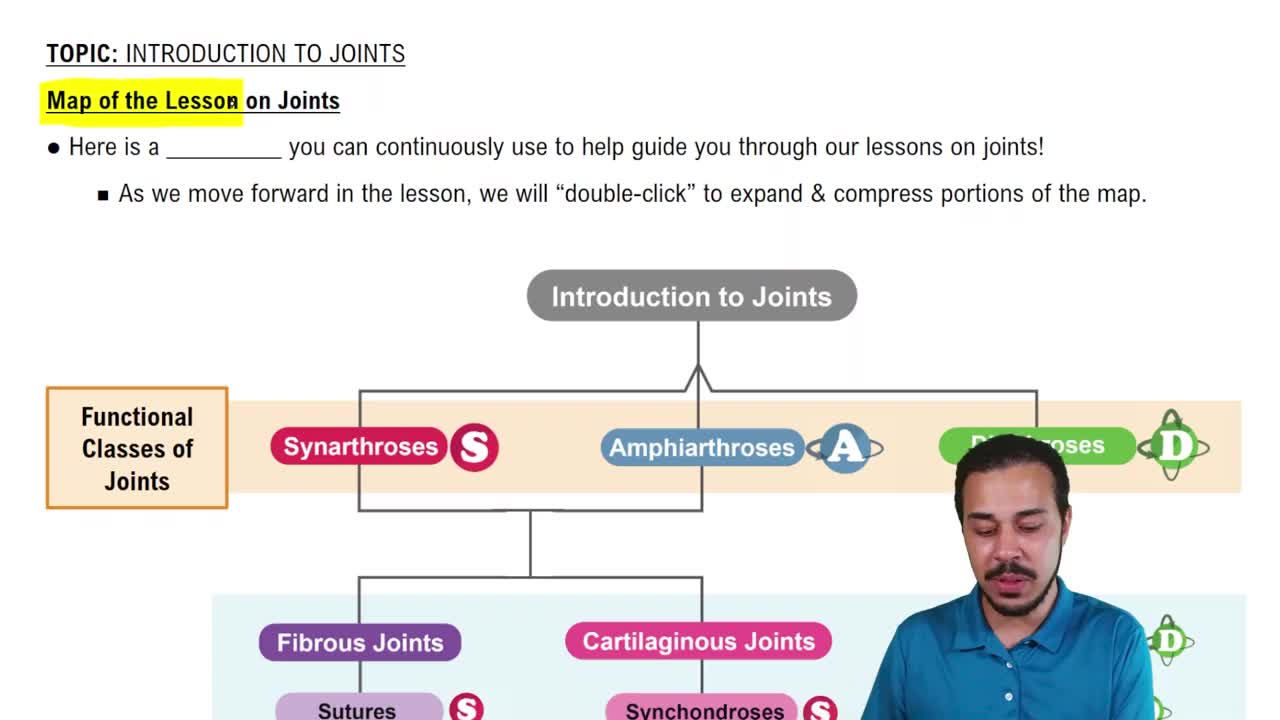
Based on the material binding bones and presence of a joint cavity: fibrous joints (fibrous tissue, no cavity), cartilaginous joints (cartilage, no cavity), and synovial joints (fluid-filled cavity).
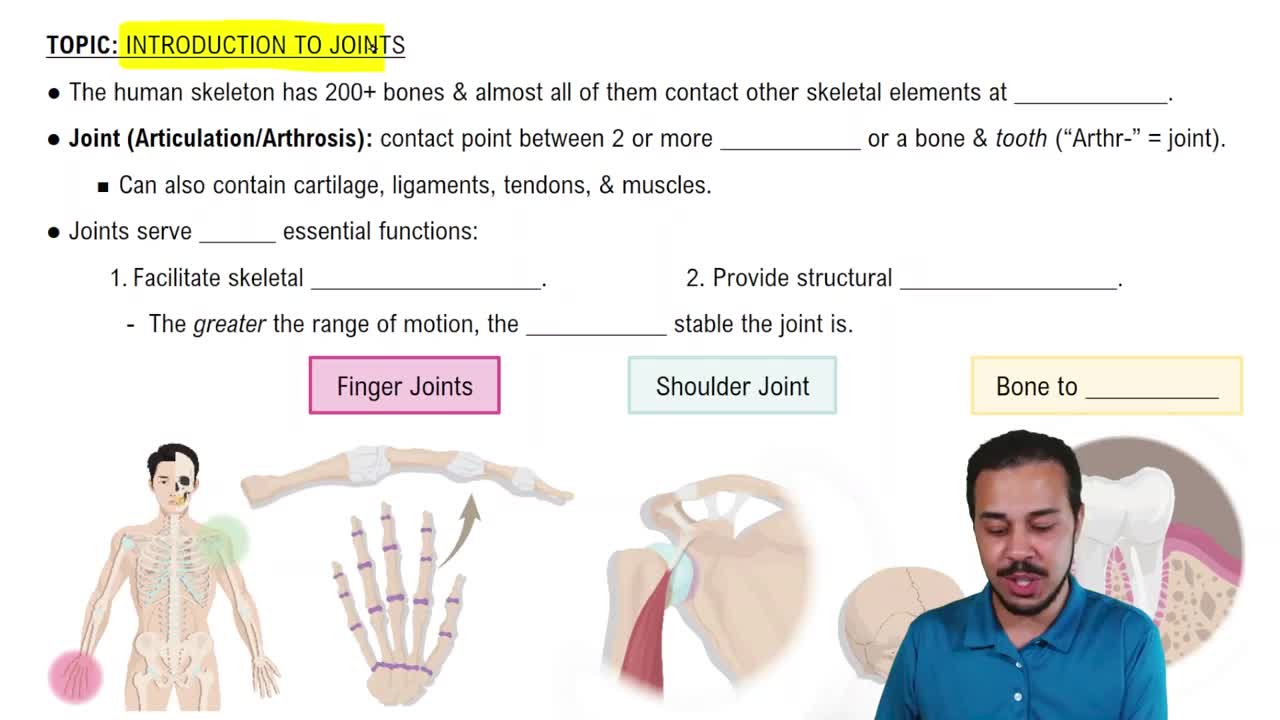
Based on movement allowed: synarthroses (immovable), amphiarthroses (slightly movable), and diarthroses (freely movable).
Include sutures (skull bones tightly bound), syndesmoses (bones connected by ligaments), and gomphoses (peg-in-socket, e.g., tooth socket).
Seams between skull bones with interlocking edges and short connective fibers; immovable and protect the brain; ossify into synostoses in middle age.
Movement depends on ligament length; short fibers allow little movement (e.g., tibia-fibula), long fibers allow more (e.g., radius-ulna interosseous membrane).
Synchondroses: bones united by hyaline cartilage, usually immovable (e.g., epiphyseal plates). Symphyses: bones united by fibrocartilage, slightly movable (e.g., intervertebral discs).
Articulating bones separated by a fluid-filled joint cavity, allowing substantial freedom of movement (diarthroses).
Two layers: an external fibrous layer of dense irregular connective tissue and an inner synovial membrane producing synovial fluid.
Reduces friction, lubricates joint surfaces, nourishes cartilage, and contains phagocytic cells to remove debris.
Shape of articular surfaces, number and location of ligaments, and muscle tone.
Flexion, extension, abduction, adduction, and rotation.
Plane (gliding), hinge (flexion/extension), pivot (rotation), condylar (angular), saddle (greater freedom), and ball-and-socket (multiaxial).
Allows hingelike opening/closing, anterior gliding to brace condyle, and lateral excursion for grinding food.
Highly mobile ball-and-socket joint stabilized mainly by muscle tendons (rotator cuff) and ligaments; shallow glenoid cavity reduces stability.
Hinge joint allowing flexion and extension; stability from interlocking bones and strong collateral ligaments.
Ball-and-socket joint with deep acetabulum and strong ligaments; more stable than shoulder due to socket depth and ligament arrangement.
Largest joint with three articulations; stability from menisci, ligaments (collateral and cruciate), and muscle tendons; allows flexion, extension, and some rotation.
Sprains (ligament tears), dislocations (bone displacement), and cartilage tears (menisci damage).
Degenerative joint disease from cartilage wear; causes stiffness, pain, and bone spurs; common in elderly and weight-bearing joints.
Autoimmune inflammation of synovial membrane causing joint swelling, pannus formation, cartilage erosion, and possible ankylosis.
Uric acid crystal deposition in joints causing sudden, severe pain, often in the big toe; more common in men.
Bacterial infection from tick bites causing joint pain, arthritis, and systemic symptoms; treated with early antibiotics.
Low-level muscle contraction maintains tendon tension, reinforcing joint stability, especially in shoulder, knee, and foot arches.
Movement of the thumb touching fingertips, enabled by the saddle joint of the thumb, crucial for grasping and manipulation.
Reduce friction between moving structures near joints; bursae are fluid-filled sacs, tendon sheaths are elongated bursae around tendons.
Improve fit between bones, increase joint stability, and reduce wear; found in knees and jaw.
Extension of a joint beyond its normal anatomical position.
Supination rotates forearm so palm faces anteriorly with radius and ulna parallel; pronation rotates palm posteriorly with radius crossing ulna.