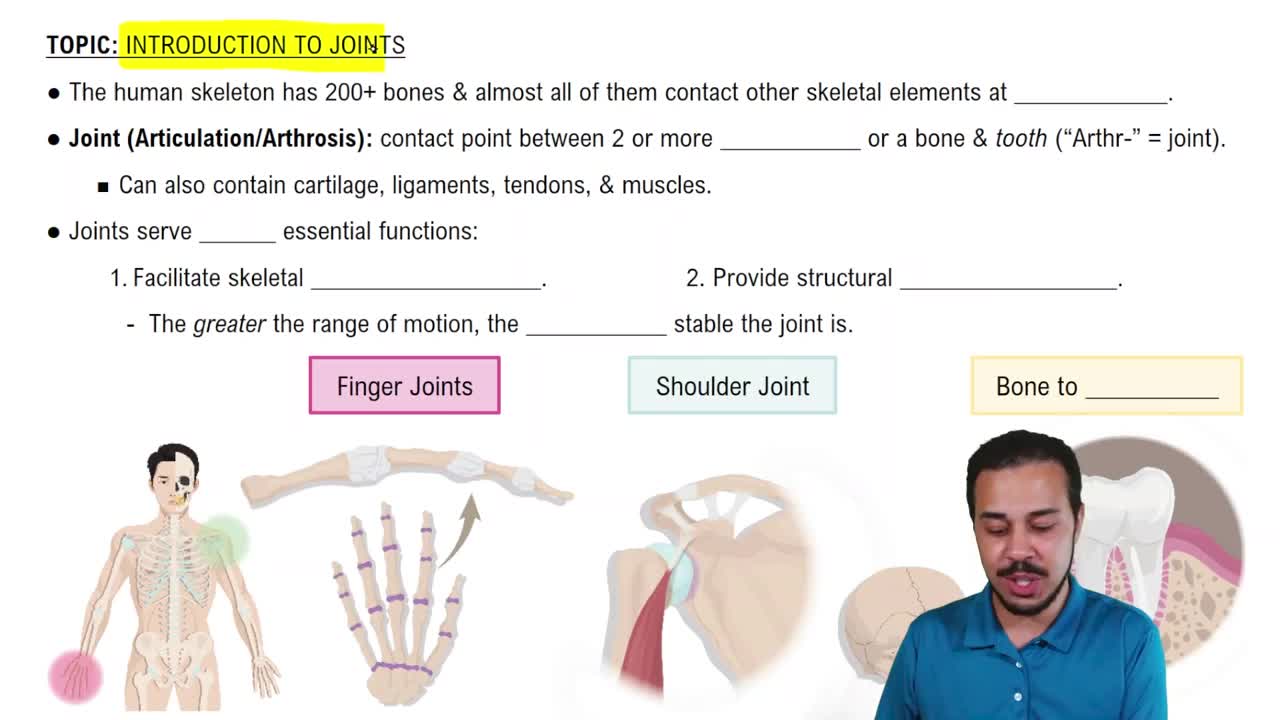
A joint or articulation is where rigid elements of the skeleton meet, such as bone to bone, bone to cartilage, or teeth in bony sockets.
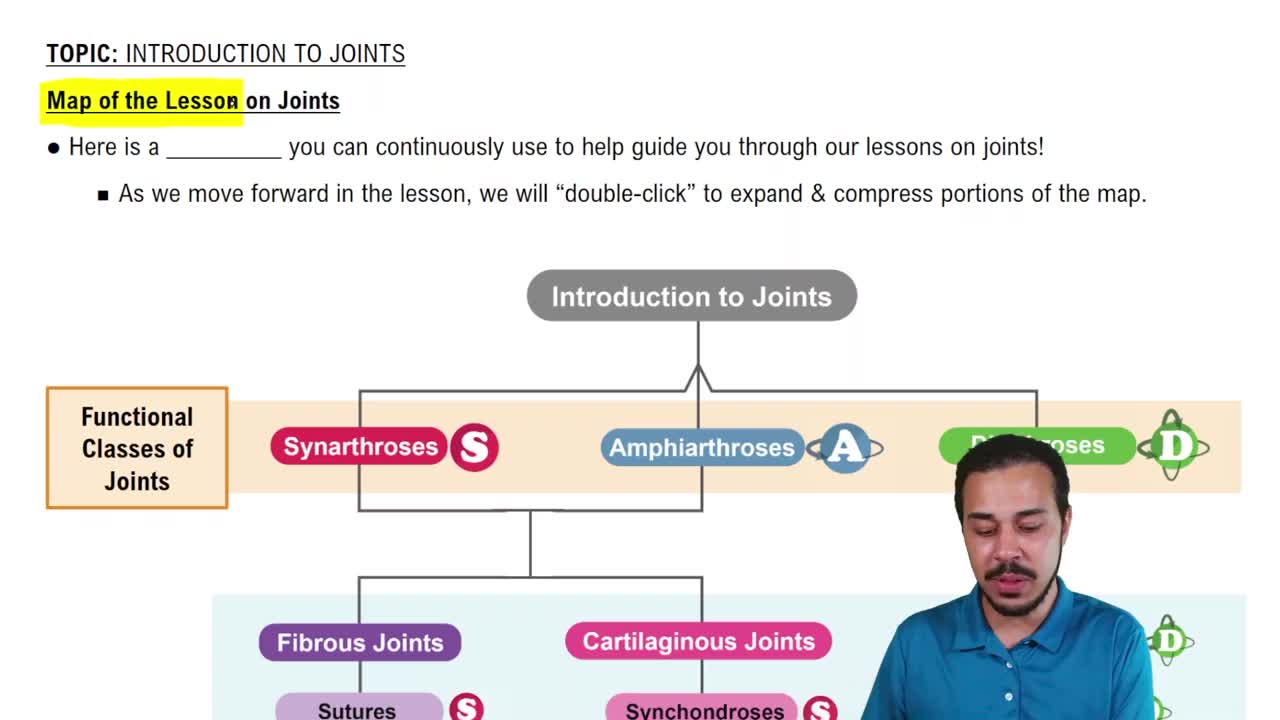
What are the three functional classifications of joints based on movement?
Synarthroses (immovable), Amphiarthroses (slightly movable), and Diarthroses (freely movable).
What are the three structural classifications of joints?
Joints are classified structurally as Fibrous, Cartilaginous, or Synovial based on the material binding bones and presence of a joint cavity.
Describe fibrous joints and their types.
Fibrous joints connect bones with fibrous connective tissue, lack a joint cavity, and are mostly immovable or slightly movable. Types include sutures, syndesmoses, and gomphoses.
What is a suture joint?
A suture is a fibrous joint where bones are tightly bound by minimal fibrous tissue, found only in the skull, allowing bone growth during childhood.
What is a syndesmosis joint?
A syndesmosis is a fibrous joint where bones are connected exclusively by ligaments; movement depends on ligament length, e.g., tibiofibular joint.
What is a gomphosis joint?
A gomphosis is a fibrous joint where a tooth is anchored in its socket by the periodontal ligament.
Describe cartilaginous joints and their types.
Cartilaginous joints unite bones with cartilage, lack a joint cavity, and include synchondroses (hyaline cartilage) and symphyses (fibrocartilage).
What is a synchondrosis joint?
A synchondrosis is a cartilaginous joint where bones are united by hyaline cartilage, such as epiphyseal plates in youth or the joint between the first rib and sternum.
What is a symphysis joint?
A symphysis is a cartilaginous joint united by fibrocartilage, providing strength and flexibility, e.g., intervertebral discs and pubic symphysis.
What defines a synovial joint?
Synovial joints are freely movable (diarthroses), have a fluid-filled joint cavity, and include most joints of the appendicular skeleton.
Name the general structures of a synovial joint.
Key structures include articular cartilage, joint cavity, articular capsule (fibrous capsule and synovial membrane), synovial fluid, and reinforcing ligaments.
What is the function of synovial fluid?
Synovial fluid lubricates joints, reduces friction, nourishes cartilage, and acts as a shock absorber.
What are bursae and tendon sheaths?
Bursae are flattened fibrous sacs lined with synovial membrane that reduce friction; tendon sheaths are elongated bursae that wrap around tendons.
What factors influence joint stability?
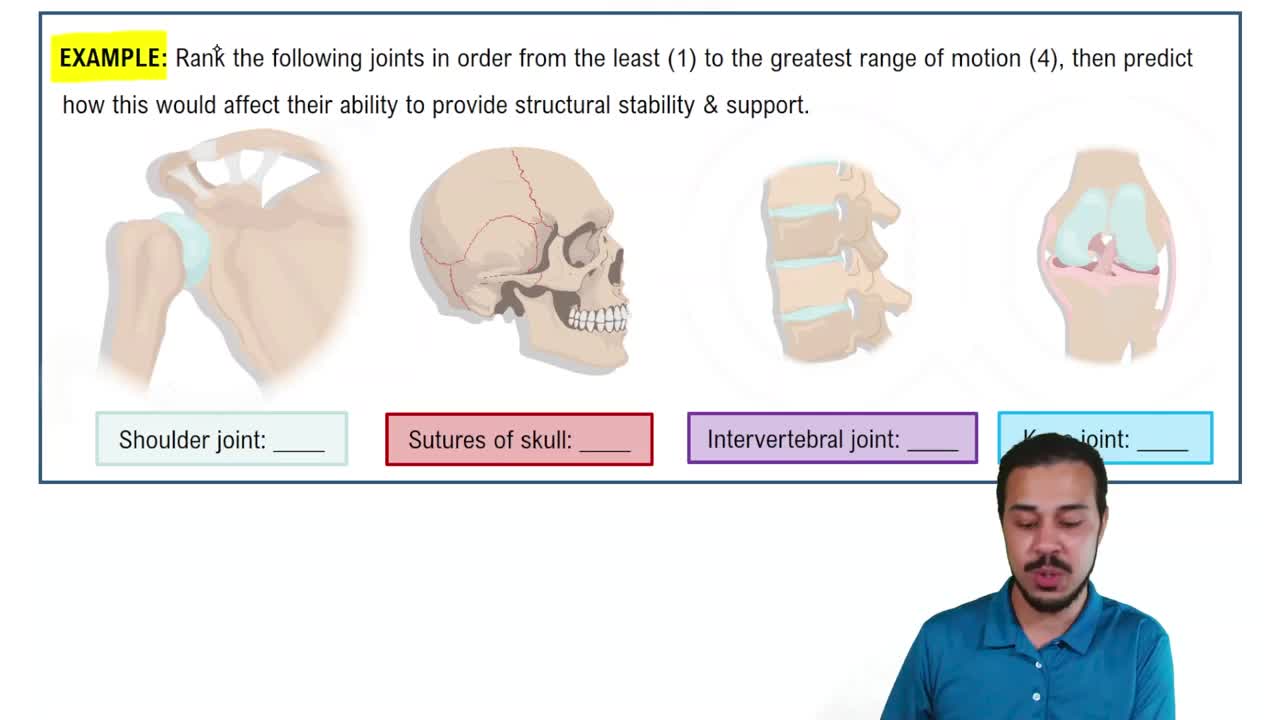
Joint stability depends on articular surfaces, ligaments (more ligaments = stronger joint), and especially muscle tone which maintains tension on tendons.
What are the three basic types of synovial joint movements?
Gliding (sliding bones), angular movements (change angle between bones), and rotation (bone turns around its long axis).
Give examples of angular movements.
Angular movements include flexion, extension, abduction, adduction, and circumduction.
What is the difference between supination and pronation?
Supination rotates the forearm laterally so the palm faces anteriorly; pronation rotates it medially so the palm faces posteriorly.
Describe special movements like dorsiflexion and plantar flexion.
Dorsiflexion lifts the foot so the superior surface approaches the shin; plantar flexion points the toes downward.
What are the six types of synovial joints classified by shape?
They are plane, hinge, pivot, condyloid, saddle, and ball-and-socket joints.
What characterizes a plane joint?
Plane joints have flat articular surfaces allowing short gliding movements; they are nonaxial, e.g., intercarpal joints.
What characterizes a hinge joint?
Hinge joints allow angular movement in one plane (uniaxial), like the elbow and knee.
What characterizes a pivot joint?
Pivot joints allow rotation around a single longitudinal axis (uniaxial), e.g., proximal radioulnar joint.
 Back
 04:06