Skip to main content
Anatomy & Physiology
My Course
Learn
Exam Prep
AI Tutor
Study Guides
Textbook Solutions
Flashcards
Explore
Try the app
My Course
Learn
Exam Prep
AI Tutor
Study Guides
Textbook Solutions
Flashcards
Explore
Try the app
Back
Anatomy & Physiology: Joints (Articulations)
You can tap to flip the card.
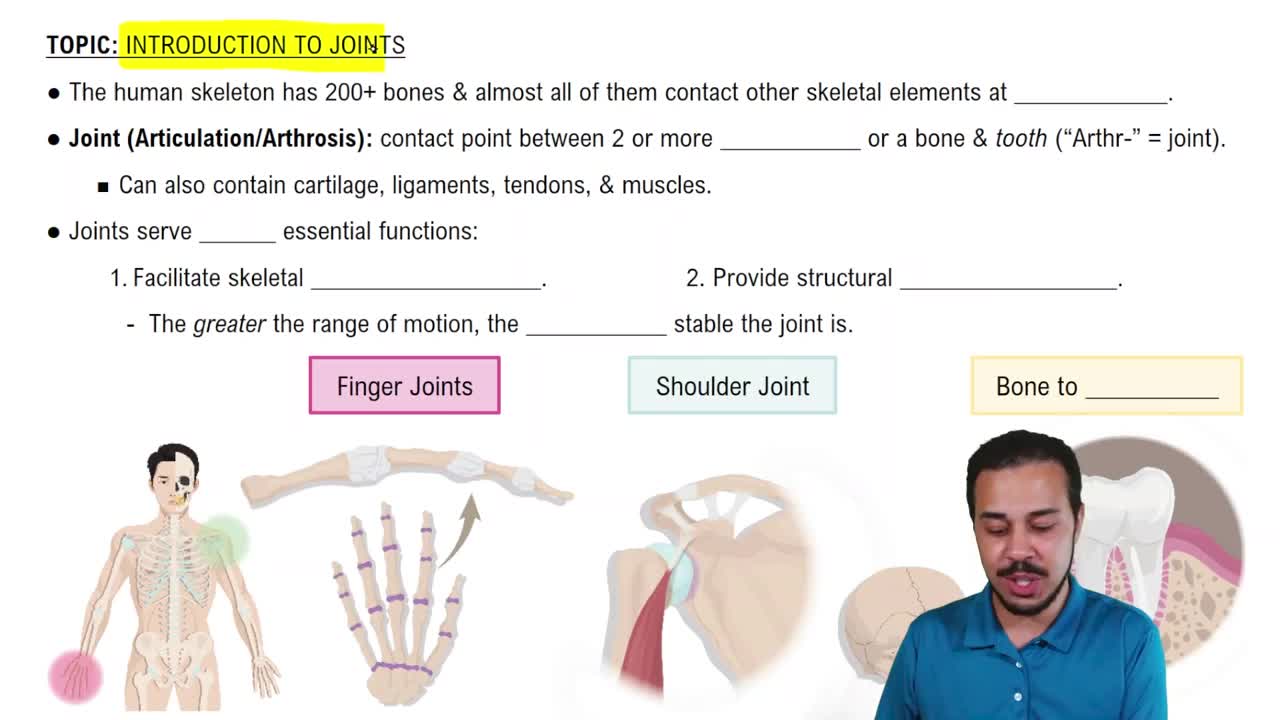
What is a joint (articulation)?
You can tap to flip the card.
👆
What is a joint (articulation)?
A
joint
is a connection between two or more bones that allows for movement and provides mechanical support.
Track progress
Control buttons has been changed to "navigation" mode.
1/27
Recommended videos
Guided course
04:06
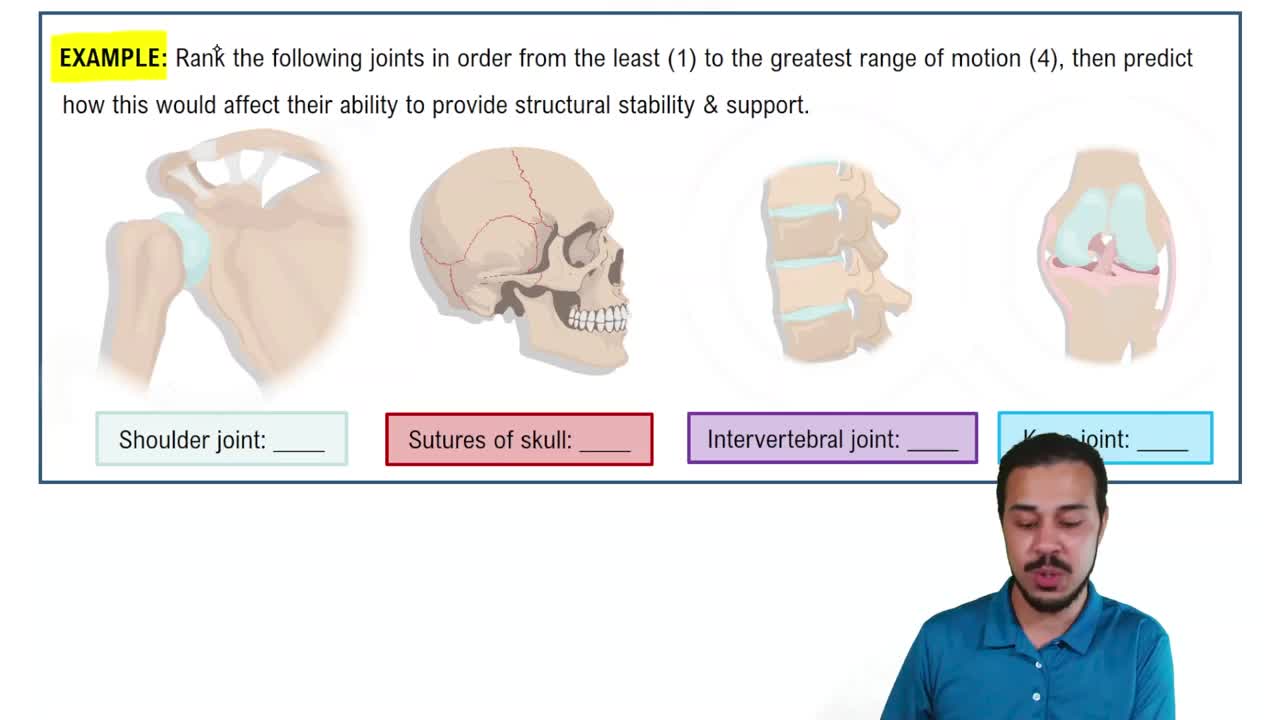
Introduction to Joints Example 1
11987
views
269
rank
Guided course
05:29
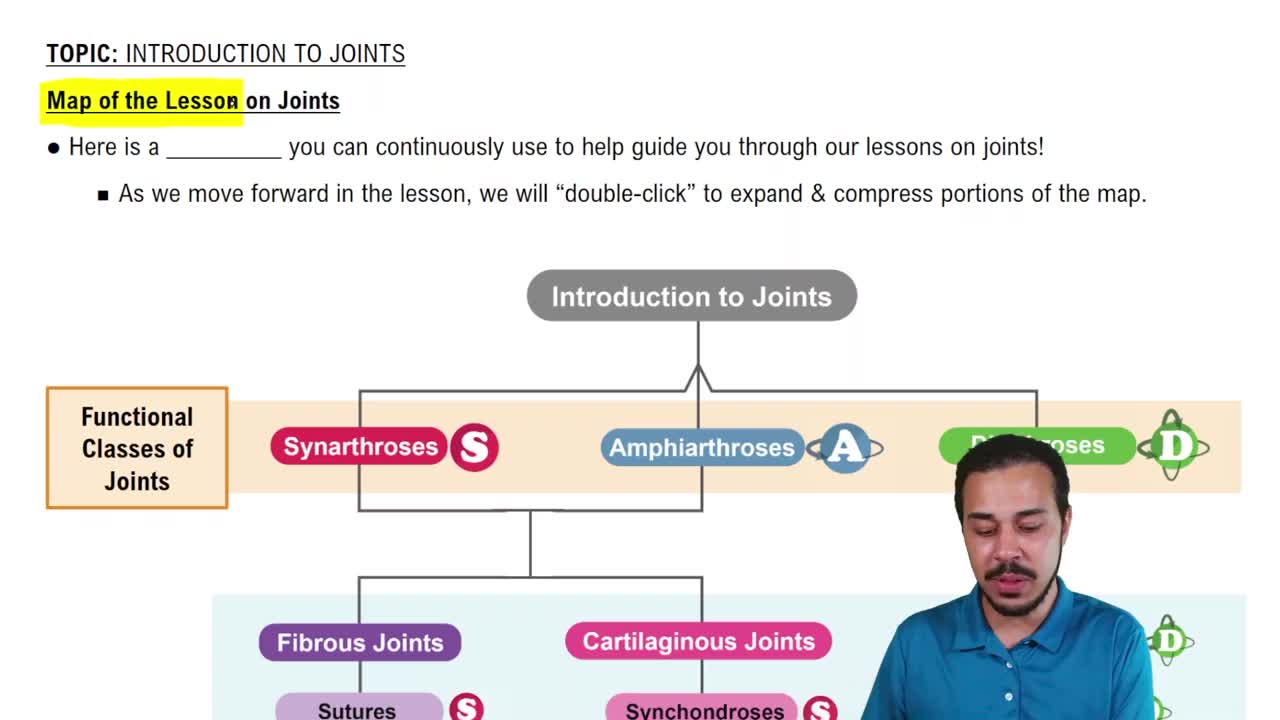
Map of the Lesson on Joints
12513
views
264
rank
1
comments
Guided course
05:39
Introduction to Joints
16793
views
431
rank
Terms in this set (27)
Hide definitions
What is a joint (articulation)?
A
joint
is a connection between two or more bones that allows for movement and provides mechanical support.
What is the primary function of joints?
Joints enable
movement
and provide
stability
to the skeleton.
What are the three structural classifications of joints?
The three structural classifications are
fibrous
,
cartilaginous
, and
synovial
joints.
What are the three functional classifications of joints?
The functional classifications are
synarthrosis
(immovable),
amphiarthrosis
(slightly movable), and
diarthrosis
(freely movable).
Example of a fibrous joint
The
sutures
between skull bones are fibrous joints.
Example of a cartilaginous joint
The
intervertebral discs
between vertebrae are cartilaginous joints.
Example of a synovial joint
The
knee joint
is a synovial joint.
What is the generalized structure of a synovial joint?
A synovial joint has a
joint cavity
,
articular cartilage
, a
synovial membrane
, and a
fibrous capsule
.
What is the function of synovial fluid?
Synovial fluid lubricates the joint, reduces friction, and nourishes the articular cartilage.
Name the six types of synovial joints
Plane
,
hinge
,
pivot
,
condylar
,
saddle
, and
ball-and-socket
joints.
Example of a plane synovial joint
Intercarpal joints in the wrist.
Example of a hinge synovial joint
The elbow joint.
Example of a pivot synovial joint
The joint between the atlas and axis vertebrae.
Example of a condylar synovial joint
The metacarpophalangeal joints (knuckles).
Example of a saddle synovial joint
The carpometacarpal joint of the thumb.
Example of a ball-and-socket synovial joint
The shoulder joint.
What is a bursa?
A
bursa
is a fluid-filled sac that reduces friction between tendons, ligaments, and bones.
What is a tendon sheath?
A
tendon sheath
is a tubular bursa that wraps around a tendon to reduce friction.
What are the main movements allowed by synovial joints?
Gliding
,
angular
(flexion, extension, abduction, adduction),
rotation
, and
special movements
.
Define flexion and give an example
Flexion
decreases the angle between bones, e.g., bending the elbow.
Define extension and give an example
Extension
increases the angle between bones, e.g., straightening the knee.
Define abduction and give an example
Abduction
moves a limb away from the midline, e.g., raising the arm sideways.
Define adduction and give an example
Adduction
moves a limb toward the midline, e.g., lowering the arm to the side.
What is opposition in joint movement?
Opposition
is the movement of the thumb to touch the fingertips.
What are common homeostatic imbalances of joints?
Sprains, dislocations, and arthritis are common inflammatory and degenerative joint conditions.
What is a sprain?
A
sprain
is a stretched or torn ligament around a joint.
What is arthritis?
Arthritis
is inflammation of a joint causing pain and stiffness.
 BackBack
 04:06