 Back
Anatomy & Physiology: Joints Overview
 04:06

Terms in this set (23)
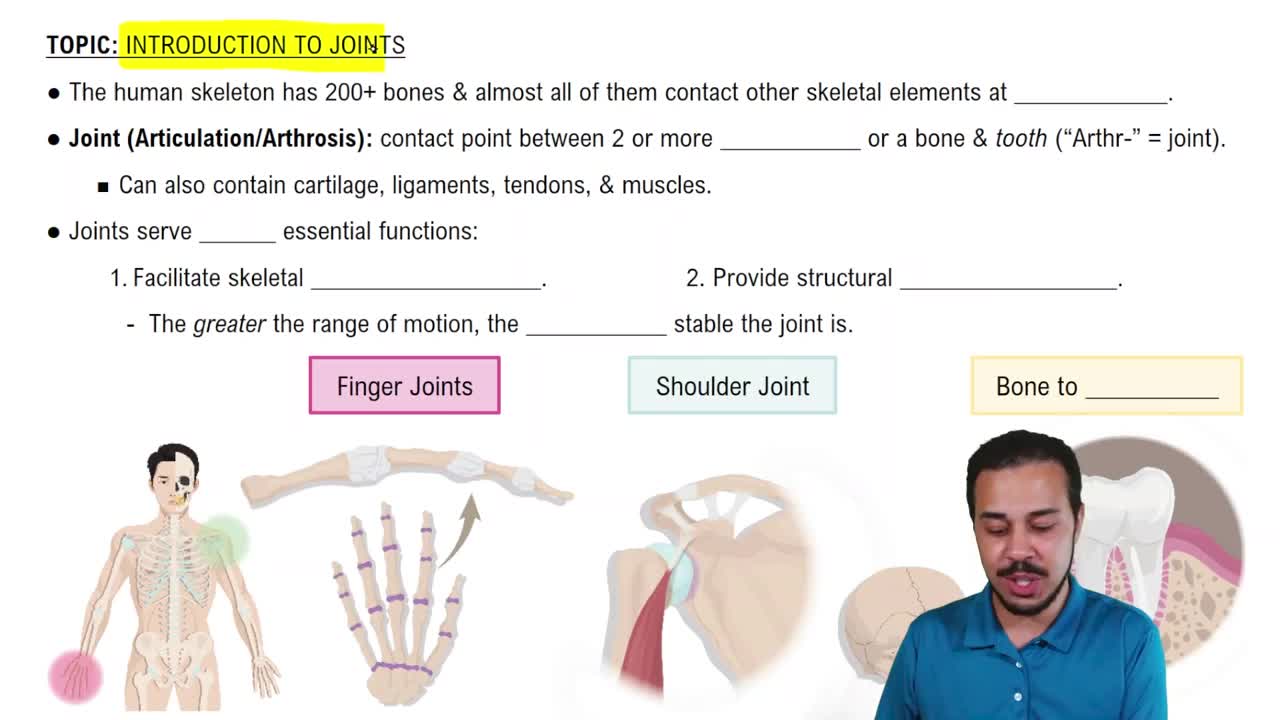
Joints connect bones, allow movement, provide mechanical support, and absorb shock.
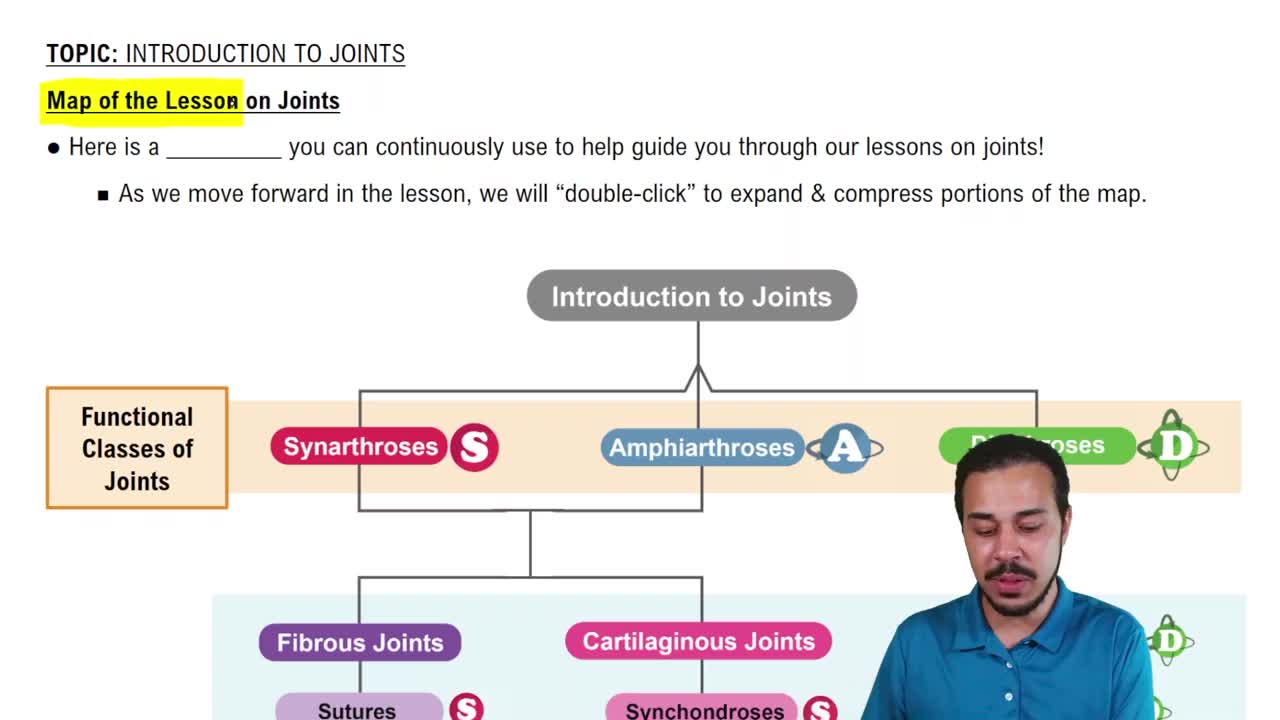
Joints are classified as fibrous, cartilaginous, or synovial based on the type of connective tissue binding the bones.
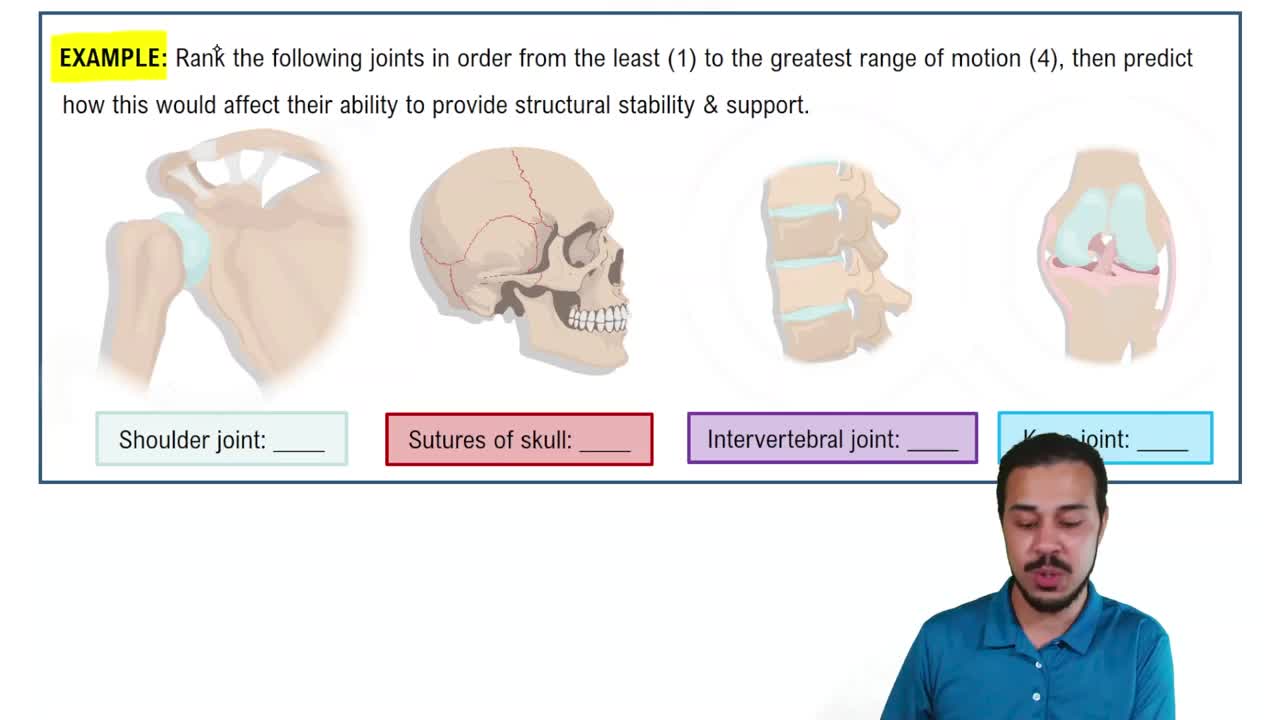
Joints are classified as synarthrosis (immovable), amphiarthrosis (slightly movable), or diarthrosis (freely movable) based on movement.
Sutures, syndesmoses, and gomphoses differ by the length and type of connective tissue fibers.
Sutures are immovable fibrous joints found between skull bones, providing protection and stability.
Syndesmoses are slightly movable fibrous joints where bones are connected by ligaments, e.g., the distal tibiofibular joint.
Gomphoses are immovable fibrous joints that anchor teeth into their sockets via the periodontal ligament.
Synchondroses (hyaline cartilage) and symphyses (fibrocartilage) differ in cartilage type and mobility.
Synchondroses are immovable joints like the epiphyseal plate, where bones are joined by hyaline cartilage.
Symphyses are slightly movable joints with fibrocartilage pads, e.g., the pubic symphysis and intervertebral discs.
Includes articular cartilage, joint cavity, synovial membrane, synovial fluid, fibrous capsule, and often ligaments.
Synovial joints are freely movable with a fluid-filled cavity, unlike the immovable or slightly movable fibrous and cartilaginous joints.
All synovial joints are diarthroses, allowing free movement in various planes.
Include gliding, angular (flexion, extension, abduction, adduction), rotation, and special movements like supination and pronation.
Include plane, hinge, pivot, condyloid, saddle, and ball-and-socket joints.
Found in intercarpal and intertarsal joints; allow gliding movements.
Include the elbow and knee; allow flexion and extension.
Include the atlantoaxial joint; allow rotational movement.
Found in the wrist; allow movement in two planes without rotation.
Found in the thumb carpometacarpal joint; allow biaxial movement including opposition.
Include the shoulder and hip; allow movement in all planes including rotation.
The knee is a complex hinge joint with multiple ligaments and menisci; the elbow is a simpler hinge joint with strong ligament support.
The shoulder is a shallow ball-and-socket joint allowing greater mobility; the hip is deeper and more stable but less mobile.