Skip to main content
Anatomy & Physiology
My Course
Learn
Exam Prep
AI Tutor
Study Guides
Textbook Solutions
Flashcards
Explore
Try the app
My Course
Learn
Exam Prep
AI Tutor
Study Guides
Textbook Solutions
Flashcards
Explore
Try the app
Back
Anatomy & Physiology Key Concepts
You can tap to flip the card.
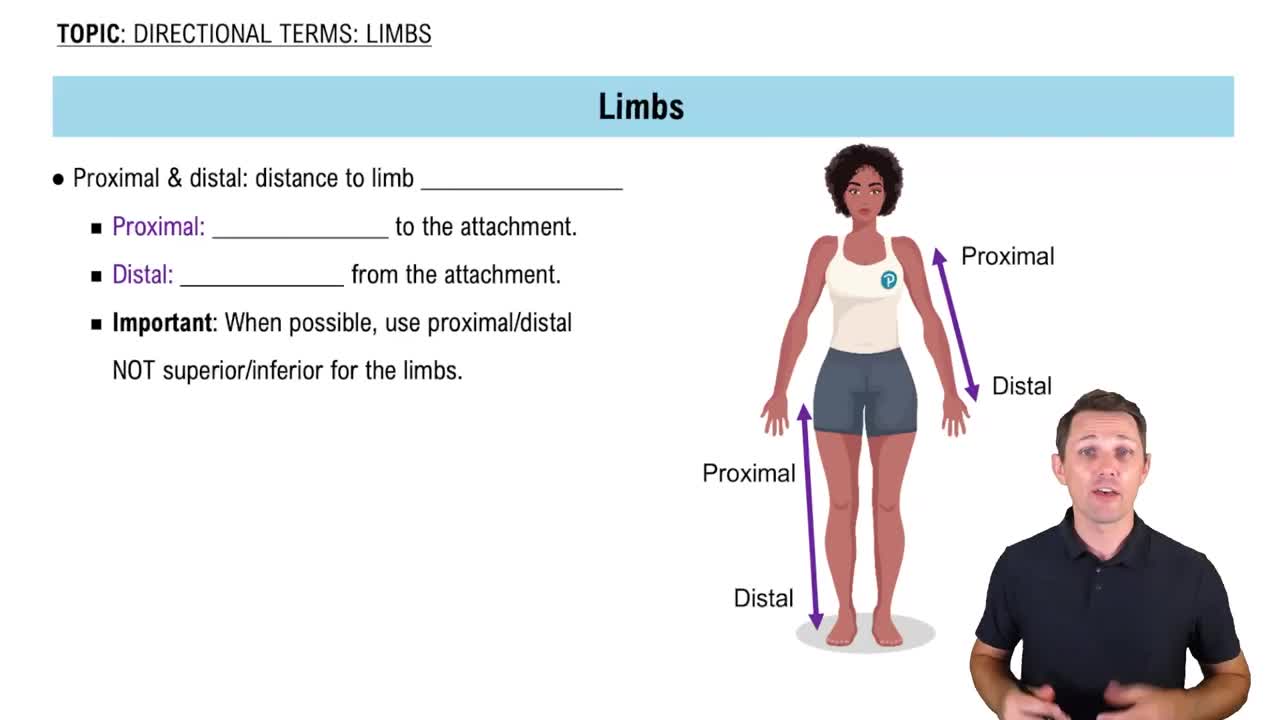
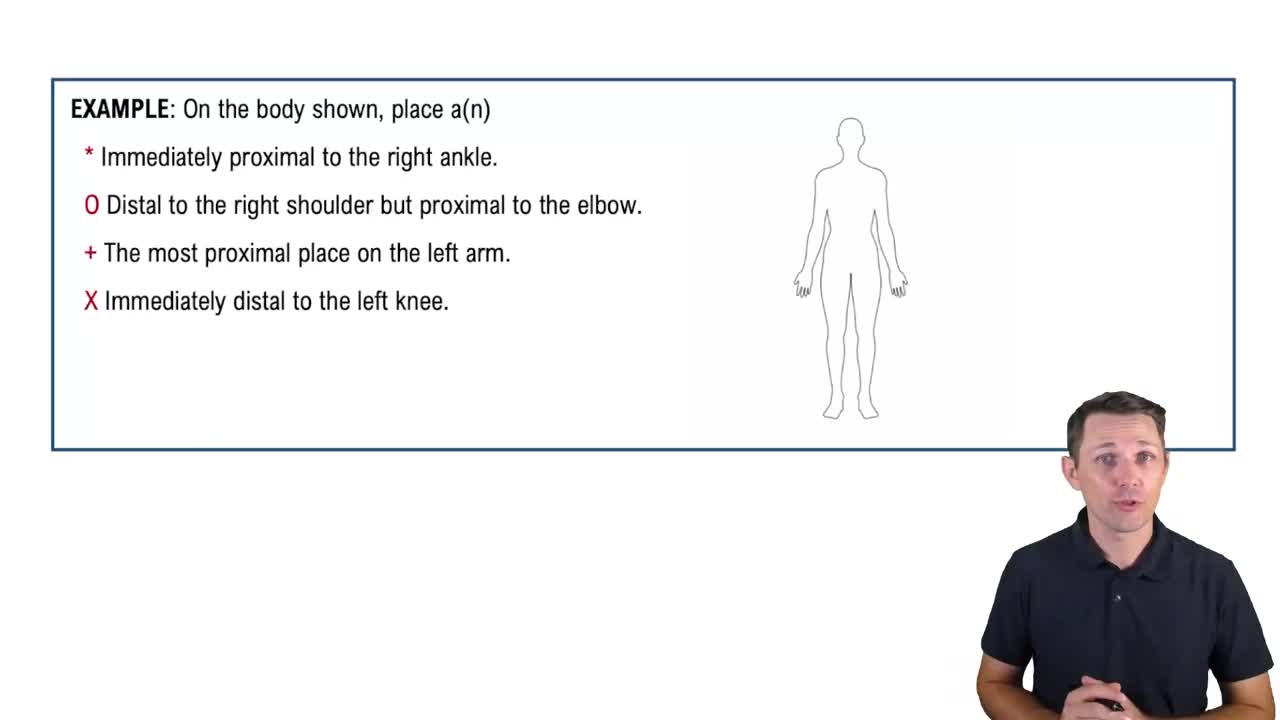
The thigh is ________ to the knee.
You can tap to flip the card.
👆
The thigh is ________ to the knee.
Proximal
Track progress
Control buttons has been changed to "navigation" mode.
1/31
Recommended videos
Guided course
02:06
Directional Terms: Limbs Example 1
8682
views
166
rank
2
comments
Guided course
02:06
Proximal and Distal
12140
views
226
rank
1
comments
Terms in this set (31)
Hide definitions
The thigh is ________ to the knee.
Proximal
Relationship between solute concentration and osmotic pressure
The
greater
the solute concentration, the
greater
the osmotic pressure.
Organelles that digest worn-out cell components and destroy microbes
Lysosomes
Why is administering pure water intravenously dangerous?
Pure water moves into red blood cells causing them to
lyse
.
A __________ is to a nucleic acid as an amino acid is to a polypeptide.
Nucleotide
Calculate total magnification: ocular lens 10×, objective lens 45×
450×
Correct order of protein synthesis steps
3. DNA uncoils for transcription, 1. mRNA produced, 6. mRNA moves to ribosome, 2. Ribosome moves along mRNA, 5. tRNA brings amino acids, 4. Polypeptide produced.
Which cannot diffuse through the plasma membrane?
Proteins
Taxol prevents which process by attaching to spindle fibers?
Anaphase
True statement about osmosis
Water is drawn toward
high concentrations of solutes
.
Body region visible only on posterior/dorsal surface
Popliteal
Cell cycle phase for protein synthesis, growth, and organelle replication
G1 phase
Function of coarse and fine adjustment knobs on a microscope
Make initial and subsequent
focusing adjustments
when viewing a specimen.
A peptide bond is found in ______ and links _______.
Proteins
; links two
amino acids
.
Organelle responsible for synthesizing ATP
Mitochondrion
Which cell is propelled by a flagellum?
Sperm
How does a letter appear under a microscope?
Upside down and backward.
Supportive frame of the microscope joining body tube to base
Arm
Organelle controlling cell activities like protein synthesis and division
Nucleus
The nosepiece on a microscope holds the
Objective lenses
The alpha-helix is an example of which protein structure level?
Secondary
Small lens under the stage that narrows and directs light through the specimen
Condenser
Effect of increased hydrogen ions on blood pH
It
decreases
blood pH.
Why can excess hydrogen ions be fatal?
They
change protein shape
, alter pH, break bonds, and disrupt tissue functions.
Basic building blocks of carbohydrates
Monosaccharides
Enzymes are biological ______ and function to ________.
Catalysts
; they
increase
the rate of chemical reactions.
DNA duplication, copying to mRNA, and reading mRNA to make protein are called
Replication
,
transcription
, and
translation
respectively.
Two hydrogen atoms sharing electrons equally form what bond?
Nonpolar covalent bond
Nitrogenous base that replaces thymine in RNA
Uracil
Which is NOT a primary component of a typical animal cell?
Cell wall
Which statement is NOT part of the cell theory?
Cells are
not
the smallest living units that perform physiological functions.
 BackBack
 02:06