Skip to main content
Anatomy & Physiology
My Course
Learn
Exam Prep
AI Tutor
Study Guides
Textbook Solutions
Flashcards
Explore
Try the app
My Course
Learn
Exam Prep
AI Tutor
Study Guides
Textbook Solutions
Flashcards
Explore
Try the app
Back
Anatomy & Physiology: Key Concepts in Chemistry and Biochemistry
1 student found this helpful
You can tap to flip the card.
What is mechanical energy in the human body?
You can tap to flip the card.
👆
What is mechanical energy in the human body?
Mechanical energy
is energy associated with muscle contraction and movement.
Track progress
Control buttons has been changed to "navigation" mode.
1/20
Recommended videos
Guided course
04:57
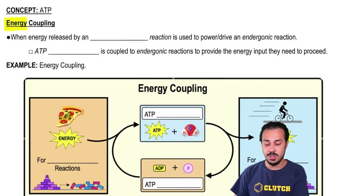
Energy Coupling
20964
views
269
rank
Guided course
06:44
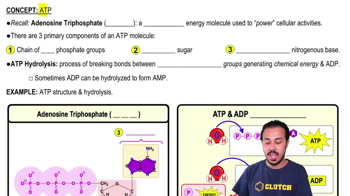
ATP
26627
views
422
rank
Guided course
03:00
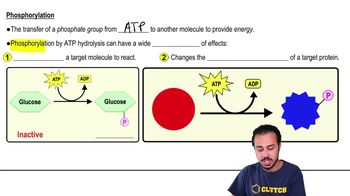
Phosphorylation
19272
views
421
rank
Terms in this set (20)
Hide definitions
What is mechanical energy in the human body?
Mechanical energy
is energy associated with muscle contraction and movement.
Define electrical energy in physiology.
Electrical energy
involves the movement of ions along neurons, enabling nerve impulses.
What is chemical energy and give an example?
Chemical energy
is stored in chemical bonds, such as phosphate bonds in ATP.
What are the three states of matter relevant to physiology?
Solid
(definite shape and volume),
liquid
(definite volume, changeable shape), and
gas
(changeable shape and volume).
What is an atom's atomic number?
The
atomic number
equals the number of protons and electrons in an atom.
What is an isotope?
Atoms with the same number of protons but different numbers of neutrons, resulting in different mass numbers.
Describe the octet rule in chemical bonding.
Atoms tend to interact to have eight electrons in their valence shell for stability, except the first shell which is full with two electrons.
Compare ionic, polar covalent, and nonpolar covalent bonds.
Ionic bonds
involve complete transfer of electrons;
polar covalent bonds
involve unequal sharing;
nonpolar covalent bonds
involve equal sharing of electrons.
What is a hydrogen bond and its importance?
A weak bond between polar molecules, important for molecular shape and properties like water's surface tension.
Define synthesis (combination) reaction.
Two or more reactants combine to form a larger product, e.g., amino acids forming proteins.
What is a decomposition reaction?
A molecule breaks down into smaller molecules or atoms, e.g., glycogen breaking into glucose.
Explain exchange reactions.
Bonds are both made and broken, exchanging parts between molecules.
What is the difference between exergonic and endergonic reactions?
Exergonic
reactions release energy;
endergonic
reactions absorb energy.
What factors influence the rate of chemical reactions?
Temperature, particle size, concentration, catalysts, and enzymes.
What are enzymes and their function?
Biological catalysts that lower activation energy and speed up chemical reactions without being consumed.
Describe the structure of ATP.
ATP consists of adenine, ribose sugar, and three phosphate groups; it stores and provides energy for cellular work.
What is the role of ATP in cellular work?
ATP provides energy for transport, mechanical, and chemical work in cells by releasing phosphate groups.
What are the four structural levels of proteins?
Primary (amino acid sequence), secondary (alpha-helix or beta-sheet), tertiary (3D folding), and quaternary (multiple polypeptide chains).
What causes protein denaturation?
Changes in pH or temperature that disrupt protein structure, potentially irreversibly.
What is the difference between DNA and RNA?
DNA is double-stranded, contains thymine, and stores genetic info; RNA is single-stranded, contains uracil, and helps in protein synthesis.
 BackBack
 04:57