Skip to main content
Anatomy & Physiology
My Course
Learn
Exam Prep
AI Tutor
Study Guides
Textbook Solutions
Flashcards
Explore
Try the app
My Course
Learn
Exam Prep
AI Tutor
Study Guides
Textbook Solutions
Flashcards
Explore
Try the app
Back
Anatomy & Physiology Lab Exam 1 Key Terms
You can tap to flip the card.
Acromial
You can tap to flip the card.
👆
Acromial
Relating to the point of the shoulder.
Track progress
Control buttons has been changed to "navigation" mode.
1/59
Recommended videos
Guided course
03:00
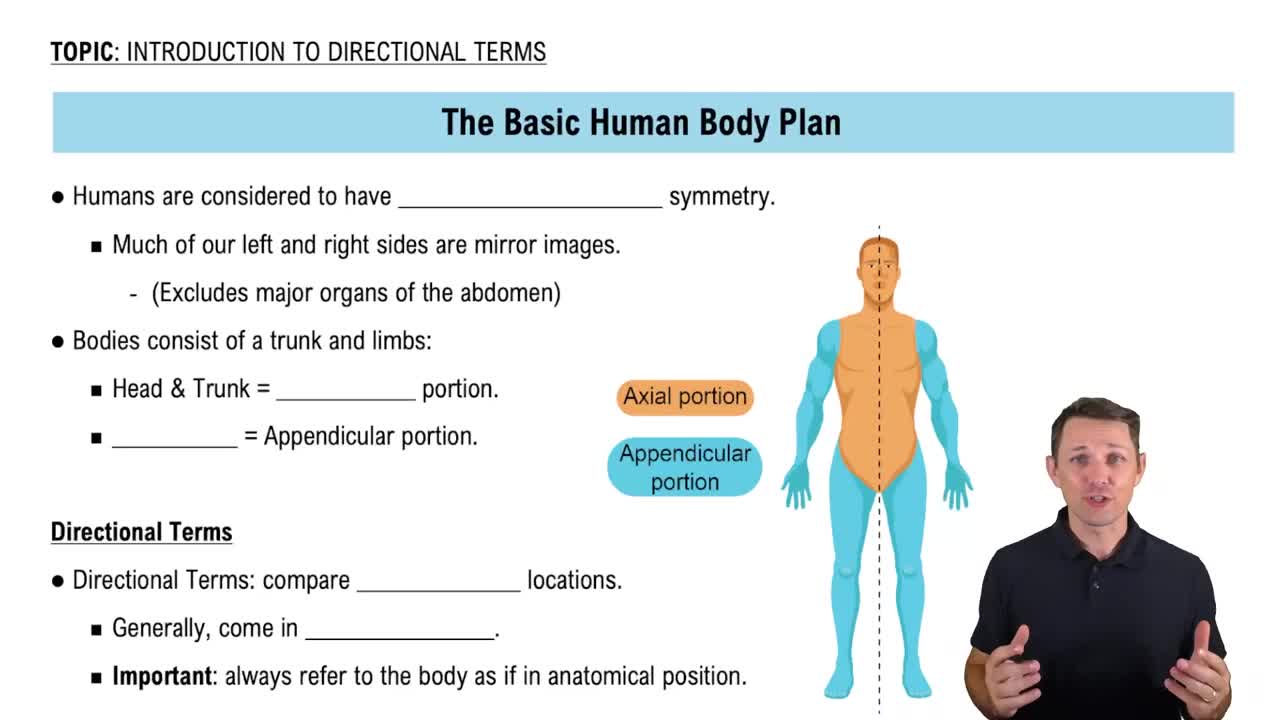
Introduction to Directional Terms
17854
views
998
rank
2
comments
Terms in this set (59)
Hide definitions
Acromial
Relating to the point of the shoulder.
Antebrachial
Pertaining to the forearm.
Axillary
Refers to the armpit region.
Brachial
Relating to the arm.
Calcaneal
Pertaining to the heel of the foot.
Cervical
Relating to the neck region.
Coxal
Refers to the hip area.
Cranial
Pertaining to the skull or head.
Dorsal
Relating to the back side of the body.
Femoral
Pertaining to the thigh.
Gluteal
Refers to the buttock region.
Inguinal
Relating to the groin area.
Lumbar
Pertaining to the lower back region.
Mammary
Relating to the breast.
Olecranal
Refers to the posterior elbow.
Patellar
Pertaining to the kneecap.
Plantar
Relating to the sole of the foot.
Sacral
Pertaining to the region between the hips at the base of the spine.
Tarsal
Refers to the ankle region.
Abdominal cavity
Body cavity containing digestive organs like stomach, liver, and intestines.
Abdominopelvic cavity
Combined abdominal and pelvic cavities housing digestive and reproductive organs.
Cranial cavity
Space within the skull that contains the brain.
Dorsal cavity
Body cavity that includes the cranial and spinal cavities.
Pelvic cavity
Body cavity containing urinary bladder, reproductive organs, and rectum.
Thoracic cavity
Cavity housing the heart and lungs, protected by the rib cage.
Pericardial cavity
Space surrounding the heart within the thoracic cavity.
Pleural cavity
Space surrounding each lung within the thoracic cavity.
Peritoneum
Membrane lining the abdominopelvic cavity and covering abdominal organs.
Frontal plane
Vertical plane dividing the body into anterior and posterior parts.
Sagittal plane
Vertical plane dividing the body into left and right parts.
Transverse plane
Horizontal plane dividing the body into superior and inferior parts.
Epidermis
Outer layer of skin composed of stratified squamous epithelium.
Dermis
Inner layer of skin containing connective tissue, blood vessels, and nerves.
Hypodermis
Subcutaneous layer beneath the dermis made mostly of adipose tissue.
Stratum basale
Deepest layer of the epidermis where new skin cells are generated.
Stratum corneum
Outermost layer of the epidermis consisting of dead, flattened cells.
Apocrine sweat gland
Sweat gland found mainly in the armpits and groin, secretes thicker sweat.
Eccrine sweat gland
Sweat gland distributed over most of the body, produces watery sweat.
Sebaceous gland
Oil gland that secretes sebum to lubricate skin and hair.
Arrector pili muscle
Small muscle attached to hair follicles that causes hair to stand up.
Tactile (Meissner’s) corpuscle
Sensory receptor in the skin for light touch.
Lamellated (Pacinian) corpuscle
Sensory receptor in the skin for deep pressure and vibration.
Simple squamous epithelium
Single layer of flat cells allowing diffusion and filtration.
Simple cuboidal epithelium
Single layer of cube-shaped cells involved in secretion and absorption.
Simple columnar epithelium
Single layer of tall cells specialized for absorption and secretion.
Pseudostratified ciliated columnar epithelium
Single layer of cells with varying heights, often with cilia, found in respiratory tract.
Stratified squamous epithelium
Multiple layers of flat cells providing protection against abrasion.
Transitional epithelium
Specialized epithelium that stretches, found in urinary bladder.
Areolar connective tissue
Loose connective tissue that cushions organs and holds tissue fluids.
Adipose tissue
Connective tissue storing fat for energy and insulation.
Dense regular connective tissue
Tissue with parallel collagen fibers providing strong attachment, found in tendons.
Dense irregular connective tissue
Tissue with collagen fibers in multiple directions providing strength in various directions.
Hyaline cartilage
Most common cartilage type, providing support with some flexibility.
Fibrocartilage
Tough cartilage found in intervertebral discs and knee menisci.
Elastic cartilage
Cartilage with elastic fibers providing flexibility, found in ear and epiglottis.
Cardiac muscle
Involuntary muscle found only in the heart, characterized by intercalated discs.
Skeletal muscle
Voluntary muscle attached to bones for movement.
Smooth muscle
Involuntary muscle found in walls of hollow organs.
Intercalated disc
Specialized connections between cardiac muscle cells for synchronized contraction.
 BackBack
 03:00
