Back

Anatomy & Physiology Lab Practical Exam 1 Study Guide

Control buttons has been changed to "navigation" mode.
1/28
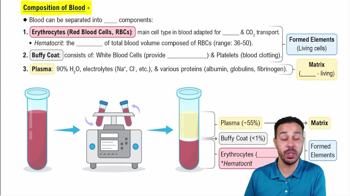
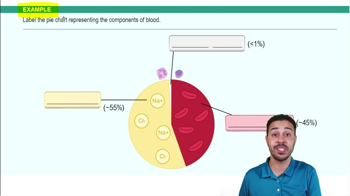
  • Identify the three main types of blood cells in a photomicrograph

    Red blood cells (erythrocytes), white blood cells (leukocytes), and platelets (thrombocytes).
  • Name the five types of white blood cells (leukocytes)

    Neutrophils, Lymphocytes, Monocytes, Eosinophils, and Basophils.
  • What are the typical percentages of each leukocyte in blood?

    Neutrophils (~60-70%), Lymphocytes (~20-25%), Monocytes (~3-8%), Eosinophils (~2-4%), Basophils (<1%).
  • How do you determine blood type using simulated blood samples?

    By interpreting agglutination reactions to identify ABO antigens and Rh factor on red blood cells.
  • What antigens and antibodies are present in blood type A?

    Antigen A on RBCs; anti-B antibodies in serum.
  • What antigens and antibodies are present in blood type B?

    Antigen B on RBCs; anti-A antibodies in serum.
  • What antigens and antibodies are present in blood type AB?

    Both antigens A and B on RBCs; no anti-A or anti-B antibodies in serum.
  • What antigens and antibodies are present in blood type O?

    No A or B antigens on RBCs; both anti-A and anti-B antibodies in serum.
  • What determines Rh positive or negative blood type?

    Presence (Rh+) or absence (Rh-) of the Rh (D) antigen on red blood cells.
  • What causes a transfusion reaction?

    Mixing incompatible blood types causes antibodies to attack donor RBC antigens, leading to agglutination and hemolysis.
  • Describe histological characteristics of cardiac muscle

    Striated, branched fibers with intercalated discs that connect cells for synchronized contraction.
  • Name the external structures of the steer/sheep heart

    Apex, Right and Left Atrium, Right and Left Ventricle, Aorta, Brachiocephalic Trunk, Pulmonary Trunk, Superior Vena Cava.
  • Name the internal structures of the steer/sheep heart

    Right and Left Atrium, Right and Left Ventricle, Bicuspid (Mitral) Valve, Tricuspid Valve, Pulmonary and Aortic Semilunar Valves, Pectinate Muscles, Chordae Tendineae, Papillary Muscles, Interventricular Septum.
  • What are the key arteries above the diaphragm in the fetal pig?

    Ascending Aorta, Aortic Arch, Thoracic Aorta, Brachiocephalic Trunk, Right and Left Common Carotid, Subclavian, Axillary, and Brachial Arteries.
  • What are the key arteries below the diaphragm in the fetal pig?

    Abdominal Aorta, Renal Arteries, Internal and External Iliac Arteries, Umbilical Arteries, Femoral Arteries.
  • What are the key veins above the diaphragm in the fetal pig?

    Superior Vena Cava, Right and Left Brachiocephalic Veins, Subclavian Veins, External and Internal Jugular Veins, Axillary and Brachial Veins.
  • What are the key veins below the diaphragm in the fetal pig?

    Inferior Vena Cava, Renal Veins, Internal and External Iliac Veins, Umbilical Vein, Common Iliac Veins, Femoral Veins.
  • What is the pathway of blood through the human heart?

    Blood enters right atrium → right ventricle → pulmonary trunk → lungs → left atrium → left ventricle → aorta → body.
  • What are the main waves and intervals on an EKG?

    P wave, QRS complex, T wave; P-R interval and Q-T interval.
  • What does the P wave represent on an EKG?

    Atrial depolarization leading to atrial contraction.
  • What does the QRS complex represent on an EKG?

    Ventricular depolarization leading to ventricular contraction.
  • What does the T wave represent on an EKG?

    Ventricular repolarization as the ventricles relax.
  • What is the isoelectric point on an EKG?

    The baseline where no electrical activity is detected between waves.
  • How do you calculate heart rate from an EKG tracing?

    Heart rate = \(\frac{60}{\text{R-R interval in seconds}}\) beats per minute.
  • What equipment is used to measure blood pressure?

    A sphygmomanometer (blood pressure cuff) and stethoscope.
  • How is pulse pressure calculated?

    Pulse Pressure = Systolic Pressure − Diastolic Pressure.
  • How is mean arterial pressure (MAP) calculated?

    MAP = Diastolic Pressure + \(\frac{1}{3}\) (Systolic − Diastolic Pressure).
  • How do body position and exercise affect pulse and blood pressure?

    Exercise increases pulse and blood pressure; changes in body position can cause temporary changes due to blood flow adjustments.