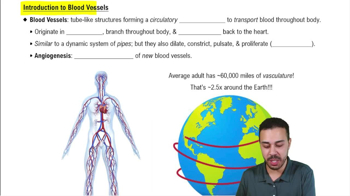
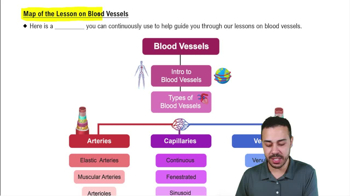
Arteries carry blood away from the heart, have thick muscular walls; veins carry blood to the heart, have valves; capillaries are thin-walled for exchange of gases and nutrients.
Equation F = AP/R
F is blood flow, A is cross-sectional area, P is pressure difference, and R is resistance; flow increases with pressure and area, decreases with resistance.
Factors influencing peripheral resistance
Blood viscosity, vessel length, and vessel diameter; vessel diameter is most significant in healthy adults.
Body compensation for severe hemorrhage
Activation of hormones like ADH, aldosterone, and reflexes such as baroreceptor reflex to maintain blood pressure and volume.
Net filtration pressure
Balance of capillary hydrostatic pressure, interstitial hydrostatic pressure, capillary osmotic pressure, and interstitial osmotic pressure determining fluid movement.
Effect of atherosclerosis on blood flow
Narrowing of arteries increases resistance, raising blood pressure and reducing blood flow.
Differences between lymphatic and blood capillaries
Lymphatic capillaries are more permeable and have blind ends; blood capillaries form continuous loops.
Differences between lymphatic vessels and veins
Lymphatic vessels have thinner walls, more valves, and transport lymph instead of blood.
Function of the thymus
Site of T cell maturation and immunocompetence development.
Consequences of lymphatic flow obstruction
Causes lymphedema due to fluid accumulation in tissues.
Functions of lymph nodes
Filter lymph, trap pathogens, and house immune cells for immune response.
Disease-causing organisms
Pathogens include viruses and bacteria; viruses invade host cells to replicate.
Innate immune response
Non-specific, immediate defense including barriers, phagocytes, inflammation; does not have memory.
Role of body surfaces in immunity
Skin and mucous membranes act as physical and chemical barriers to pathogens.
Phagocytes in immune function
Cells like macrophages and neutrophils engulf and destroy pathogens.
Inflammation in immune defense
Controls pathogen spread and promotes removal of debris by increasing blood flow and immune cell recruitment.
Complement proteins
Enhance phagocytosis, lyse bacteria, and promote inflammation.
Interferon function
Proteins produced by infected cells that inhibit viral replication in neighboring cells; no memory.
Benefits and risks of fever
Fever enhances immune response but can cause damage if too high or prolonged.
Humoral vs cell-mediated immunity
Humoral involves B cells producing antibodies; cell-mediated involves T cells attacking infected cells.
Functions of T helper (Th) and cytotoxic (Tc) cells
Th cells activate other immune cells; Tc cells kill infected or abnormal cells.
How vaccines work
Introduce antigens to stimulate adaptive immunity and memory without causing disease.
Active vs passive immunity
Active immunity is produced by own immune response; passive immunity is received from another source.
Primary vs secondary immune response
Primary is first exposure, slower and weaker; secondary is faster and stronger due to memory cells.
Immunocompetence
Ability of B and T cells to recognize specific antigens; occurs in bone marrow for B cells and thymus for T cells.
Definition of antigen
A molecule that triggers an immune response.
Definition of antibody
Proteins produced by B cells that bind specific antigens; five classes include IgG, IgA, IgM, IgE, and IgD.
 Back
 3:38