Back

Anatomy & Physiology: Module 1 - Introduction and Body Organization
Control buttons has been changed to "navigation" mode.
1/43
  • What is the difference between anatomy and physiology?

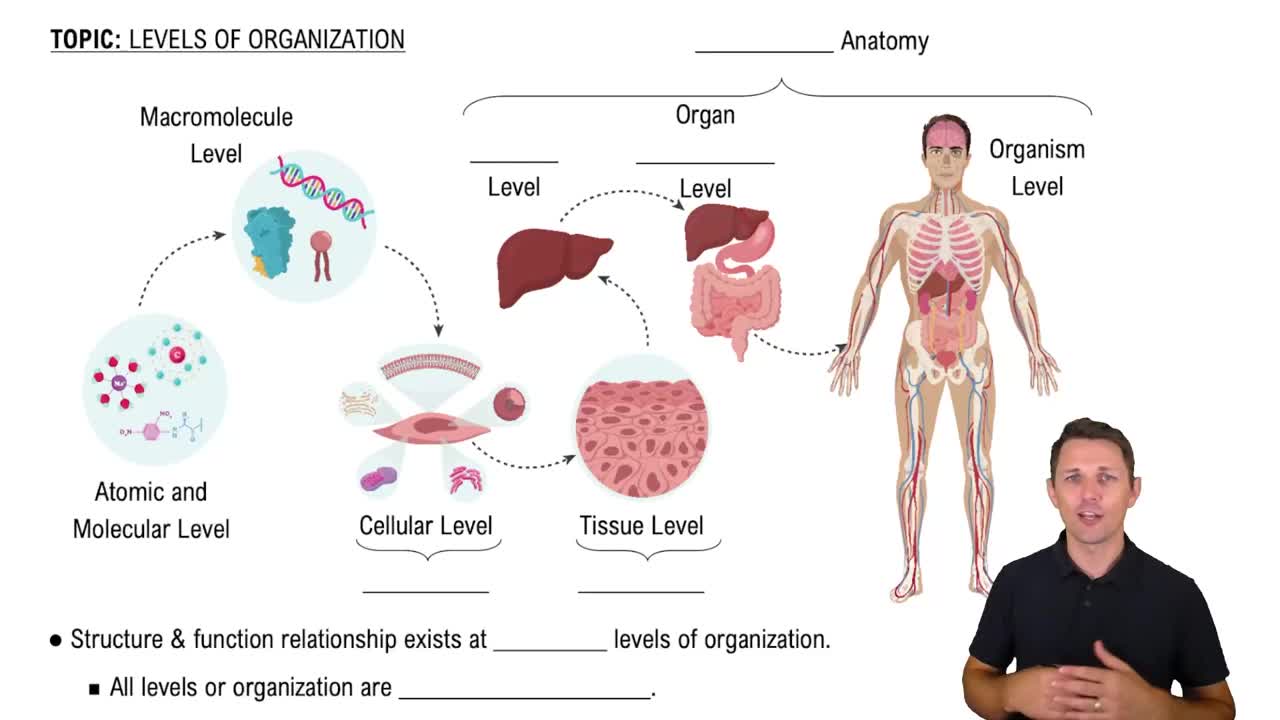
    Anatomy is the study of the structure of the human body, while physiology is the study of the functions of those structures.
  • List the six levels of structural organization in the human body.

    1) Chemical level, 2) Cellular level, 3) Tissue level, 4) Organ level, 5) Organ system level, 6) Organism level.
  • What is the chemical level of organization?

    The chemical level includes single atoms and molecules, such as phospholipid molecules, which form the basis of cellular structures.
  • Describe the cellular level of organization.

    The cellular level consists of cells, the smallest living units, such as squamous epithelial cells with a cell membrane.
  • What defines the tissue level of organization?

    The tissue level is composed of groups of similar cells working together, like stratified squamous epithelium.
  • What is an organ in anatomical terms?

    An organ is a structure composed of two or more tissue types that perform a specific function, such as the esophagus.
  • What is the organ system level?

    The organ system level consists of related organs working together to perform broad functions, like the digestive system.
  • Name the 11 major human body systems.

    Integumentary, Skeletal, Muscular, Nervous, Endocrine, Cardiovascular, Lymphatic, Respiratory, Digestive, Urinary, and Reproductive systems.
  • What are the main functions of the integumentary system?

    Protects the body from the external environment, produces vitamin D, retains water, and regulates body temperature.
  • List key functions of the skeletal system.

    Supports the body, protects internal organs, provides leverage for movement, produces blood cells, and stores calcium salts.
  • What are the primary roles of the muscular system?

    Produces movement, controls body openings, and generates heat.
  • What functions does the nervous system regulate?

    Regulates body functions and provides for sensation, movement, automatic functions, and higher mental functions via nerve impulses.
  • What is the role of the endocrine system?

    Regulates body functions through hormones secreted by glands and tissues.
  • Describe the cardiovascular system's main functions.

    Pumps and delivers oxygen-poor blood to the lungs and oxygen-rich blood to tissues, removes wastes, and transports cells and substances.
  • What does the lymphatic system do?

    Returns excess tissue fluid to the cardiovascular system and provides immunity against disease.
  • What are the primary functions of the respiratory system?

    Delivers oxygen to the blood, removes carbon dioxide, and maintains acid-base balance.
  • List the main functions of the digestive system.

    Digests food, absorbs nutrients, removes food waste, and maintains fluid, electrolyte, and acid-base balance.
  • What are the functions of the urinary system?

    Removes metabolic wastes from the blood, maintains fluid, electrolyte, and acid-base balance, and stimulates blood cell production.
  • What are the key functions of the male reproductive system?

    Produces and transports sperm, secretes hormones, and supports sexual function.
  • What are the key functions of the female reproductive system?

    Produces and transports oocytes (eggs), supports fetal development and childbirth, secretes hormones, and supports sexual function.
  • What is the anatomical position?

    A standard reference position where the body stands upright, facing forward, with palms facing forward; right and left refer to the body's sides.
  • Define the directional terms anterior and posterior.

    Anterior (ventral) means toward the front of the body; posterior (dorsal) means toward the back.
  • What do superior and inferior mean in anatomical terms?

    Superior (cranial) means toward the head; inferior (caudal) means toward the feet.
  • Explain proximal and distal.

    Proximal means closer to the point of origin; distal means farther from the point of origin.
  • What do medial and lateral mean?

    Medial means closer to the midline of the body; lateral means farther from the midline.
  • Define superficial and deep.

    Superficial means closer to the surface of the body; deep means farther from the surface.
  • What are the two broad regions of the body?

    Axial region (head, neck, trunk) and appendicular region (upper and lower limbs).
  • Name the four abdominopelvic quadrants.

    Right upper quadrant (RUQ), right lower quadrant (RLQ), left upper quadrant (LUQ), left lower quadrant (LLQ).
  • What are serous membranes?

    Thin tissue layers that line body cavities and cover organs, consisting of parietal (outer) and visceral (inner) layers with lubricating serous fluid between.
  • What is homeostasis?

    The maintenance of a stable internal environment within narrow limits essential for survival.
  • Describe negative feedback in homeostasis.

    A control mechanism that opposes initial changes to return a variable to its normal range, involving stimulus, receptor, control center, and effector.
  • What is positive feedback?

    A less common feedback mechanism that amplifies the initial stimulus, such as during childbirth.
  • What organs are part of the integumentary system?


    Skin, hair, nails

  • What organs are part of the skeletal system?


    Bones, joints

  • What organs are part of the muscular system?


    Skeletal muscles

  • What organs are part of the endocrine system?


    Pineal gland, hypothalamus, thyroid gland, thymus gland, pituitary gland, pancreas, adrenal glands, ovaries/testes

  • What organs are part of the nervous system?


    Brain, nerves, spinal cord (vertebrae)

  • What organs are part of the digestive system?


    Mouth, esophagus, stomach, small intestine, large intestine

  • What organs are part of the urinary (renal) system?


    Kidneys, ureters, bladder, urethra

  • What organs are part of the respiratory system?


    Nasal cavity, pharynx, larynx, lungs, trachea

  • What organs are part of the cardiovascular system?


    Heart, blood vessels

  • What organs are part of the lymphatic system?


    Lymph nodes, lymphatic vessels, tonsils, spleen, thymus

  • What organs are part of the reproductive system?


    Testes, penis, prostate (males).

    Ovaries, uterus, vagina , mammary glands (females)