 Back
Anatomy & Physiology: Nervous System and Membrane Potentials
 07:53

Terms in this set (43)
The CNS consists of the brain and spinal cord, responsible for processing and integrating information.
The PNS includes all nerves outside the CNS, connecting it to limbs and organs.
The cell body contains the nucleus and organelles; it integrates incoming signals.
Dendrites are branched projections that receive electrical signals from other neurons.
The axon transmits electrical impulses away from the cell body to other neurons or effectors.
Anterograde transport moves materials from the cell body down the axon toward the synapse.
Retrograde transport moves materials from the axon terminal back to the cell body.
Motor neurons carry signals from the CNS to muscles or glands to produce a response.
Sensory neurons transmit information from sensory receptors to the CNS.
Interneurons connect sensory and motor neurons within the CNS for processing.
A multipolar neuron has one axon and multiple dendrites; most common neuron type.
A bipolar neuron has one axon and one dendrite; found in sensory organs like the retina.
A unipolar neuron has a single process that splits into two branches; common in sensory neurons.
Anaxonic neurons have no distinct axon and are involved in local signal processing.
Schwann cells myelinate axons in the PNS, aiding faster signal conduction.
Satellite cells surround neuron cell bodies in ganglia, providing support and nutrients.
Myelination insulates axons; Nodes of Ranvier are gaps that enable saltatory conduction.
Oligodendrocytes myelinate axons in the CNS, increasing conduction speed.
Microglia act as immune cells in the CNS, removing debris and pathogens.
Astrocytes support neurons, maintain the blood-brain barrier, and regulate extracellular ions.
Ependymal cells line brain ventricles and spinal canal, producing and circulating cerebrospinal fluid.
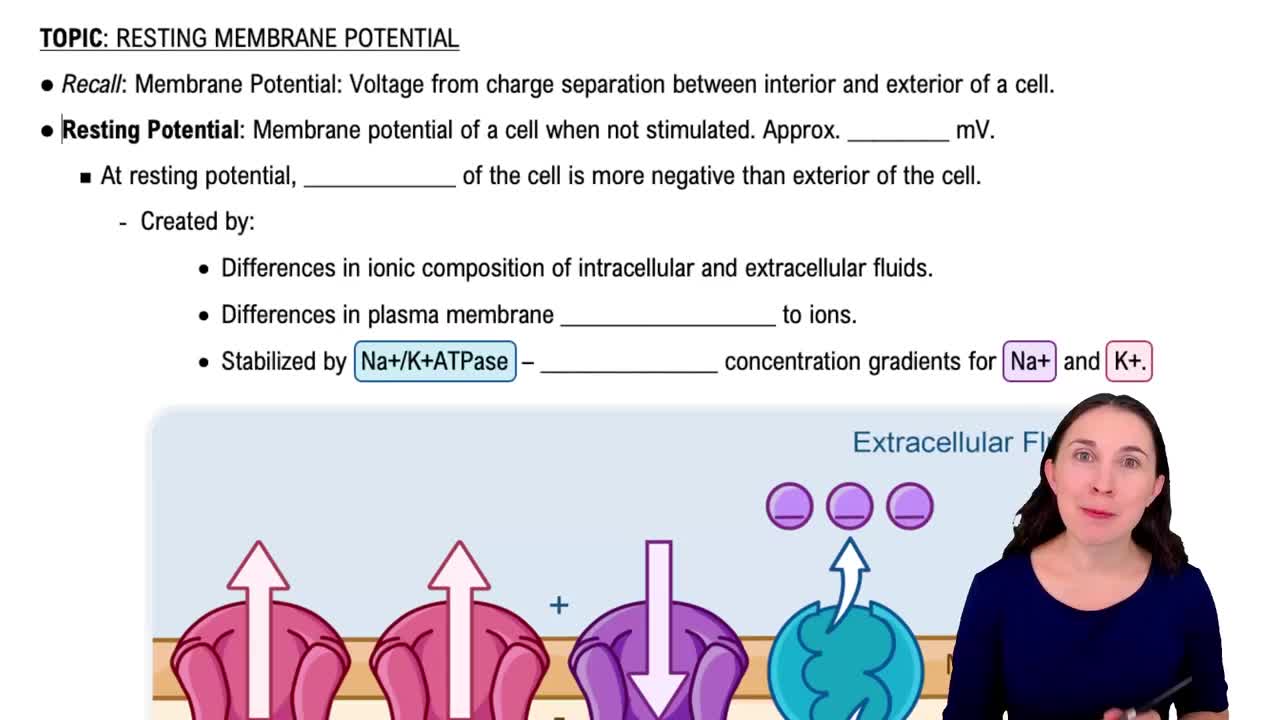
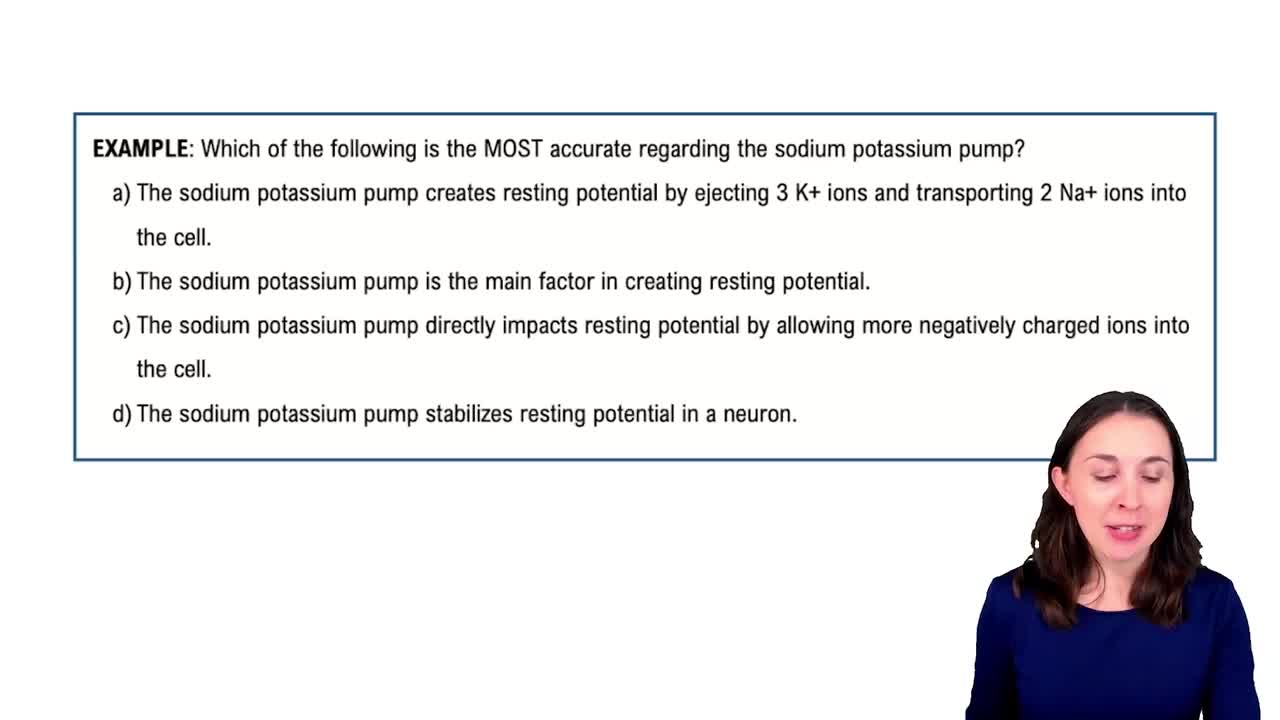
The resting membrane potential is the voltage across the membrane at rest, typically around -70 mV, due to ion distribution.
Graded potentials are small, variable changes in membrane potential that can summate to trigger action potentials.
Action potentials are rapid, all-or-none electrical impulses that propagate along axons.
Leak channels allow passive ion flow, contributing to the resting membrane potential.
Depolarization is a decrease in membrane potential making the inside less negative, often due to Na+ influx.
Repolarization restores the membrane potential to resting state, usually by K+ efflux.
Hyperpolarization makes the membrane potential more negative than resting, inhibiting action potential generation.
Voltage-gated channels open or close in response to changes in membrane potential, crucial for action potentials.
The absolute refractory period prevents new action potentials; the relative refractory period allows them with stronger stimuli.
Saltatory conduction is the rapid jumping of action potentials between Nodes of Ranvier on myelinated axons.
Electrical synapses allow direct ion flow between cells via gap junctions for fast communication.
Chemical synapses use neurotransmitters to transmit signals across a synaptic cleft.
EPSPs depolarize the postsynaptic membrane, increasing the chance of an action potential.
IPSPs hyperpolarize the postsynaptic membrane, decreasing the chance of an action potential.
Divergence is when one neuron sends signals to multiple neurons.
Convergence is when multiple neurons send signals to one neuron.
Ionotropic receptors are ligand-gated ion channels that open quickly to change membrane potential.
Metabotropic receptors activate second messenger systems, causing slower but longer-lasting effects.
Temporal summation is rapid repeated stimuli; spatial summation is simultaneous stimuli from multiple synapses.
LTP is a long-lasting increase in synaptic strength, important for learning and memory.
LTD is a long-lasting decrease in synaptic strength, involved in synaptic plasticity.
Presynaptic inhibition reduces neurotransmitter release from the presynaptic neuron, decreasing signal transmission.