Skip to main content
Anatomy & Physiology
My Course
Learn
Exam Prep
AI Tutor
Study Guides
Textbook Solutions
Flashcards
Explore
Try the app
My Course
Learn
Exam Prep
AI Tutor
Study Guides
Textbook Solutions
Flashcards
Explore
Try the app
Back
Anatomy & Physiology: Nervous System and Neurons
You can tap to flip the card.
Difference between endocrine and nervous system responses
You can tap to flip the card.
👆
Difference between endocrine and nervous system responses
Endocrine system
responses are slower, longer lasting, and widespread;
nervous system
responses are faster, shorter, and targeted to specific organs.
Track progress
Control buttons has been changed to "navigation" mode.
1/26
Recommended videos
1:06
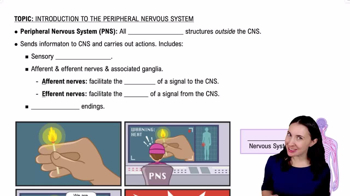
Introduction to the Peripheral Nervous System Example 1
8391
views
197
rank
3:33
Peripheral Nervous System
12102
views
308
rank
1
comments
Terms in this set (26)
Hide definitions
Difference between endocrine and nervous system responses
Endocrine system
responses are slower, longer lasting, and widespread;
nervous system
responses are faster, shorter, and targeted to specific organs.
Main subdivisions of the nervous system
CNS
: brain and spinal cord;
PNS
: nerves and ganglia outside CNS.
Functional divisions of the PNS
Sensory (afferent)
: carries signals to CNS;
Motor (efferent)
: carries signals from CNS to muscles and glands.
Subdivisions of the motor division
Somatic motor
: voluntary control of skeletal muscles;
Autonomic nervous system (ANS)
: involuntary control of cardiac, smooth muscles, and glands.
Sympathetic vs Parasympathetic divisions
Sympathetic
: fight or flight, increases heart rate and respiration, decreases digestion;
Parasympathetic
: rest and digest, decreases heart rate and respiration, increases digestion.
Three physiological properties of neurons
Excitability
: respond to stimuli;
Conductivity
: transmit electrical signals;
Secretion
: release neurotransmitters.
Structural classification of neurons
Multipolar
: many dendrites, one axon;
Bipolar
: one dendrite, one axon;
Unipolar
: single process with soma off to side.
Functions of dendrites and axon
Dendrites
: receive signals toward soma;
Axon
: sends nerve impulses away from soma.
Role of axon hillock and initial segment
Form the
trigger zone
where action potentials originate if threshold is reached.
Types of axonal transport
Anterograde
: away from soma (kinesin);
Retrograde
: toward soma (dynein).
Neuroglial cells in CNS and their functions
Astrocytes
: blood-brain barrier;
Oligodendrocytes
: myelin sheath;
Ependymal cells
: produce CSF;
Microglia
: immune defense.
Neuroglial cells in PNS
Schwann cells
: myelinate axons;
Satellite cells
: support neuron soma.
Myelin sheath characteristics
Insulating layer around axons; speeds conduction; formed by oligodendrocytes in CNS and Schwann cells in PNS.
Nodes of Ranvier
Gaps in myelin sheath where voltage-gated ion channels are concentrated; enable saltatory conduction.
Factors affecting conduction speed
Presence of myelin and axon diameter; myelinated and thicker axons conduct faster.
Resting membrane potential (RMP)
Typically
-70mV
; inside of neuron is negative relative to outside due to ion distribution.
Local (graded) potentials
Short-range, variable strength changes in membrane potential; reversible and decremental.
Action potentials
All-or-none, nondecremental electrical impulses that propagate along axons when threshold is reached.
Phases of action potential
Depolarization (Na+ influx), repolarization (K+ efflux), hyperpolarization (overshoot), then return to RMP.
Absolute vs relative refractory periods
Absolute: no new AP possible; Relative: stronger stimulus can trigger AP.
Saltatory conduction
APs jump between nodes of Ranvier in myelinated axons, increasing conduction speed.
Types of synapses
Axodendritic
,
Axosomatic
, and
Axoaxonic
based on connection points.
Acetylcholine (ACh) synaptic transmission steps
AP triggers Ca2+ influx, ACh released by exocytosis, binds postsynaptic receptors, opens Na+ channels causing depolarization.
Inhibitory GABAergic synapse
Uses GABA neurotransmitter; opens Cl- channels causing hyperpolarization and inhibition.
Neural integration and summation
EPSPs and IPSPs combine; if EPSP > IPSP and threshold reached, neuron fires.
Temporal vs spatial summation
Temporal: repeated signals from one synapse; Spatial: simultaneous signals from multiple synapses.
 BackBack
 1:06
1:06