 Back
BackAnatomy & Physiology Practical 1 Key Terms
 03:00
03:00
Terms in this set (58)
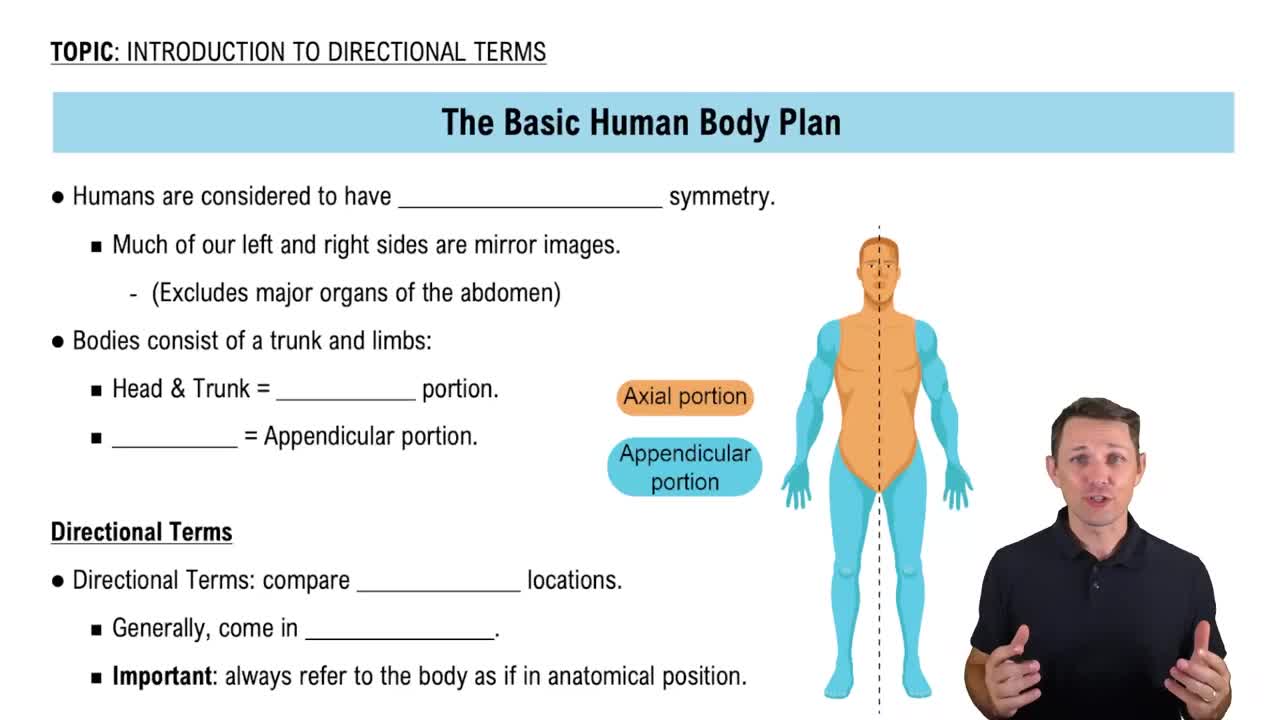
Superior means toward the head or upper part of a structure.
Inferior means away from the head or toward the lower part of a structure.
Anterior means toward the front of the body.
Posterior means toward the back of the body.
Medial means toward the midline of the body.
Lateral means away from the midline of the body.
Proximal means closer to the origin of a body part or point of attachment.
Distal means farther from the origin of a body part or point of attachment.
Superficial means toward or on the surface of the body.
Deep means away from the surface, more internal.
The median plane divides the body into equal right and left halves.
The frontal plane divides the body into anterior and posterior parts.
The transverse plane divides the body into superior and inferior parts.
The orbital region refers to the eye sockets.
The nasal region refers to the nose area.
The oral region refers to the mouth area.
The brachial region refers to the arm.
The antecubital region is the front of the elbow.
The carpal region refers to the wrist.
The digital region refers to the fingers or toes.
The cervical region refers to the neck.
The sternal region is the breastbone area.
The axillary region is the armpit area.
The thoracic region refers to the chest.
The abdominal region is the area between the chest and pelvis.
The pelvic region is the lower part of the torso.
The inguinal region is the groin area.
The femoral region refers to the thigh.
The patellar region is the front of the knee.
The cranial cavity houses the brain.
The vertebral cavity contains the spinal cord.
The thoracic cavity contains the heart and lungs.
The abdominopelvic cavity contains abdominal and pelvic organs.
The right upper quadrant contains the liver and gallbladder.
The left upper quadrant contains the stomach and spleen.
Interphase is the cell cycle phase where the cell grows and DNA replicates.
Prophase is when chromosomes condense and the nuclear envelope breaks down.
Metaphase is when chromosomes align at the cell's equator.
Anaphase is when sister chromatids separate and move to opposite poles.
Telophase is when nuclear envelopes reform; cytokinesis divides the cytoplasm.
Chromosomes are tightly coiled DNA structures visible during cell division.
Chromatin is the uncoiled DNA and proteins in the nucleus during interphase.
The nucleus contains the cell's genetic material and controls activities.
Adipose tissue stores fat and insulates the body; composed of adipocytes.
Areolar tissue is loose connective tissue with fibroblasts, collagen, and elastin fibers.
Elastic cartilage contains chondrocytes in lacunae and an elastin fiber matrix for flexibility.
Hyaline cartilage has chondrocytes in lacunae and a collagen fiber matrix for support.
An osteon is the structural unit of compact bone.
Erythrocytes are red blood cells that carry oxygen.
Neural tissue consists of neurons and neuroglial cells for communication.
Simple squamous epithelium is a single layer of flat cells for diffusion.
Simple cuboidal epithelium is a single layer of cube-shaped cells for secretion and absorption.
Skeletal muscle is voluntary, striated muscle with multiple nuclei per fiber.
Cardiac muscle is involuntary, striated muscle found in the heart with one nucleus per fiber.
Smooth muscle is involuntary, non-striated muscle found in walls of organs.
The hypodermis is the subcutaneous layer containing adipose tissue for insulation.
The dermis is dense irregular connective tissue containing hair follicles, glands, and blood vessels.
The epidermis is stratified squamous epithelium with layers including stratum basale and stratum corneum.