 Back
BackAnatomy & Physiology: Reproductive System Review
 2:08
2:08
Terms in this set (31)
The scrotum protects and regulates the temperature of the testes, keeping them slightly cooler than body temperature for optimal sperm production.
The dartos and cremaster muscles contract or relax to move the testes closer or farther from the body to regulate temperature.
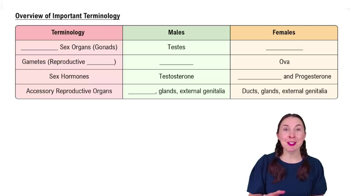
The testes produce sperm and secrete testosterone, the primary male sex hormone.
Spermatogenesis occurs in the seminiferous tubules, where sperm cells develop from germ cells.
Interstitial (Leydig) cells produce testosterone, which supports sperm production and male secondary sex characteristics.
The epididymis stores and matures sperm, allowing them to gain motility before ejaculation.
The penis delivers sperm into the female reproductive tract and contains erectile tissues that enable erection.
The penis contains corpora cavernosa and corpus spongiosum, which fill with blood to cause an erection.
Transports sperm from the testes to the urethra via the ductus epididymis, ductus deferens, and ejaculatory duct.
These accessory glands produce seminal fluid that nourishes sperm and facilitates their transport.
Semen contains sperm and seminal fluid, providing nutrients and a medium for sperm to swim.
An erection is caused by parasympathetic stimulation that dilates penile arteries, filling erectile tissues with blood.
Ejaculation is caused by sympathetic nervous system stimulation, propelling semen through the urethra.
Spermatogenesis involves mitosis of spermatogonia, meiosis to form haploid spermatids, and spermiogenesis to mature sperm.
During meiosis in the seminiferous tubules, sperm cells reduce chromosome number from diploid to haploid.
Sustentocytes support and nourish developing sperm and form the blood-testis barrier.
The hypothalamus releases GnRH, stimulating the pituitary to release LH and FSH, which act on the testes to regulate testosterone and sperm production.
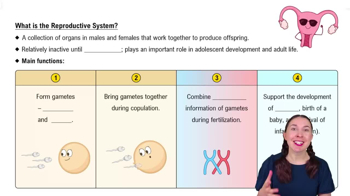
The ovaries produce oocytes (eggs) and secrete female sex hormones estrogen and progesterone.
Uterine tubes transport oocytes from ovaries to uterus; regions include infundibulum, ampulla, and isthmus.
An ectopic pregnancy occurs when a fertilized egg implants outside the uterus, often in the uterine tube.
The uterus supports fetal development; it has regions (fundus, body, cervix) and layers (endometrium, myometrium, perimetrium).
The vagina serves as the birth canal, receives sperm, and provides an exit for menstrual flow.
Mammary glands produce milk to nourish infants and are influenced by hormonal changes.
Oogenesis begins with oogonia that enter meiosis I and arrest as primary oocytes before birth.
Oogenesis produces one haploid ovum and polar bodies with long pauses, while spermatogenesis produces four sperm continuously.
Follicles develop from primordial to primary, secondary, and mature (Graafian) follicles during the ovarian cycle.
During the follicular phase, FSH stimulates follicle growth and estrogen levels rise.
The luteal phase features the corpus luteum producing progesterone to prepare the uterus for possible pregnancy.
The uterine cycle includes menstrual, proliferative, and secretory phases, regulated by estrogen and progesterone.
Capacitation is the process that sperm undergo in the female tract to gain the ability to fertilize an egg.
Females have XX chromosomes, males XY; the Y chromosome determines male sex by triggering testes development.