Bone tissue is composed of inorganic hydroxyapatite salts and organic components including cells (osteoblasts, osteocytes, osteoclasts) and osteoid (matrix and collagen fibers).
Name the two types of bone tissue.
Compact bone is dense and organized in concentric lamellae, while spongy bone has many spaces and contains trabeculae filled with marrow.
List the four anatomical classifications of bones.
Bones are classified as long (longer than wide), short (cubic), flat (thin and curved), and irregular (varied shapes).
What are the two types of ossification?
Intramembranous ossification forms bone from connective tissue membranes, and endochondral ossification forms bone from a hyaline cartilage model.
Where is hematopoietic tissue found and what is its function?
Hematopoietic tissue is found in the medullary cavity and spongy bone, producing new blood cells from stem cells in red bone marrow.
How many bones are in the human skeleton and how are they divided?
The human skeleton has 206 bones, divided into the axial skeleton (80 bones) and the appendicular skeleton (126 bones).
What bones make up the axial skeleton?
The axial skeleton includes the skull (29 bones), vertebral column (26 bones), and thoracic cage (25 bones).
Name the major sutures of the skull.
The four major sutures are coronal, sagittal, squamous, and lambdoid. The metopic suture is present only in infants.
What are fontanelles and their function in the fetal skull?
Fontanelles are soft spots between cranial bones that allow the skull to expand during brain growth in infants.
Describe the structure of a long bone.
A long bone has an outer periosteum with fibrous and osteogenic layers, a diaphysis (shaft), and two epiphyses (ends) with articular cartilage.
What bones are included in the appendicular skeleton?
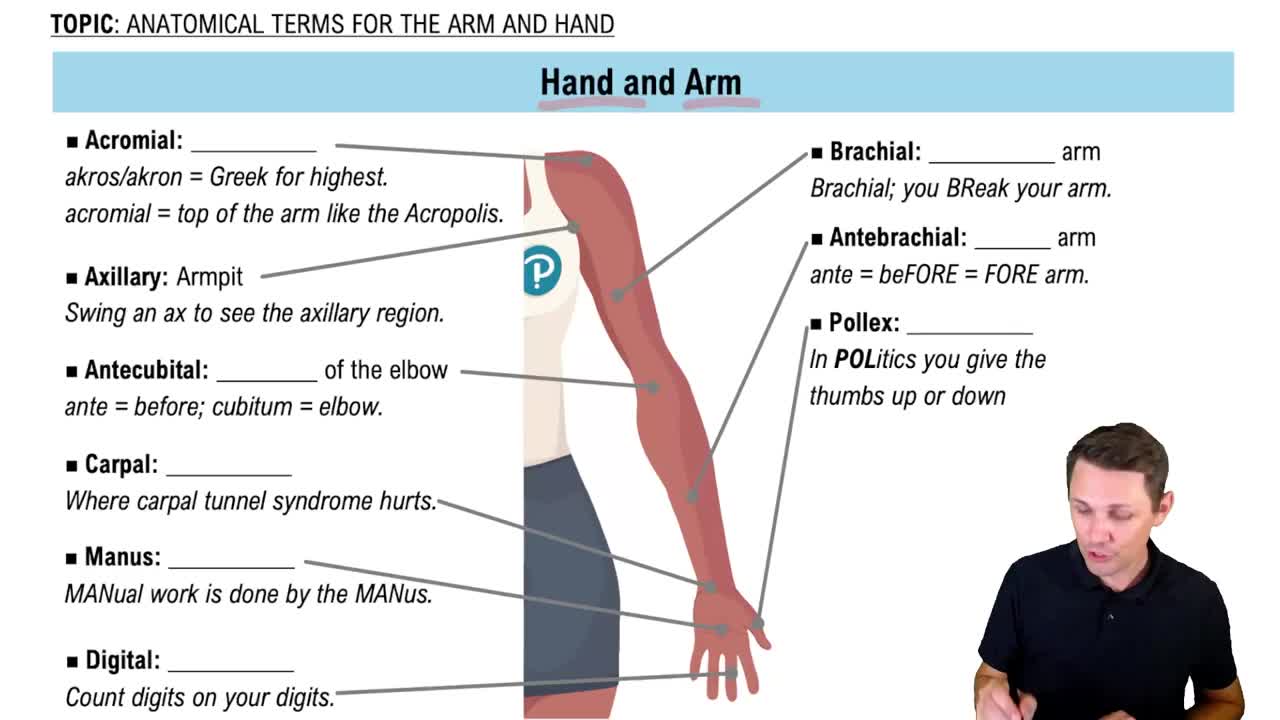
The appendicular skeleton includes the pectoral girdle, upper limbs, pelvic girdle, and lower limbs.
What is the functional classification of joints based on mobility?
Joints are classified as diarthrosis (mobile), amphiarthrosis (semi-mobile), and synarthrosis (immobile).
What are the three structural classifications of joints?
Joints are structurally classified as fibrous, cartilaginous, or synovial based on the connective tissue between bones.
Name the types of synovial joints found in the elbow and knee.
The elbow has hinge joints (ulnohumeral and radiohumeral), and the knee has a plane joint (femoropatellar) and a hinge joint (tibiofemoral).
List five movements permitted by synovial joints.
Movements include flexion, extension, abduction, adduction, and rotation.
What is the difference between red and yellow bone marrow?
Red bone marrow contains many hematopoietic cells for blood cell formation, while yellow marrow stores adipocytes (fat).
What is the periosteum and its layers?
The periosteum is a double membrane covering bone with an outer fibrous layer of dense irregular connective tissue and an inner osteogenic layer containing osteoblasts and osteoclasts.
What are sesamoid bones and give an example?
Sesamoid bones are small, round bones embedded in tendons; the patella is a common example.
Name the bones of the pelvic girdle.
The pelvic girdle consists of two coxal bones, each formed by the fusion of the ilium, ischium, and pubis.
What is the function of trabeculae in spongy bone?
Trabeculae provide structural support and house bone marrow within the spaces of spongy bone.
 Back
 02:05