Skip to main content
Anatomy & Physiology
My Course
Learn
Exam Prep
AI Tutor
Study Guides
Textbook Solutions
Flashcards
Explore
Try the app
My Course
Learn
Exam Prep
AI Tutor
Study Guides
Textbook Solutions
Flashcards
Explore
Try the app
Back
Anatomy & Physiology: Skeletal System and Axial Skeleton
You can tap to flip the card.
What is an osteon?
You can tap to flip the card.
👆
What is an osteon?
An
osteon
, or Haversian system, is the microscopic structural unit of compact bone composed of concentric rings of calcified matrix called lamellae.
Track progress
Control buttons has been changed to "navigation" mode.
1/21
Recommended videos
Guided course
3:56
What is Bone?
29698
views
936
rank
3
comments
Guided course
3:00
An Introduction to Bone and Skeletal Tissue Example 2
16626
views
357
rank
1
comments
Guided course
4:14
Types of Bones
19747
views
503
rank
1
comments
Terms in this set (21)
Hide definitions
What is an osteon?
An
osteon
, or Haversian system, is the microscopic structural unit of compact bone composed of concentric rings of calcified matrix called lamellae.
What is the function of the central (Haversian) canal?
The
central canal
contains blood vessels, nerves, and lymphatic vessels that supply nutrients and remove waste from osteocytes.
What are canaliculi and their role in bone?
Canaliculi
are tiny channels that connect lacunae and the central canal, allowing nutrient and waste exchange between osteocytes.
Differentiate between compact and spongy bone.
Compact bone
is dense and forms the outer walls of bones, while
spongy bone
is porous and found mainly in the epiphysis, containing red marrow.
What are the two main parts of a long bone?
A long bone consists of the
diaphysis
(shaft) and the
epiphysis
(ends), with the diaphysis containing the medullary cavity filled with yellow marrow.
What is the chemical composition of bone?
Bone matrix is made of
organic collagen fibers
for flexibility and
inorganic hydroxyapatite crystals
for hardness and strength.
How does acid affect bone composition?
Acid dissolves the inorganic mineral salts in bone, making it flexible but weak due to loss of hardness.
How does heat affect bone composition?
Heat destroys the organic collagen fibers, making bone brittle and prone to breaking.
What are the primary functions of the skeleton?
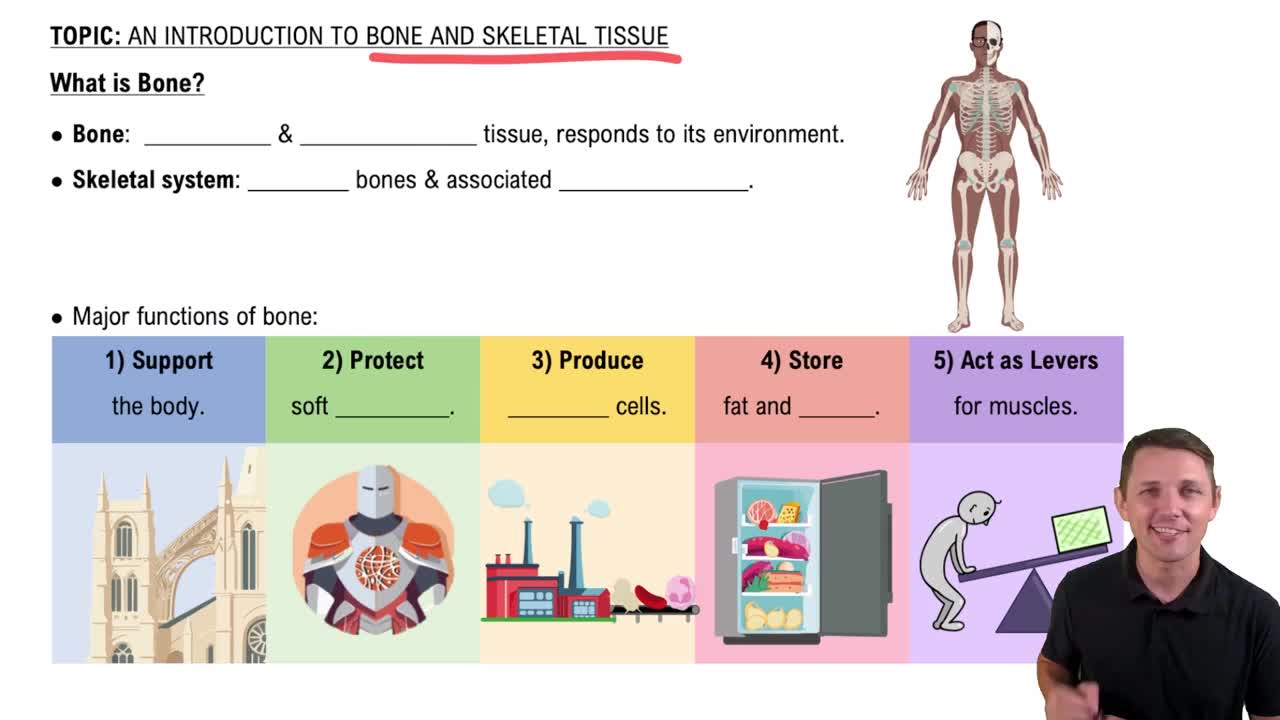
The skeleton protects organs, supports body weight, and provides attachment points for muscles to enable movement.
What bones make up the axial skeleton?
The
axial skeleton
includes the skull, vertebral column, ribs, and sternum, forming the body's central axis.
What are the two subdivisions of the skull?
The skull is divided into the
cranial bones
(protect the brain) and the
facial bones
(form the face).
Name three important markings on the temporal bone.
The temporal bone has the
external auditory meatus
,
zygomatic process
, and
mastoid process
.
What is the foramen magnum?
The
foramen magnum
is the large opening at the base of the skull allowing the spinal cord to connect with the brain.
What are the four major sutures of the skull?
The major sutures are the
coronal
,
sagittal
,
squamous
, and
lambdoid
sutures.
How many vertebrae are in the cervical region and what is unique about C1 and C2?
There are 7 cervical vertebrae; C1 (atlas) supports the skull and lacks a body, C2 (axis) has the dens for head rotation.
Describe the characteristics of thoracic vertebrae.
Thoracic vertebrae have heart-shaped bodies, long downward-pointing spinous processes, and circular vertebral foramina.
What distinguishes lumbar vertebrae from others?
Lumbar vertebrae have large, kidney-shaped bodies, short blunt spinous processes, and triangular vertebral foramina.
What forms the sacrum and coccyx?
The sacrum is formed by fusion of 5 sacral vertebrae; the coccyx is formed by fusion of 4 small coccygeal vertebrae.
What are the three parts of the sternum?
The sternum consists of the
manubrium
,
body
, and
xiphoid process
.
Differentiate between true, false, and floating ribs.
True ribs (1-7) attach directly to the sternum; false ribs (8-12) attach indirectly or not at all; floating ribs (11-12) do not attach anteriorly.
What are fontanelles and their function in the fetal skull?
Fontanelles
are soft spots of connective tissue between skull bones in infants that allow skull flexibility during birth and brain growth.
 BackBack
 3:56