 Back
Anatomy & Physiology: Skeletal System and Bone Biology
 3:56

Terms in this set (20)
Bone remodeling is the continuous process where old bone tissue is replaced by new bone tissue to maintain bone strength and mineral homeostasis.
Compact bone is dense and forms the outer layer; spongy bone is porous and found inside bones.
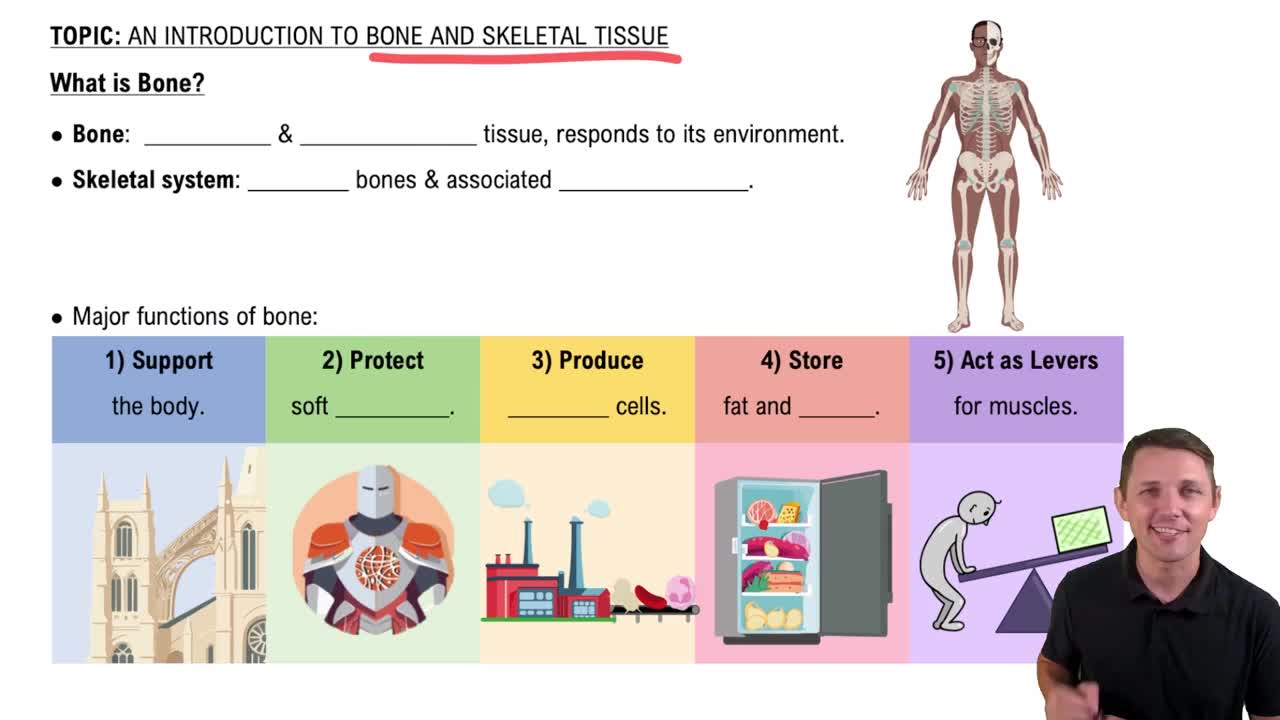
Support, protection of organs, movement facilitation, mineral storage, blood cell production, and energy storage.
Bone develops directly from mesenchymal tissue, mainly forming flat bones like the skull.
Bone forms by replacing hyaline cartilage, primarily in long bones.
Osteoblasts synthesize new bone matrix and initiate mineralization.
Osteoclasts resorb bone by breaking down mineralized matrix.
Osteocytes are mature bone cells that maintain bone matrix and communicate mechanical stress.
Calcium phosphate in the form of hydroxyapatite crystals.
A dense connective tissue layer covering the outer surface of bones, containing nerves and blood vessels.
A thin membrane lining the inner surface of bone cavities and the medullary cavity.
The central cavity within long bones that contains bone marrow.
Red marrow produces blood cells; yellow marrow stores fat.
Parathyroid hormone (PTH) increases blood calcium by stimulating bone resorption.
Calcitonin lowers blood calcium by inhibiting osteoclast activity and promoting bone formation.
The osteon or Haversian system, consisting of concentric lamellae around a central canal.
Concentric rings of mineralized matrix in compact bone surrounding the central canal.
Small channels that connect osteocytes, allowing nutrient and waste exchange.
A cartilage plate in growing bones where lengthwise growth occurs.
Bone strengthens by increasing osteoblast activity and remodeling in response to stress.