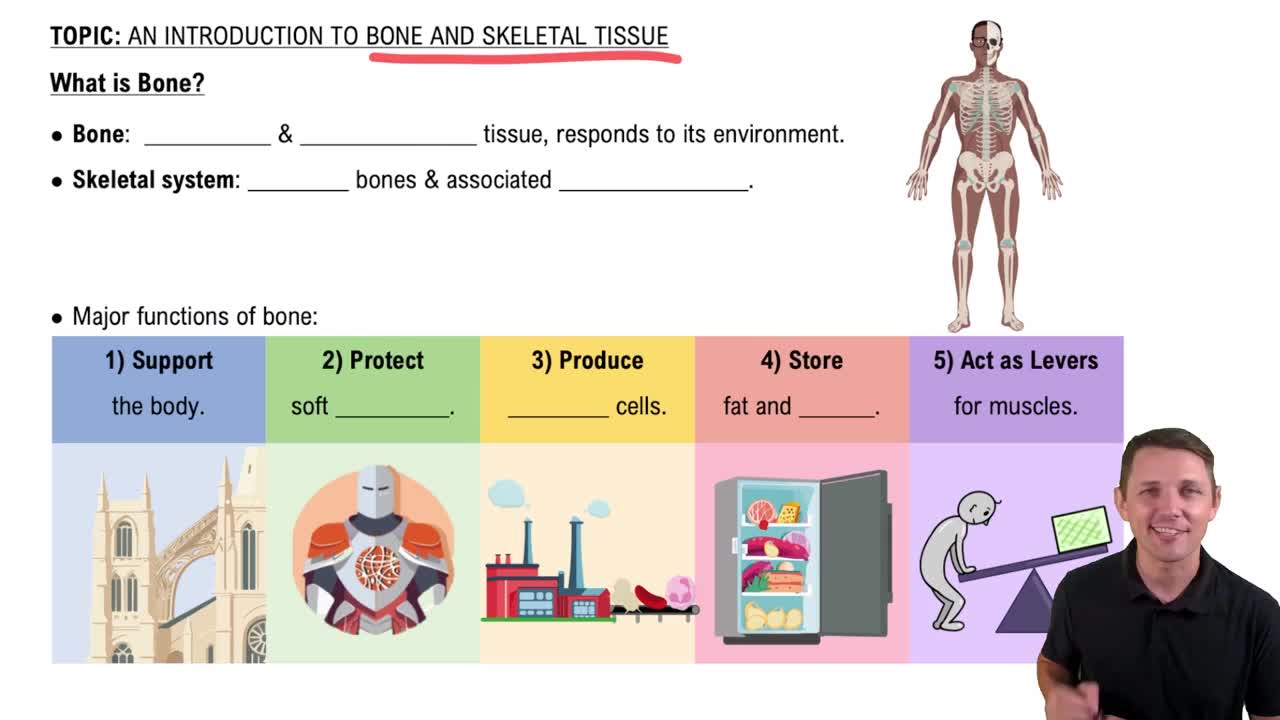
Support, Protection, Anchorage, Mineral storage, Blood cell formation (hematopoiesis), Triglyceride (fat) storage, and Hormone production.
What is the function of bone in mineral storage?
Bones act as a reservoir for minerals, especially calcium (Ca2+) and phosphorus, which are constantly exchanged with the blood.
Where does blood cell formation occur in bones?
Blood cells are formed in the red bone marrow of certain bones through a process called hematopoiesis.
What is stored in yellow bone marrow?
Triglycerides, a type of fat molecule, are stored in yellow marrow as a source of energy.
What hormone do bones produce and what is its function?
Bones produce osteocalcin, a hormone that helps regulate processes across many organ systems, including insulin secretion and testosterone production.
How are bones classified by location?
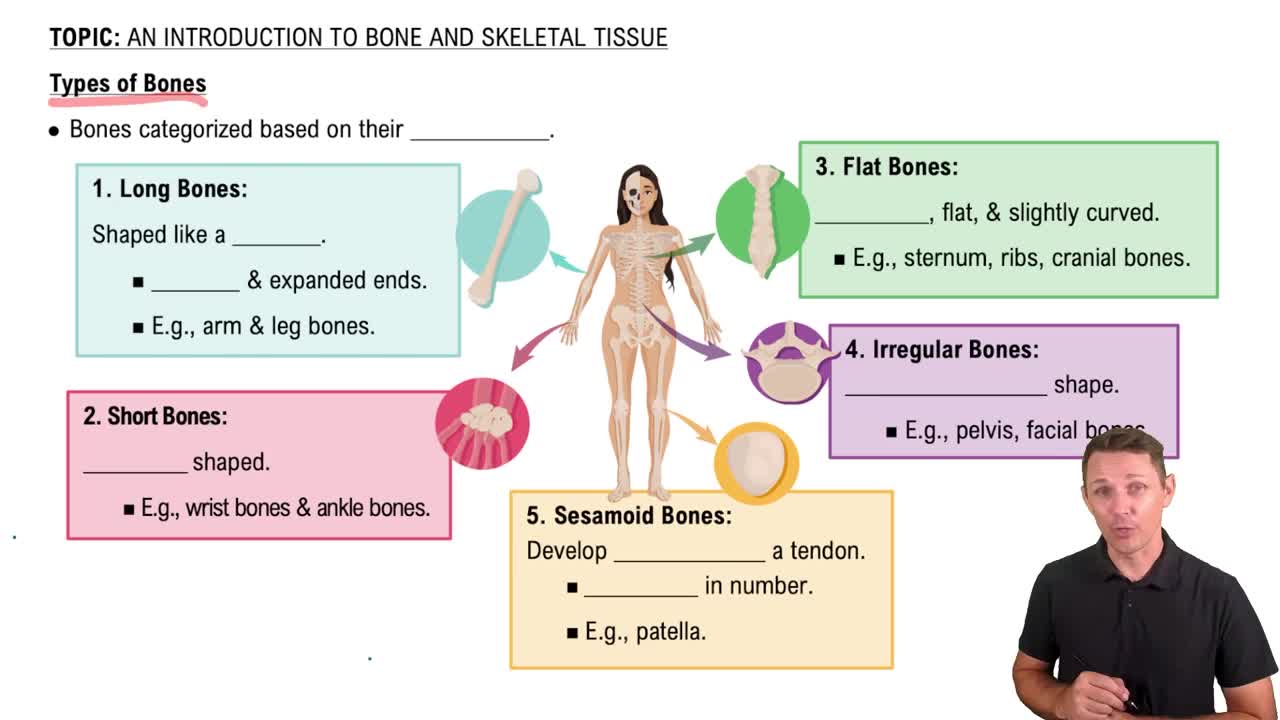
Bones are classified into the axial skeleton (skull, vertebral column, rib cage) and the appendicular skeleton (limbs and girdles attaching limbs to axial skeleton).
What are the four bone shapes used for classification?
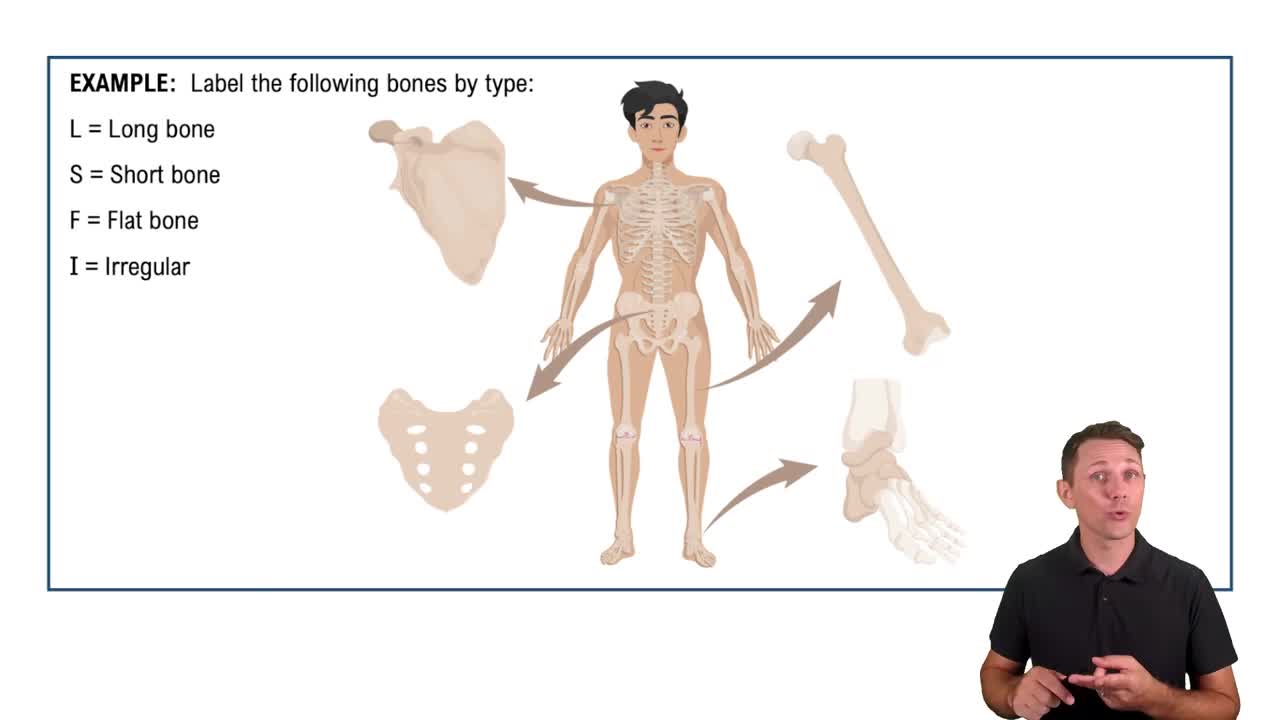
Long (longer than wide), Short (cube-shaped), Flat (thin and curved), and Irregular (complicated shapes).
What are the three types of skeletal cartilage?
Hyaline cartilage, Elastic cartilage, and Fibrocartilage.
What are the characteristics of cartilage tissue?
Cartilage is tough and flexible, withstands tension and compression, is avascular, and consists of 80% water with dense collagen fibers.
What is the role of the perichondrium in cartilage?
The perichondrium is a layer of dense irregular connective tissue surrounding cartilage that helps resist expansion and delivers nutrients.
Where is hyaline cartilage found in the skeleton?
Hyaline cartilage is found in articular cartilage (joint ends), costal cartilages (ribs to sternum), respiratory cartilage (larynx), and the nasal cartilage.
What distinguishes elastic cartilage from hyaline cartilage?
Elastic cartilage contains both collagen and elastic fibers, making it very flexible; found in the external ear and epiglottis.
Where is fibrocartilage found and what is its function?
Fibrocartilage is found in intervertebral discs, menisci of the knee, and pubic symphysis; it endures tension and pressure well.
What are the two mechanisms of cartilage growth?
Appositional growth (growth from outside in) and Interstitial growth (growth from inside out).
Describe appositional cartilage growth.
Cells in the perichondrium mature into chondroblasts, secrete matrix on the outside, become embedded, and mature into chondrocytes, adding new layers externally.
Describe interstitial cartilage growth.
Chondrocytes within lacunae divide and secrete matrix, expanding cartilage from within like inflating a balloon; occurs mainly in young cartilage.
What limits cartilage thickness?
Cartilage thickness is limited by the distance nutrients can diffuse from blood vessels in the perichondrium.
What is the difference between cartilage and bone in terms of vascularization?
Cartilage is avascular with no blood vessels or nerves except in the perichondrium, while bone is vascularized with blood vessels and nerves throughout.
What cells produce the extracellular matrix in cartilage and bone?
In cartilage, chondroblasts produce the matrix; in bone, osteoblasts produce the matrix.
How does growth differ between cartilage and bone?
Cartilage grows by both appositional and interstitial growth, while bone grows only by appositional growth.
 Back
 3:56