Skip to main content
Anatomy & Physiology
My Course
Learn
Exam Prep
AI Tutor
Study Guides
Textbook Solutions
Flashcards
Explore
Try the app
My Course
Learn
Exam Prep
AI Tutor
Study Guides
Textbook Solutions
Flashcards
Explore
Try the app
Back
Anatomy & Physiology: Skeletal System Basics
You can tap to flip the card.
What is the primary function of the skeletal system?
You can tap to flip the card.
👆
What is the primary function of the skeletal system?
The skeletal system provides
support
,
protection
for organs,
movement
via muscle attachment,
mineral storage
, and
blood cell production
.
Track progress
Control buttons has been changed to "navigation" mode.
1/20
Recommended videos
Guided course
3:56
What is Bone?
29698
views
936
rank
3
comments
Guided course
3:00
An Introduction to Bone and Skeletal Tissue Example 2
16626
views
357
rank
1
comments
Guided course
4:14
Types of Bones
19747
views
503
rank
1
comments
Terms in this set (20)
Hide definitions
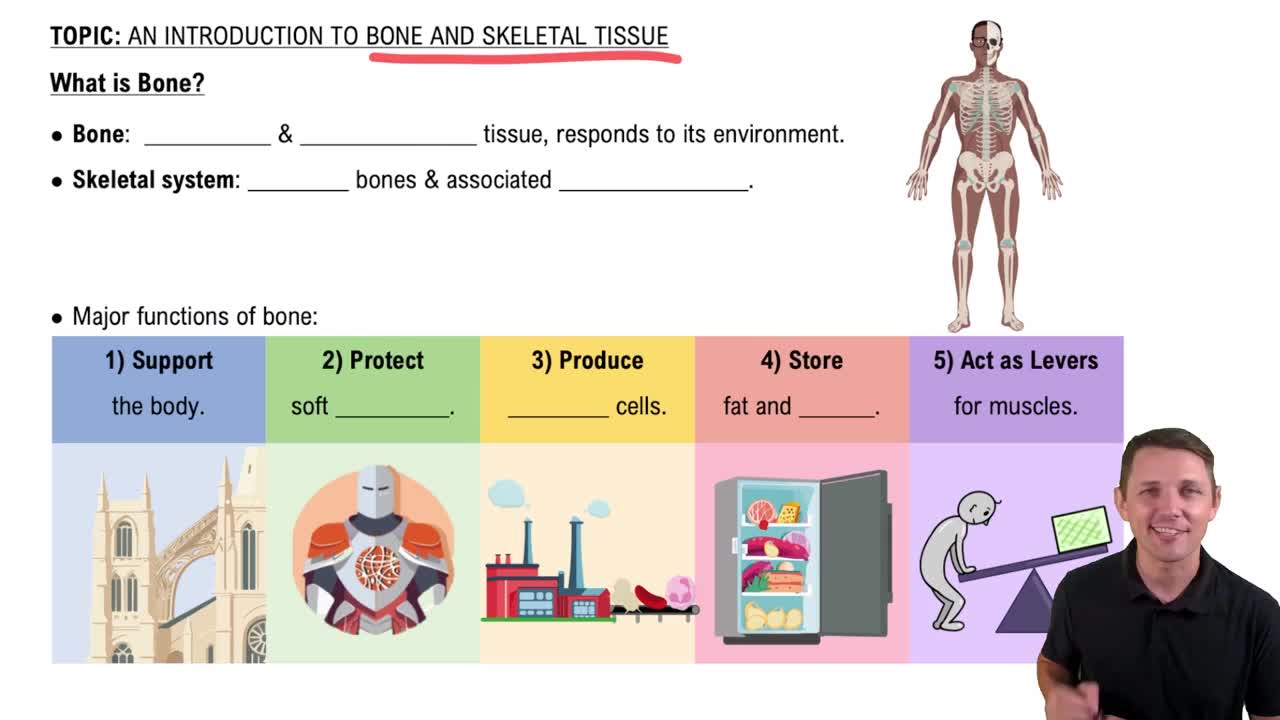
What is the primary function of the skeletal system?
The skeletal system provides
support
,
protection
for organs,
movement
via muscle attachment,
mineral storage
, and
blood cell production
.
What are the two main types of bone tissue?
Compact bone
is dense and forms the outer layer;
spongy bone
is porous and found inside bones.
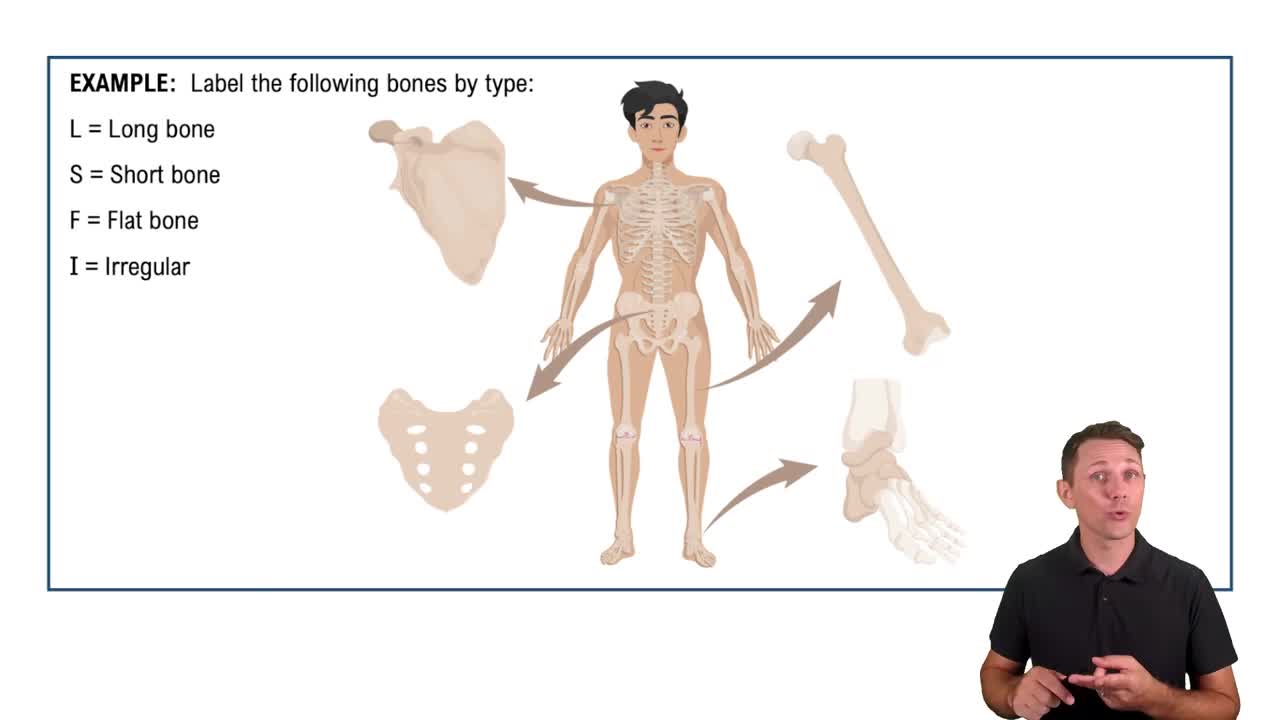
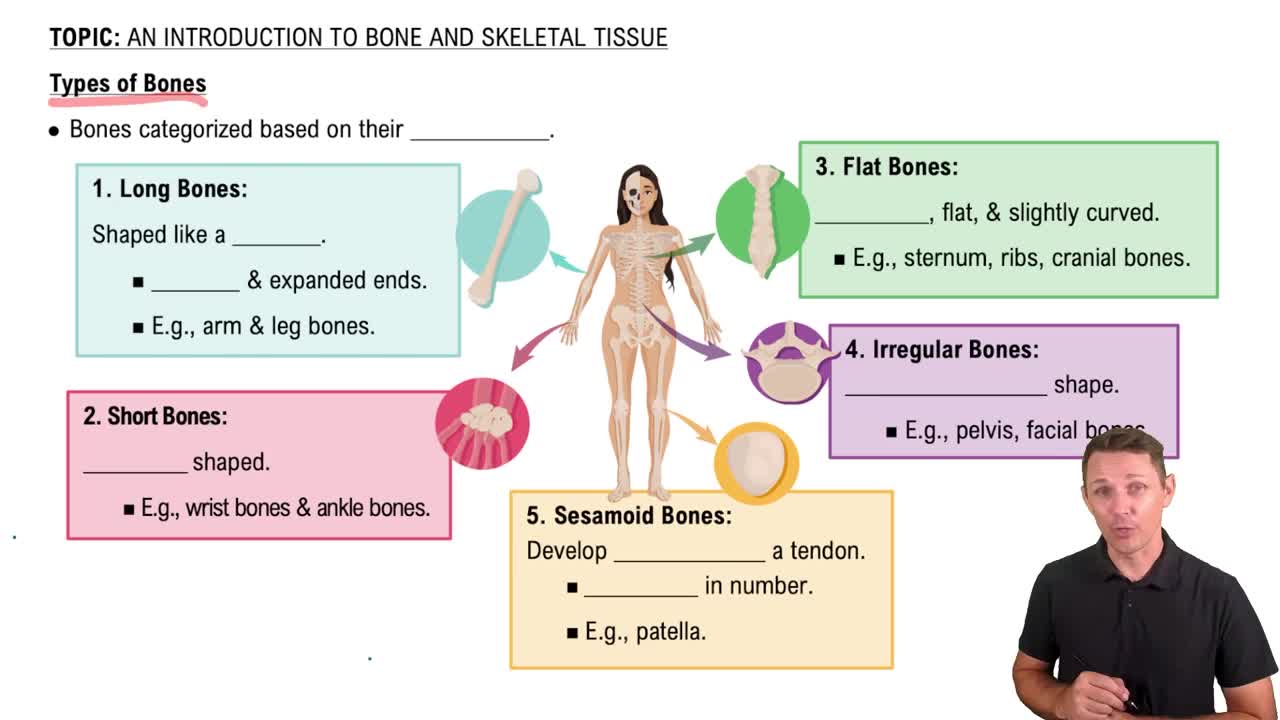
Name the four types of bones based on shape.
Long bones
,
short bones
,
flat bones
, and
irregular bones
.
What is the role of osteocytes in bone tissue?
Osteocytes
are mature bone cells that maintain bone matrix and communicate with other bone cells.
Define the term 'periosteum'.
The
periosteum
is a dense connective tissue layer covering the outer surface of bones, containing nerves and blood vessels.
What is the function of red bone marrow?
Red bone marrow
produces
red blood cells
,
white blood cells
, and
platelets
.
Where is yellow bone marrow found and what is its function?
Yellow bone marrow
is found in the medullary cavity and stores
fat
.
What is the epiphyseal plate?
The
epiphyseal plate
is a growth plate of cartilage where
long bones lengthen
during development.
Describe the process of bone remodeling.
Bone remodeling involves
osteoclasts
breaking down old bone and
osteoblasts
forming new bone.
What mineral is primarily stored in bones?
Bones primarily store
calcium
and
phosphorus
.
Name the main components of the axial skeleton.
The axial skeleton includes the
skull
,
vertebral column
, and
rib cage
.
What bones make up the appendicular skeleton?
The appendicular skeleton consists of the
limbs
,
pectoral girdle
, and
pelvic girdle
.
What is the function of joints in the skeletal system?
Joints connect bones and allow for
movement
and
flexibility
.
Differentiate between fibrous, cartilaginous, and synovial joints.
Fibrous joints
are immovable,
cartilaginous joints
allow limited movement, and
synovial joints
are freely movable.
What is the role of ligaments in the skeletal system?
Ligaments
connect bone to bone and provide joint stability.
Define osteogenesis.
Osteogenesis
is the process of bone formation.
What is the medullary cavity?
The
medullary cavity
is the central hollow space inside long bones containing marrow.
What type of cartilage covers the ends of long bones?
Articular cartilage
covers the ends of long bones to reduce friction in joints.
Name the cells responsible for bone formation.
Osteoblasts
are cells that synthesize new bone matrix.
What is the function of osteoclasts?
Osteoclasts
break down bone tissue during remodeling and calcium release.
 BackBack
 3:56