Skip to main content
Anatomy & Physiology
My Course
Learn
Exam Prep
AI Tutor
Study Guides
Textbook Solutions
Flashcards
Explore
Try the app
My Course
Learn
Exam Prep
AI Tutor
Study Guides
Textbook Solutions
Flashcards
Explore
Try the app
Back
Anatomy & Physiology: Skeletal System Review
You can tap to flip the card.
Function of the skeletal system important in a car accident
You can tap to flip the card.
👆
Function of the skeletal system important in a car accident
Storage of minerals
is especially important for bone strength and repair after trauma.
Track progress
Control buttons has been changed to "navigation" mode.
1/38
Recommended videos
3:56
What is Bone?
26834
views
859
rank
2
comments
3:00
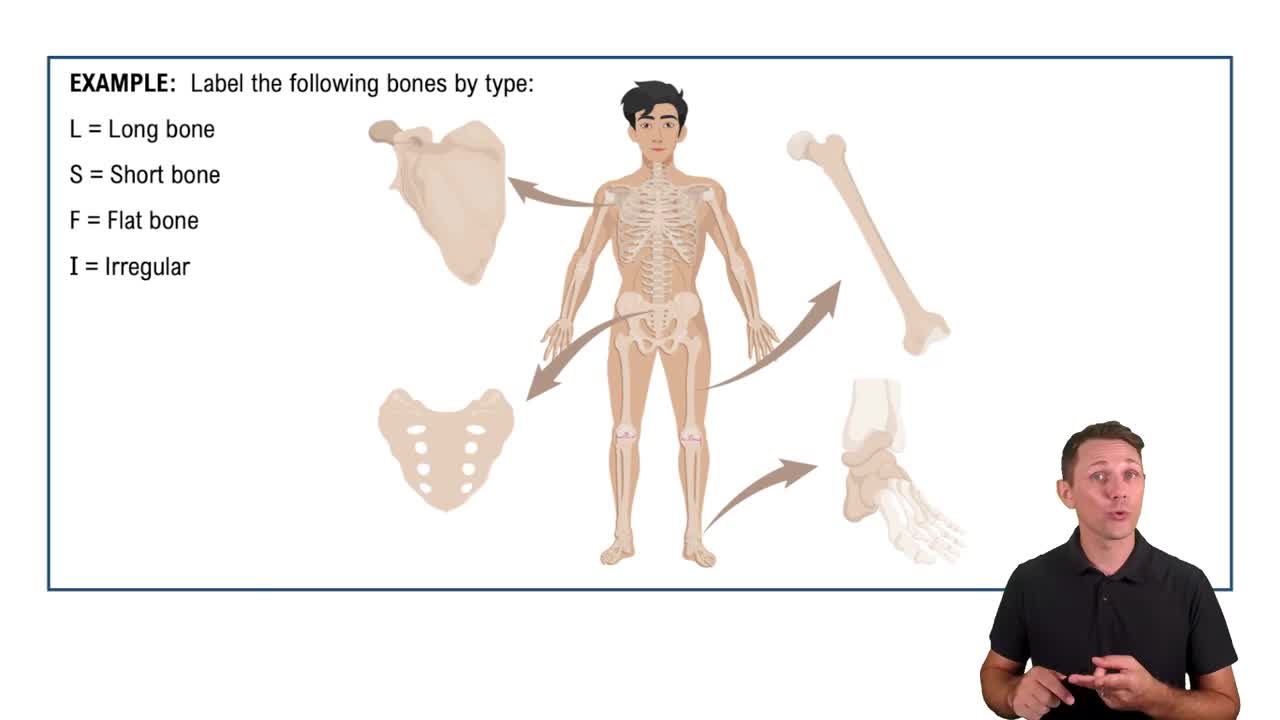
An Introduction to Bone and Skeletal Tissue Example 2
14924
views
323
rank
1
comments
4:14
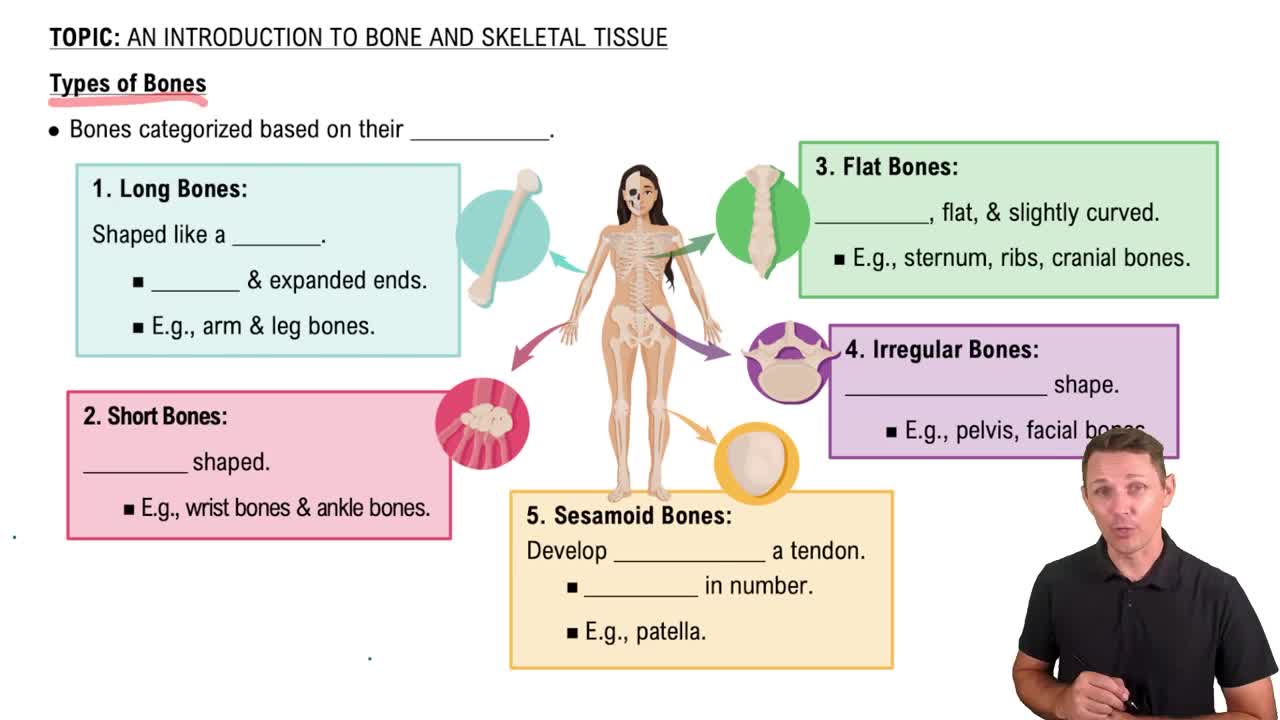
Types of Bones
17746
views
460
rank
1
comments
Terms in this set (38)
Hide definitions
Function of the skeletal system important in a car accident
Storage of minerals
is especially important for bone strength and repair after trauma.
Description of bone tissue
Bone tissue is
dead calcified tissue
that provides structure and support.
Role of red marrow in bones
Red marrow is essential for
hematopoiesis
, the production of blood cells.
What is yellow marrow?
Yellow marrow is primarily
fat storage
within the bone.
Where is red marrow found?
Red marrow is found in areas of
movement
such as spongy bone in epiphyses.
Composition of the skeletal system
The skeletal system is made of
minerals and fat
, mainly calcium phosphate and marrow.
Classification of wrist bones
Wrist bones are classified as
short bones
, not long or flat bones.
Location of sesamoid bones
Sesamoid bones are embedded in
tendons
near joints.
Bones surrounding the spinal cord
These bones are classified as
irregular bones
.
Most numerous bone category in the skeleton
Long bones
are the most numerous bones in the body.
Function of long bones in movement
Long bones act as
fulcrums
to enable body movement.
Function of spongy bone in the epiphysis
Spongy bone in the epiphysis provides
shock absorption
and supports bone growth.
Contents of the diaphysis
The diaphysis contains
fat stores
in the medullary cavity.
Fibrous membrane covering the outer bone surface
The
periosteum
covers the outer surface of bones.
Bone cells capable of mitosis
Osteoblasts
are the bone cells that can undergo mitosis.
Cells not originating from osteogenic cells
Osteoclasts
do not originate from osteogenic cells.
Structures found in both compact and cancellous bone
Lacunae
are found in both compact and cancellous bone.
Structures only found in cancellous bone
Volkmann’s canals
are only found in cancellous bone.
Bone marking formed by nutrient foramen
The nutrient foramen forms a
canal
in the bone.
Reason cartilage heals slowly
Cartilage is slow to heal because it is
semi-solid and flexible
with limited blood supply.
Why osteocytes are spread out in bone tissue
Osteocytes are spread out because they are surrounded by
osteoid
matrix.
Fate of chondrocytes in endochondral ossification
Chondrocytes group to form the
primary ossification center
during ossification.
Bones formed by intramembranous ossification
Flat bones like the
skull bones
are formed by intramembranous ossification.
Bone growth in length occurs at
Bones grow in length due to activity in the
epiphyseal plate
.
Bone growth in diameter occurs by
Bone diameter increases by formation in the
periosteum
.
Correct sequence of zones in the epiphyseal plate
The sequence is
reserve, proliferation, maturation, calcification
.
Types of fractures that can occur simultaneously
A fracture can be both
open and closed
depending on skin involvement.
How fractured diaphysis releases fat globules
Fat globules enter the bloodstream when the fracture pierces
fat stores
in the bone marrow.
Definition of a compound fracture
A compound fracture is when the broken bone
pierces the skin
.
What replaces internal and external calli during fracture repair
Calli are replaced by
woven bone
during healing.
First type of bone formed in fracture repair
The first bone formed is
woven bone
, which is later remodeled.
Wolff’s law in bone remodeling
Wolff’s law states bones adapt to mechanical stress, so a cyclist’s dominant leg has
thicker bones
.
Vitamin necessary for calcium absorption
Vitamin
D
is necessary for calcium absorption in the small intestine.
Best food for bone health
Liver
is rich in nutrients beneficial for bone health.
Hormones responsible for adolescent growth spurt
Growth hormone and parathyroid hormone
regulate adolescent bone growth.
Hormones with opposing effects on bone
Calcitonin and calcitriol
have opposing effects on bone metabolism.
Body system primarily affected by abnormal calcium levels
The
skeletal system
is primarily affected by calcium imbalances.
Hormone released when blood calcium is elevated
Calcitonin
is released to lower high blood calcium levels.
 BackBack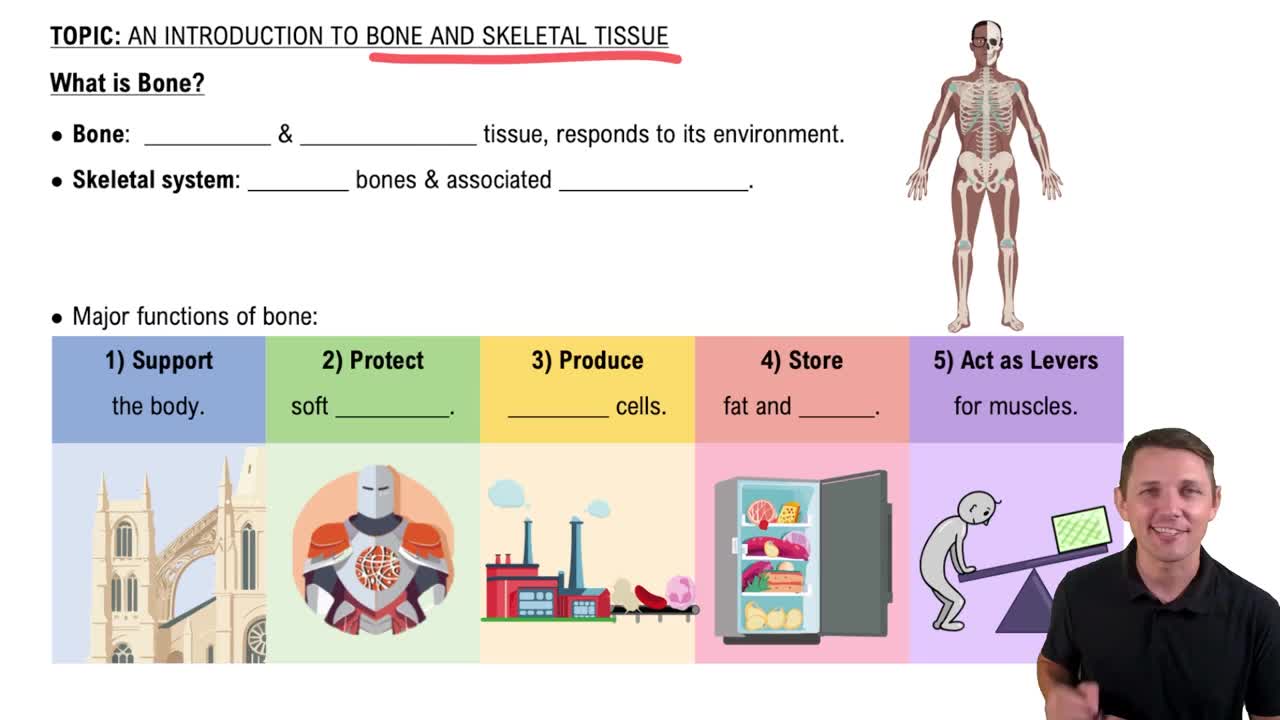
 3:56
3:56