Axial skeleton consists of 80 bones including the skull, vertebral column, and thoracic cage. Appendicular skeleton consists of 126 bones including limbs and girdles.
Four Major Bone Shapes
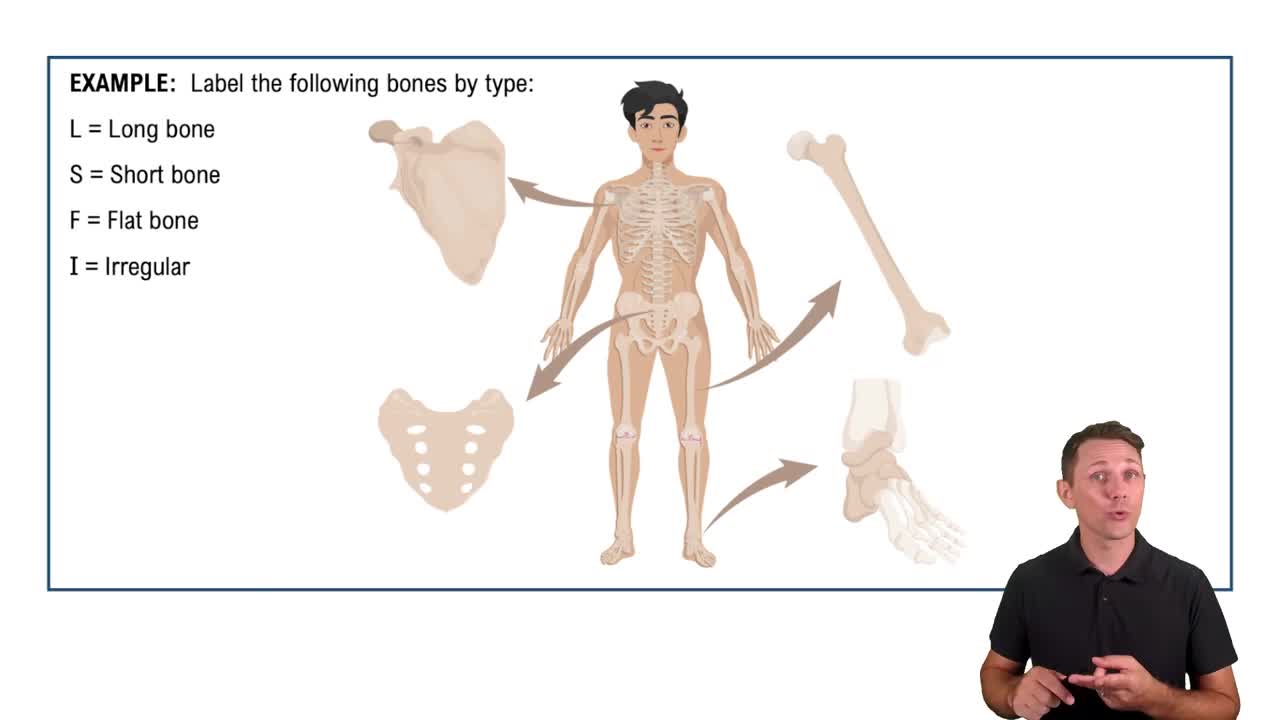
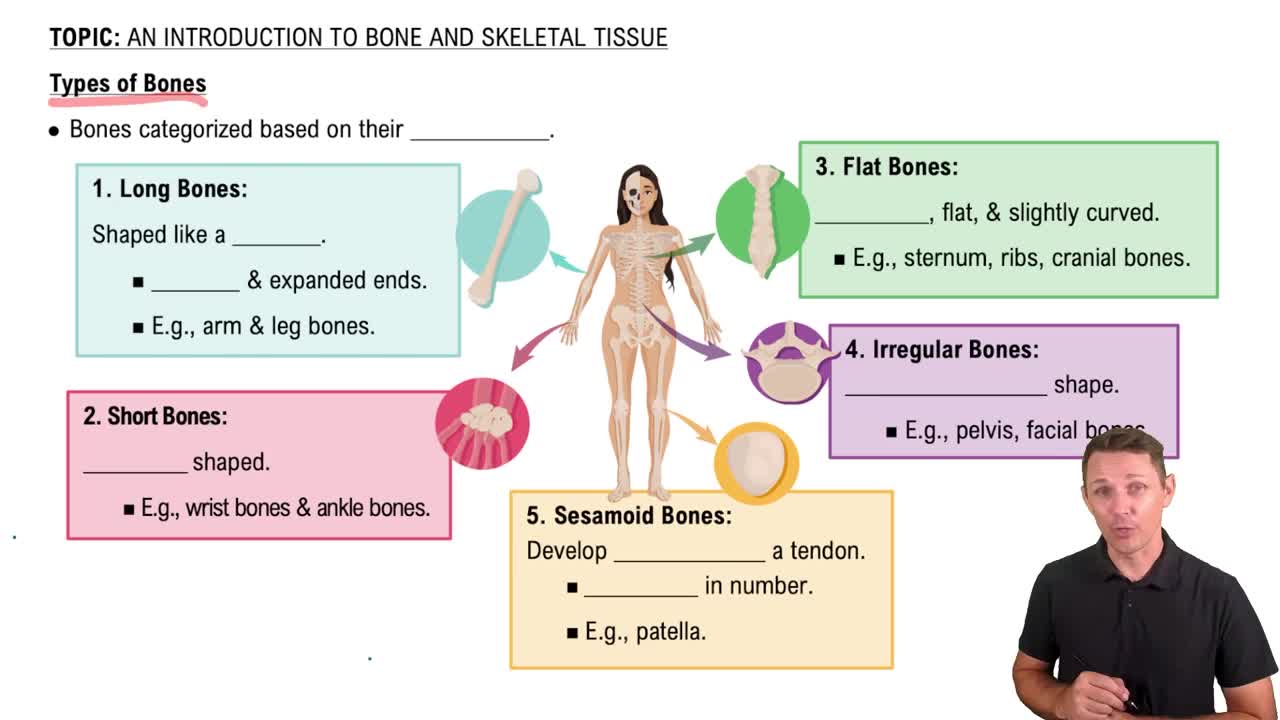
Long bones are longer than wide (e.g., humerus). Short bones are cube-shaped (e.g., talus). Flat bones are thin with two layers of compact bone (e.g., sternum). Irregular bones have complex shapes (e.g., vertebrae).
Cranial Bones of the Adult Skull
Includes frontal, parietal (2), temporal (2), occipital, sphenoid, and ethmoid bones.
Facial Bones of the Adult Skull
Includes maxillae (2), zygomatic (2), nasal (2), lacrimal (2), vomer, inferior nasal conchae (2), palatine (2), and mandible.
Foramen vs Fossa vs Sulcus
Foramen is a hole. Fossa is a shallow depression. Sulcus is a shallow groove.
Common Bone Processes
Condyle is a large rounded projection. Facet is a small smooth surface. Head is a rounded projection atop a neck.
Ethmoid Bone Key Structures
Includes crista galli, cribriform plate, perpendicular plate, and middle nasal concha.
Sphenoid Bone Key Structures
Includes greater wing, lesser wing, optic canal, and hypophyseal fossa (sella turcica).
Important Skull Foramina and Their Functions
Supraorbital foramen allows passage of supraorbital artery and nerve. Infraorbital foramen allows passage of cranial nerve V. Jugular foramen allows passage of internal jugular vein and cranial nerves IX, X, XI.
Mandible Features
Includes body, ramus, angle, coronoid process, condylar process, mental foramen, and mandibular foramen.
Temporomandibular Joint (TMJ)
Articulation between the condylar process of the mandible and the mandibular fossa of the temporal bone.
Major Sutures of the Skull
Includes coronal suture, sagittal suture, squamous suture, and lambdoid suture.
Fontanelles of the Infant Skull
Includes anterior fontanelle, sphenoidal (anterolateral) fontanelle, mastoid (posterolateral) fontanelle, and posterior fontanelle.
External Occipital Protuberance
A prominent midline projection on the occipital bone used as a muscle attachment site.
Zygomatic Arch Composition
Formed by the zygomatic process of the temporal bone and the temporal process of the zygomatic bone.
Optic Canal Function
Allows passage of cranial nerve II (optic nerve) from the orbit to the brain.
Foramen Magnum Importance
Large opening in the occipital bone allowing passage of the spinal cord.
Mandibular Foramen Function
Allows passage of nerves that provide sensation to the teeth.
Mental Foramen Function
Allows passage of blood vessels and nerves to the skin of the chin.
Alveolar Processes
Ridges on the maxilla and mandible that contain the tooth sockets.
 Back
 3:56