 Back
Anatomy & Physiology: Skeletal System - Skull, Vertebral Column, and Thoracic Cage
 3:56

Terms in this set (20)
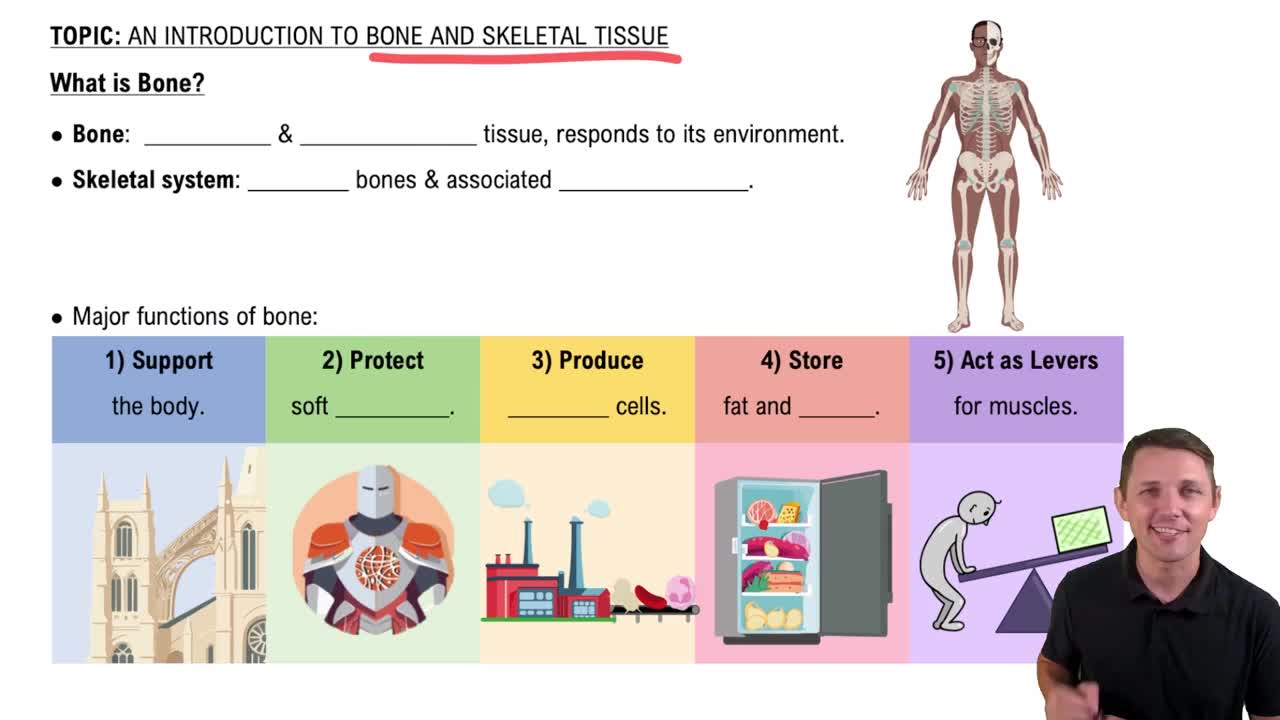
Axial skeleton forms the central axis including skull, vertebral column, ribs, sternum, and sacrum. Appendicular skeleton includes limbs and girdles (pectoral and pelvic).
Typically 206 bones in an adult skeleton, starting from about 270 at birth which decreases due to bone fusion.
Supports skull and trunk, allows movement, protects spinal cord, absorbs stress from movement, and provides attachment for limbs and muscles.
Cranial bones (8) surround and protect the brain. Facial bones (14) support teeth, form nasal cavity and orbit, and provide muscle attachments.
Skull bones are joined by sutures, dense connective tissue joints, including coronal, sagittal, lambdoid, and squamous sutures.
Anterior fossa holds frontal lobes, middle fossa holds temporal lobes, posterior fossa contains cerebellum.
Large opening in occipital bone allowing passage of the spinal cord from brain to vertebral column.
Located between orbits, includes cribiform plate, labyrinth (ethmoid air cells), and perpendicular plate forming part of nasal septum.
Air-filled cavities in frontal, maxillary, ethmoid, and sphenoid bones that lighten the skull and enhance voice resonance.
Supports skull, has no body, ring-shaped with large vertebral foramen, allows nodding 'yes' motion.
Has dens (odontoid process) projecting into atlas, allowing head rotation 'no' motion.
Discs of fibrocartilage between vertebrae with gelatinous nucleus pulposus and fibrous anulus fibrosus; absorb shock and bind vertebrae.
Cervical: small body, large vertebral foramen, transverse foramina. Thoracic: medium body, costal facets for ribs. Lumbar: large body, blunt spinous process, resistant to twisting.
Sacrum: 5 fused vertebrae forming posterior pelvis. Coccyx: 4 fused vertebrae, tailbone, attachment for pelvic muscles.
Includes thoracic vertebrae, ribs, sternum; protects organs, supports shoulder girdle, and aids respiration.
True ribs (1-7) attach directly to sternum via costal cartilage. False ribs (8-12) attach indirectly or not at all (floating ribs 11-12).
Consists of clavicle and scapula; attaches upper limbs to axial skeleton and allows wide range of shoulder movement.
Triangular bone with spine ending in acromion, coracoid process for muscle attachment, and glenoid fossa for humerus articulation.
Head articulates with scapula, greater and lesser tubercles for muscle attachment, capitulum and trochlea articulate with radius and ulna.
Female pelvis is lighter, wider pubic arch (>100°), and round pelvic inlet; male pelvis is heavier, narrower arch, and heart-shaped inlet.