 Back
BackAnatomy & Physiology: Structural Organization and Body Cavities
 05:04
05:04
Terms in this set (14)
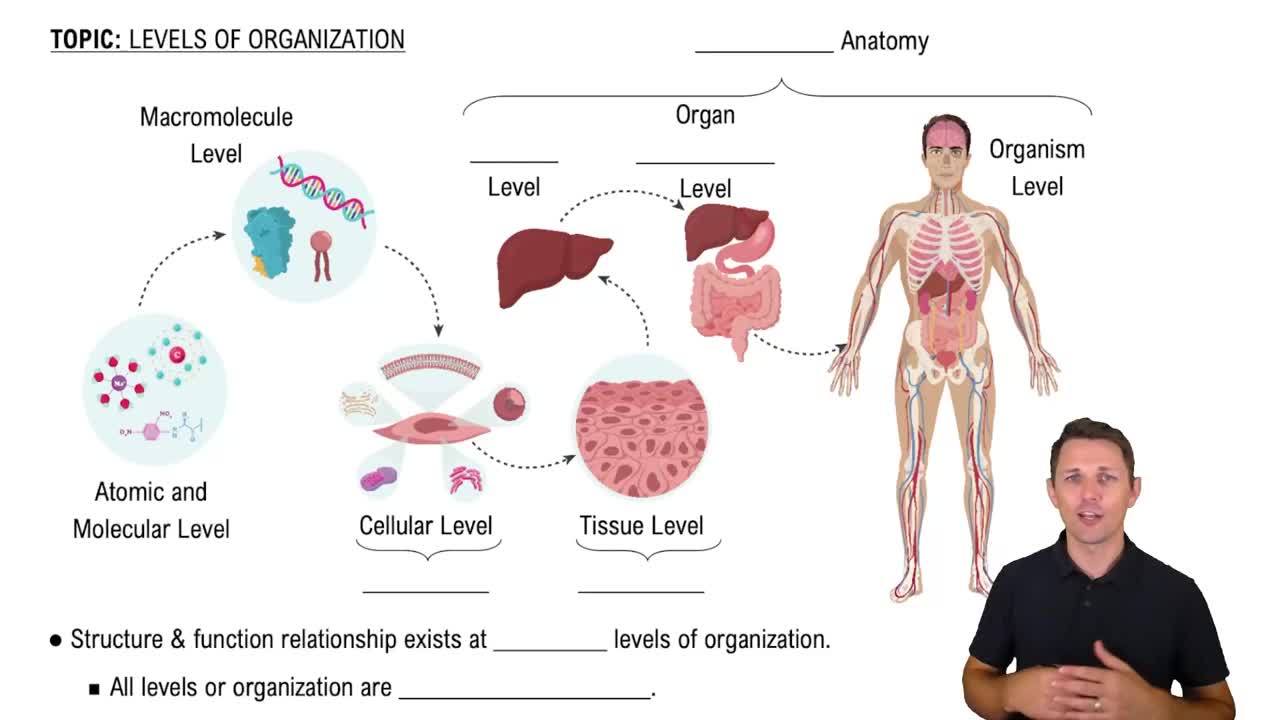
1. Chemical Level
2. Cellular Level
3. Tissue Level
4. Organ Level
5. Organ System Level
6. Organismal Level
Chemical Level: Atoms combine to form molecules, the building blocks of cells.
Cellular Level: Molecules form organelles within cells, the smallest units of life.
Tissue Level: Similar cells group to form tissues like muscle or epithelial tissue.
Organ Level: Different tissues combine to create organs, such as the heart or liver, performing specific functions.
Organ System Level: Organs work together in systems (e.g., cardiovascular system) to achieve common goals.
Organismal Level: All organ systems function collectively to sustain a living organism.
The Dorsal body cavity and the Ventral body cavity, separated physically by the diaphragm.
Cranial Cavity: Encases the brain.
Vertebral (Spinal) Cavity: Encloses the spinal cord.
Meninges: Membranes covering both brain and spinal cord.
Pleural Cavities: Each surrounds a lung.
Mediastinum: Contains the pericardial cavity (heart) and surrounds other thoracic organs like esophagus and trachea.
Abdominal Cavity: Contains stomach, intestines, spleen, liver, and digestive organs.
Pelvic Cavity: Contains urinary bladder, reproductive organs, and rectum.
Parietal serosae: Line cavity walls.
Visceral serosae: Cover organs directly.
They reduce friction during organ movement and expansion.
1. Right Upper Quadrant (RUQ)
2. Left Upper Quadrant (LUQ)
3. Right Lower Quadrant (RLQ)
4. Left Lower Quadrant (LLQ)
RUQ: Liver, gallbladder, right kidney, portions of stomach.
LUQ: Most of stomach, spleen, left kidney, pancreas, parts of colon.
RLQ: Appendix, right ureter, part of small intestine, reproductive organs.
LLQ: Parts of small intestine and colon.
1. Epigastric Region: Above umbilical; includes stomach and liver.
2. Umbilical Region: Around navel; contains parts of small intestine.
3. Hypogastric (Pubic) Region: Below umbilical; contains urinary bladder.
Right & Left Hypochondriac Regions: Lateral to epigastric; include lower ribs.
Right & Left Lumbar Regions: Lateral to umbilical; contain parts of large intestine.
Right & Left Inguinal (Iliac) Regions: Lateral to hypogastric; right side includes cecum and appendix.