The three main parts are the plasma membrane, cytoplasm, and nucleus.
What is the function of the plasma membrane?
The plasma membrane controls the movement of substances in and out of the cell and provides protection and communication.
Describe the fluid mosaic model of the plasma membrane.
The plasma membrane is a phospholipid bilayer with embedded proteins, carbohydrates, and lipids that move fluidly, creating a dynamic and selectively permeable barrier.
What is the amphipathic nature of phospholipids and why is it important?
Phospholipids have a polar (hydrophilic) head and nonpolar (hydrophobic) tails, allowing the membrane to form a bilayer that separates intracellular and extracellular fluids.
What roles do proteins play in the plasma membrane?
Proteins act as integral or peripheral components involved in transport, receptors, enzymes, and structural support.
Define simple diffusion.
Simple diffusion is the passive movement of solutes from an area of higher concentration to lower concentration without energy or assistance.
What is facilitated diffusion?
Facilitated diffusion is passive transport where solutes move down their concentration gradient through a protein channel or carrier.
Explain osmosis.
Osmosis is the passive movement of water molecules across a selectively permeable membrane from a region of low solute concentration to high solute concentration.
Compare isotonic, hypertonic, and hypotonic solutions.
Isotonic solutions have equal solute concentration inside and outside the cell; hypertonic solutions cause cells to shrink; hypotonic solutions cause cells to swell.
What is primary active transport?
Primary active transport uses energy from ATP to move solutes against their concentration gradient via pumps like the Na+/K+ pump.
Describe secondary active transport.
Secondary active transport uses the energy stored in an ion gradient created by primary active transport to move other substances against their gradient.
What is the function of vesicular transport?
Vesicular transport moves large particles or fluids into or out of the cell via vesicles, including endocytosis and exocytosis.
Name and describe the types of endocytosis.
Phagocytosis engulfs large particles; pinocytosis takes in fluids; receptor-mediated endocytosis uses receptors to selectively internalize molecules.
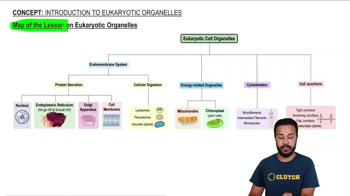
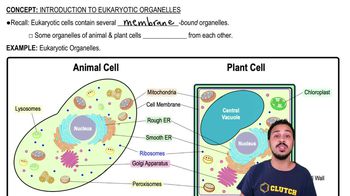
What are organelles?
Organelles are specialized structures within the cytoplasm that perform distinct cellular functions.
What is the function of mitochondria?
Mitochondria produce ATP through cellular respiration, supplying energy for the cell.
Describe the rough and smooth endoplasmic reticulum.
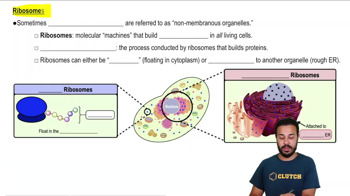
Rough ER has ribosomes and synthesizes proteins; smooth ER synthesizes lipids and detoxifies substances.
What is the Golgi apparatus responsible for?
The Golgi apparatus modifies, sorts, and packages proteins and lipids for secretion or delivery to other organelles.
What is the cytoskeleton?
The cytoskeleton is a network of protein filaments (actin filaments, intermediate filaments, microtubules) that provide structure, support, and enable cellular movement.
What are microvilli, cilia, and flagella?
Microvilli increase surface area for absorption; cilia move substances across the cell surface; flagella enable cell motility.
Describe the structure and function of the nucleus.
The nucleus contains DNA, controls cellular activities, and is surrounded by a nuclear envelope with pores for molecular exchange.
What is chromatin?
Chromatin is DNA wrapped around proteins called histones, existing in a loose form during interphase.
What are chromosomes and sister chromatids?
Chromosomes are condensed chromatin visible during cell division; sister chromatids are identical copies joined at the centromere.
What is the nucleolus?
The nucleolus is a dense region within the nucleus where ribosomal RNA is synthesized.
What is the genetic code?
The genetic code is the sequence of DNA triplets that specify amino acids for protein synthesis.
Describe transcription.
Transcription is the process of copying DNA into messenger RNA (mRNA) in the nucleus.
Describe translation.
Translation is the process where ribosomes read mRNA codons to assemble amino acids into a polypeptide chain.
What is the cell cycle?
The cell cycle is the sequence of phases a cell goes through from growth (interphase) to division (mitosis and cytokinesis).
What happens during interphase?
Interphase includes G1 (cell growth), S (DNA replication), and G2 (preparation for division).
What is mitosis?
Mitosis is the division of the nucleus resulting in two identical daughter nuclei.
What is cytokinesis?
Cytokinesis is the division of the cytoplasm, completing cell division.
 Back
 03:45