What are the two main circuits of the cardiovascular system?
Pulmonary circuit carries blood to and from the lungs for gas exchange. Systemic circuit carries blood to and from the rest of the body.
What is the function of arteries in the cardiovascular system?
Arteries are efferent vessels that carry blood away from the heart.
What is the function of veins in the cardiovascular system?
Veins are afferent vessels that carry blood to the heart.
What is the role of capillaries in the cardiovascular system?
Capillaries are the site of gas and nutrient exchange between blood and tissues.
Name the four chambers of the heart and their associated circuits.
Right atrium and right ventricle belong to the pulmonary circuit. Left atrium and left ventricle belong to the systemic circuit.
Where is the heart located in the body?
The heart is located in the anterior chest wall, posterior to the sternum, about 1/2 inch to the left of center.
What is the pericardium and its function?
The pericardium is a sac that surrounds and protects the heart, stabilizing its position and containing lubricating pericardial fluid.
Differentiate between the visceral and parietal pericardium.
The visceral pericardium (epicardium) covers the outer surface of the heart, while the parietal pericardium lines the inner surface of the pericardial sac.
What is pericarditis and its potential complication?
Pericarditis is infection of the pericardium that can lead to cardiac tamponade, an excess of pericardial fluid compressing the heart.
Describe the structure and function of the heart wall layers.
The heart wall has three layers: epicardium (outer, visceral pericardium), myocardium (muscular middle layer), and endocardium (inner lining continuous with blood vessels).
What are intercalated discs and their role in cardiac muscle?
Intercalated discs connect cardiac muscle cells, containing desmosomes for strength and gap junctions for electrical signal propagation.
What separates the atria and ventricles internally in the heart?
The interatrial septum separates the atria, and the interventricular septum separates the ventricles.
What is the function of atrioventricular (AV) valves?
AV valves permit blood flow from atria to ventricles and prevent backflow during ventricular contraction.
What is the role of chordae tendineae and papillary muscles?
Chordae tendineae connect AV valve cusps to papillary muscles, preventing valve prolapse during ventricular contraction.
What is the moderator band and its function?
The moderator band is a muscular ridge in the right ventricle that carries part of the conducting system to coordinate papillary muscle contraction.
How do the right and left ventricles differ in function and structure?
The right ventricle pumps blood to the lungs and has a moderator band; the left ventricle pumps blood to the body and is more muscular without a moderator band.
What are the semilunar valves and their function?
The pulmonary and aortic semilunar valves prevent backflow of blood from arteries into ventricles during relaxation.
What is the cardiac skeleton?
The cardiac skeleton is a dense network of collagen and elastic fibers that support heart valves and electrically isolate atria from ventricles.
Describe the coronary circulation and its importance.
Coronary circulation supplies blood to the heart muscle via coronary arteries and veins, ensuring oxygen and nutrient delivery.
What is the sinoatrial (SA) node and its role?
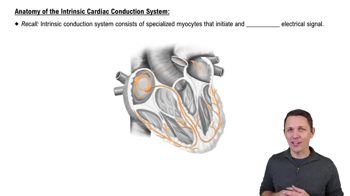
The SA node is the heart's pacemaker, generating electrical impulses that set the heart rate.
Outline the pathway of electrical conduction in the heart.
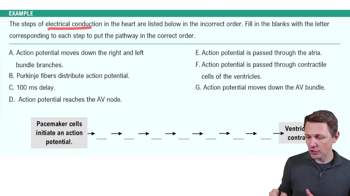
Impulse starts at SA node, spreads through atria, reaches AV node, travels down AV bundle and bundle branches, then through Purkinje fibers to ventricles.
What is the significance of the delay at the AV node?
The delay allows atria to contract and fill ventricles before ventricular contraction begins.
Describe the phases of the cardiac action potential in contractile cells.
Phase 1: rapid depolarization via Na+ influx; Phase 2: plateau due to Ca2+ influx balancing K+ efflux; Phase 3: repolarization by K+ efflux.
Why can't cardiac muscle undergo tetanus like skeletal muscle?
Cardiac muscle action potentials have a long refractory period preventing summation and tetanus.
What is cardiac output and how is it calculated?
Cardiac output is the volume of blood pumped per minute, calculated as \(CO=HR \times SV\) (heart rate times stroke volume).
How does the autonomic nervous system affect heart rate?
Sympathetic stimulation increases heart rate via norepinephrine; parasympathetic stimulation decreases heart rate via acetylcholine.
What is the atrial reflex?
An increase in venous return stretches atrial receptors, triggering a reflexive increase in heart rate.
What do the P wave, QRS complex, and T wave represent on an EKG?
P wave: atrial depolarization; QRS complex: ventricular depolarization; T wave: ventricular repolarization.
 Back
Back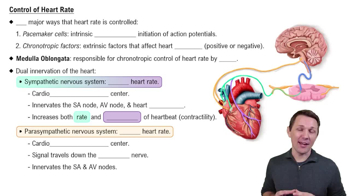
 6:13
6:13