Back

Anatomy & Physiology: The Skeletal System

Control buttons has been changed to "navigation" mode.
1/21
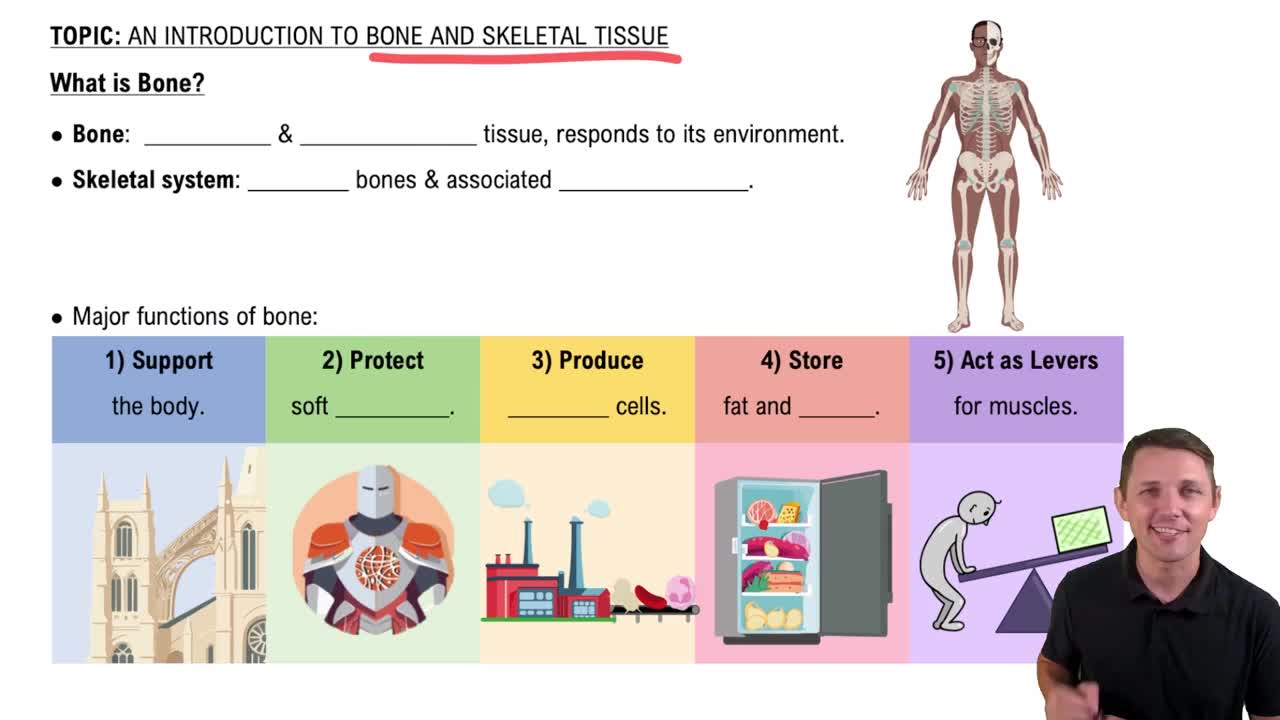
  • What components make up the skeletal system?

    The skeletal system consists of the skeleton, cartilages, ligaments, and other connective tissues that stabilize them.
  • What is the major tissue component of the skeletal system?

    Bone tissue, or osseous tissue, is the major component of the skeletal system.
  • List the primary functions of the skeletal system.

    Support, storage of minerals (especially calcium), blood cell production, protection of organs, and leverage for movement.
  • What percentage of the body's calcium is stored in bones?

    98% of the body's calcium is stored in bones.
  • What is the periosteum and its role?

    The periosteum is the outer covering of bone that isolates and protects bone, provides attachment for circulatory and nervous supply, participates in growth and repair, and connects bone to deep fascia.
  • What is the composition of the bone matrix?

    The bone matrix is 2/3 calcium phosphate (hydroxyapatite crystals) and 1/3 collagen fibers.
  • Why is bone tissue extremely strong?

    Because of the combination of hydroxyapatite crystals, which resist compression, and collagen fibers, which resist stretching.
  • Name the four main types of bone cells and their functions.

    Osteocytes: mature cells maintaining bone; Osteoblasts: immature cells producing osteoid; Osteoprogenitor cells: stem cells forming osteoblasts; Osteoclasts: multinucleated cells performing osteolysis.
  • What is osteogenesis?

    Osteogenesis is the process of making new bone.
  • What is osteolysis?

    Osteolysis is the process by which osteoclasts break down bone tissue.
  • How do compact and spongy bone differ structurally?

    Compact bone is dense and solid with osteons as functional units; spongy bone has an open network of trabeculae (struts and plates).
  • What are the three main regions of a long bone?

    The epiphyses (ends), the diaphysis (shaft), and the metaphysis (connecting region between epiphyses and diaphysis).
  • What is ossification?

    Ossification is the process of bone replacing existing tissue.
  • What is calcification in bone formation?

    Calcification is the deposition of calcium salts into tissues.
  • Which ions are important for bone growth?

    Calcium, phosphate, magnesium, citrate, carbonate, and sodium ions.
  • Which vitamins regulate bone growth?

    Vitamins A, C, and derivatives of Vitamin D.
  • How does parathyroid hormone (PTH) affect bone?

    PTH increases blood calcium by stimulating osteoclast activity to break down bone.
  • What is the role of calcitonin in bone metabolism?

    Calcitonin lowers blood calcium levels and acts as an antagonist to PTH.
  • How do growth hormone and thyroxine influence bone?

    They increase osteoblast activity, promoting bone growth.
  • What effect do sex hormones have on bone growth?

    Sex hormones dramatically increase bone growth during puberty.
  • What is the relationship between the skeletal system and other body systems?

    The skeletal system is closely linked to other systems and serves as a reservoir for calcium, phosphate, and other minerals.