 Back
Anatomy & Physiology: Transport, Diffusion, and Intercellular Junctions
 05:33

Terms in this set (20)
Diffusion is the passive movement of molecules from an area of higher concentration to an area of lower concentration.
Factors include concentration gradient, temperature, molecule size, and membrane permeability.
Passive transport moves substances across membranes without energy input, relying on concentration gradients.
Active transport requires energy (ATP) to move substances against their concentration gradient.
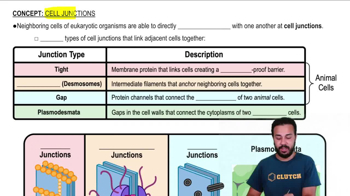
Tight junctions, desmosomes, and gap junctions.
Tight junctions seal cells together to prevent leakage of molecules between them.
Desmosomes are anchoring junctions that provide mechanical strength by linking cytoskeletons of adjacent cells.
Gap junctions allow direct communication and passage of ions and small molecules between adjacent cells.
Facilitated diffusion uses carrier proteins to move molecules down their concentration gradient, unlike simple diffusion which is direct.
Osmosis is the diffusion of water across a selectively permeable membrane from low to high solute concentration.
The concentration gradient drives diffusion; molecules move from high to low concentration to reach equilibrium.
Intercellular transport occurs between cells, while extracellular transport involves movement outside cells.
They connect cells physically and functionally, maintaining tissue structure and communication.
Carrier proteins facilitate the movement of specific molecules across membranes, often in facilitated diffusion or active transport.
Endocytosis is the process by which cells engulf substances into vesicles to bring them inside.
Exocytosis is the process of vesicles fusing with the membrane to release contents outside the cell.
It allows cells to control the internal environment by regulating substance entry and exit.
Higher temperatures increase molecular movement, speeding up diffusion.
Paracellular transport passes substances between cells; transcellular transport passes substances through cells.
They maintain barrier function and regulate passage of substances between body compartments.