Back

Anatomy & Physiology: Vertebrae and Thoracic Cage

Control buttons has been changed to "navigation" mode.
1/17
  • Which vertebrae look like the head of a giraffe from the side?

    The thoracic vertebrae resemble the head of a giraffe when viewed from the side.
  • Which vertebrae look like the head of a moose from the side?

    The cervical vertebrae resemble the head of a moose when viewed from the side.
  • What are the atlas, axis, and dens in cervical vertebrae?

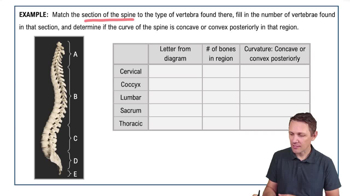
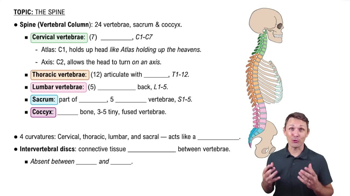
    The atlas (C1) supports the skull, the axis (C2) allows head rotation, and the dens is a peg-like projection on the axis that acts as a pivot.
  • What passes through the transverse foramina of cervical vertebrae?

    The vertebral arteries and veins pass through the transverse foramina.
  • What is the main function of thoracic vertebrae?

    Thoracic vertebrae articulate with the ribs to form the rib cage.
  • What is the primary function of lumbar vertebrae?

    Lumbar vertebrae provide attachment points for large back muscles and support body weight.
  • What is the sacrum and its function?

    The sacrum is a bone formed by the fusion of 5 vertebrae; it connects the spine to the pelvis and supports body weight.
  • Where is the coccyx located?

    The coccyx, or tailbone, is located at the base of the vertebral column below the sacrum.
  • What is spina bifida?

    Spina bifida is a birth defect where the vertebral arches fail to fully close around the spinal cord.
  • How do aging and osteoporosis contribute to vertebral fractures?

    Aging and osteoporosis weaken bones, making vertebrae more prone to fractures.
  • What are the components of the thoracic cage?

    The thoracic cage consists of the thoracic vertebrae, ribs, sternum, and costal cartilages.
  • What are the three sections of the sternum?

    the manubrium, the body, and the xiphoid process.

  • Why is correct hand position important in CPR?

    Correct hand position ensures effective chest compressions and reduces injury risk during CPR.
  • How many pairs of ribs do males and females have?

    Both males and females typically have 12 pairs of ribs.
  • What are vertebrosternal ribs?

    Vertebrosternal ribs (true ribs) attach directly to the sternum via their own costal cartilages.
  • What are vertebrochondral ribs?

    Vertebrochondral ribs (false ribs) attach to the sternum indirectly via the cartilage of the rib above.
  • What are vertebral ribs?

    Vertebral ribs (floating ribs) do not attach to the sternum at all and end in the posterior abdominal musculature.