 Back
Anatomy Unit 6
 03:39

Terms in this set (21)
Genetics is the study of heredity and how traits and genetic information are passed from one generation to the next.
A gene is a unit of hereditary information located at a specific position on a chromosome that contains instructions for producing functional products like proteins.
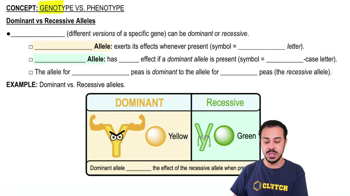
An allele is a particular version of a gene. Individuals usually have two alleles for each gene, one from each parent.
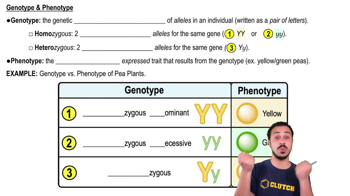
Genotype is the genetic makeup (the alleles an individual has), while phenotype is the observable trait resulting from the genotype and environment.
Homozygous means having two identical alleles for a gene, e.g., BB (homozygous dominant) or bb (homozygous recessive).
Heterozygous means having two different alleles for a gene, e.g., Bb.
A dominant allele is expressed in the phenotype if at least one copy is present. A recessive allele is expressed only when two copies are present.
Mendelian inheritance describes how alleles separate during gamete formation and combine at fertilization to determine offspring genotypes.
A Punnett square is a diagram used to predict possible genotypes and phenotypes of offspring from parental genotypes.
Genotype probabilities are 25% BB, 50% Bb, and 25% bb.
Phenotype probabilities are 75% dominant (BB or Bb) and 25% recessive (bb).
Because offspring receive different combinations of alleles from each parent, leading to genetic variation.
Continuous variation refers to traits influenced by multiple genes and environment, showing a range of phenotypes, e.g., height.
Humans have 23 pairs of chromosomes; one pair are sex chromosomes: XX typically female, XY typically male.
X-linked inheritance involves genes on the X chromosome, where males (XY) have only one copy, affecting expression of recessive traits.
Males (XY) with a recessive allele on X are affected; females (XX) can be unaffected, carriers, or affected depending on their two X alleles.
Include sex chromosomes in gametes (X or Y) and track alleles on the X chromosome separately from autosomal alleles.
An affected XY father passes his Y chromosome to sons and his X chromosome to daughters, so sons do not inherit his X-linked allele.
Autosomal genes are on non-sex chromosomes; X-linked genes are on the X chromosome and require tracking sex chromosomes in inheritance.
Confusing genotype with phenotype, homozygous with heterozygous, assuming dominant means more common, and forgetting to include sex chromosomes in X-linked traits.
Gene: hereditary instruction; Allele: version of a gene; Genotype: genetic combination; Phenotype: observable trait.