 Back
Anatomy unit 7
 05:04

Terms in this set (28)
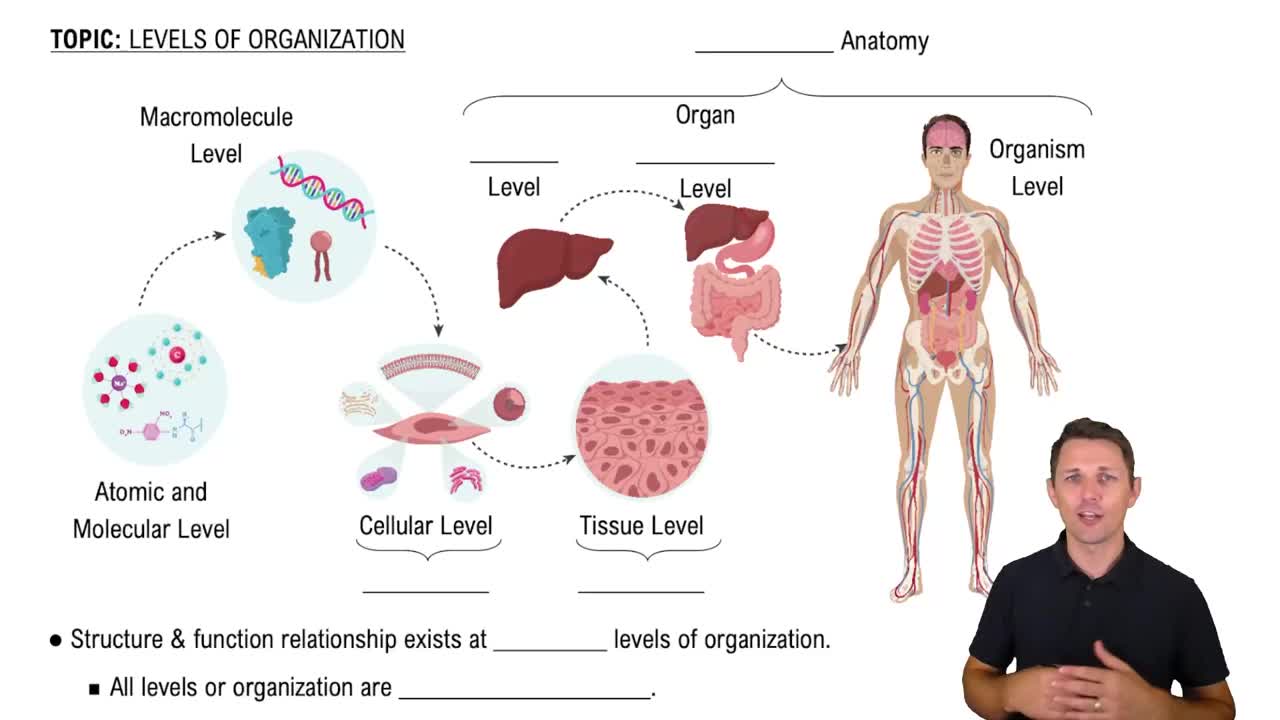
Chemical → Cellular → Tissue → Organ → Organ System → Organism, from smallest to largest.
Fluid surrounding cells that allows exchange of nutrients and waste between blood and cells.
Epithelial: covers and protects; Connective: connects and supports; Muscle: contracts for movement; Nervous: communicates via electrical signals.
Tight junctions (seal), Desmosomes (anchor), Gap junctions (communication).
Tightly packed cells, avascular, has an apical surface facing free space or lumen.
Apical faces free space/lumen; Basal faces underlying tissue and attaches to basement membrane.
Supports and anchors epithelial tissue; separates it from connective tissue; allows nutrient diffusion.
By number of cell layers (simple or stratified) and shape of apical cells (squamous, cuboidal, columnar).
One thin layer of flat cells; allows diffusion and filtration; found in alveoli and blood vessels.
One layer of cube-shaped cells; functions in absorption and secretion; found in kidney tubules.
Multiple layers with flat apical cells; provides protection against abrasion; found in skin and esophagus.
Appears multilayered but is one layer; nuclei at different heights; found in respiratory tract; often ciliated.
Specialized for stretching; cells change shape from rounded to flat; found in urinary bladder.
Exocrine glands have ducts and secrete onto surfaces; endocrine glands have no ducts and release hormones into blood.
Cells, extracellular matrix (fibers + ground substance), and abundant extracellular material.
Collagen (strength), Elastic (stretch and recoil), Reticular (supportive network).
Blast = build, Cyte = maintain, Clast = break down.
Break down bone matrix to release calcium into the blood.
Loose arrangement of fibers and cells; highly vascular; supports and cushions tissues; found under epithelial tissue.
Dense regular: collagen fibers parallel, strong in one direction; Dense irregular: fibers in many directions, strong in multiple directions.
Cartilage is avascular, so nutrients reach cells slowly by diffusion.
Hyaline: smooth, glassy; Elastic: flexible with elastic fibers; Fibrocartilage: strong, shock-absorbing with collagen fibers.
Organic components (proteins, carbohydrates) provide flexibility; inorganic components (calcium phosphate) provide hardness and strength.
Bone stores calcium; osteoclasts break down bone to release calcium for nerve, muscle, and heart function.
Consists of cells (RBCs, WBCs, platelets) and extracellular matrix (plasma).
Skeletal: voluntary, striated; Cardiac: involuntary, striated, branched; Smooth: involuntary, no striations.
Striated, involuntary, branched cells with intercalated discs; found only in the heart.
Communication via electrical signals; includes neurons (signal transmission) and glial cells (support and protection).