 Back
Antibody-Mediated Immunity and Antibody Structure & Function
 4:23

Terms in this set (23)
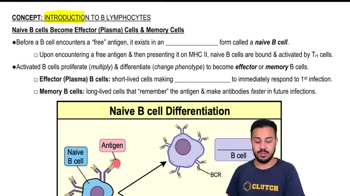
Antibody-mediated immunity is the immune response involving B cells that produce antibodies to neutralize pathogens in body fluids.
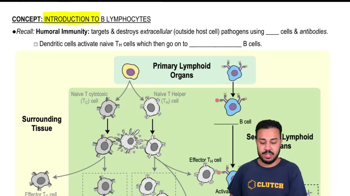
The three phases are recognition (antigen detection), activation (B cell activation), and effector (antibody production by plasma cells).
Antibodies are also called immunoglobulins (Ig).
Self-reactive B cells are destroyed to prevent autoimmune reactions where the immune system attacks the body’s own tissues.
Helper T cells (CD4+ T cells) activate B cells by providing necessary signals.
Plasma cells are activated B cells that secrete large amounts of antibodies.
Antiserum is blood serum containing antibodies used to provide passive immunity.
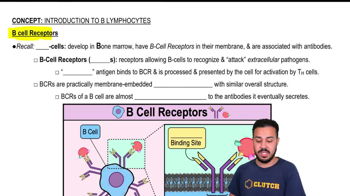
An antibody has two heavy chains and two light chains forming a Y-shaped structure with variable and constant regions.
They refer to antibody structures: monomer (single unit), dimer (two units), and pentamer (five units) linked together.
The classes are IgG, IgA, IgM, IgE, and IgD.
IgM is the pentamer antibody class.
IgG is the most abundant antibody in the serum.
IgE antibodies bind to allergens and parasites.
Allergens are harmless substances that trigger allergic reactions via IgE antibodies.
The constant region is similar within each antibody class and determines its function.
Class switching is the process where a B cell changes the antibody class it produces without altering antigen specificity.
Functions include neutralization, agglutination, precipitation, opsonization, and complement activation.
Agglutination is the clumping of pathogens by antibodies to enhance clearance.
Precipitation is the formation of insoluble antigen-antibody complexes that are easier to remove.
Opsonization is the coating of pathogens by antibodies to promote phagocytosis.
Neutralization is when antibodies block pathogen binding sites to prevent infection.
Complement activation is triggered by antibodies to destroy pathogens via a protein cascade.
No, antibodies do not directly kill pathogens but mark them for destruction by other immune cells.