Skip to main content
Anatomy & Physiology
My Course
Learn
Exam Prep
AI Tutor
Study Guides
Textbook Solutions
Flashcards
Explore
Try the app
My Course
Learn
Exam Prep
AI Tutor
Study Guides
Textbook Solutions
Flashcards
Explore
Try the app
Back
Appendicular Skeleton - Upper Extremity Anatomy
You can tap to flip the card.
Scapula
You can tap to flip the card.
👆
Scapula
A flat, triangular bone that forms the posterior part of the shoulder girdle.
Track progress
Control buttons has been changed to "navigation" mode.
1/35
Recommended videos
02:05
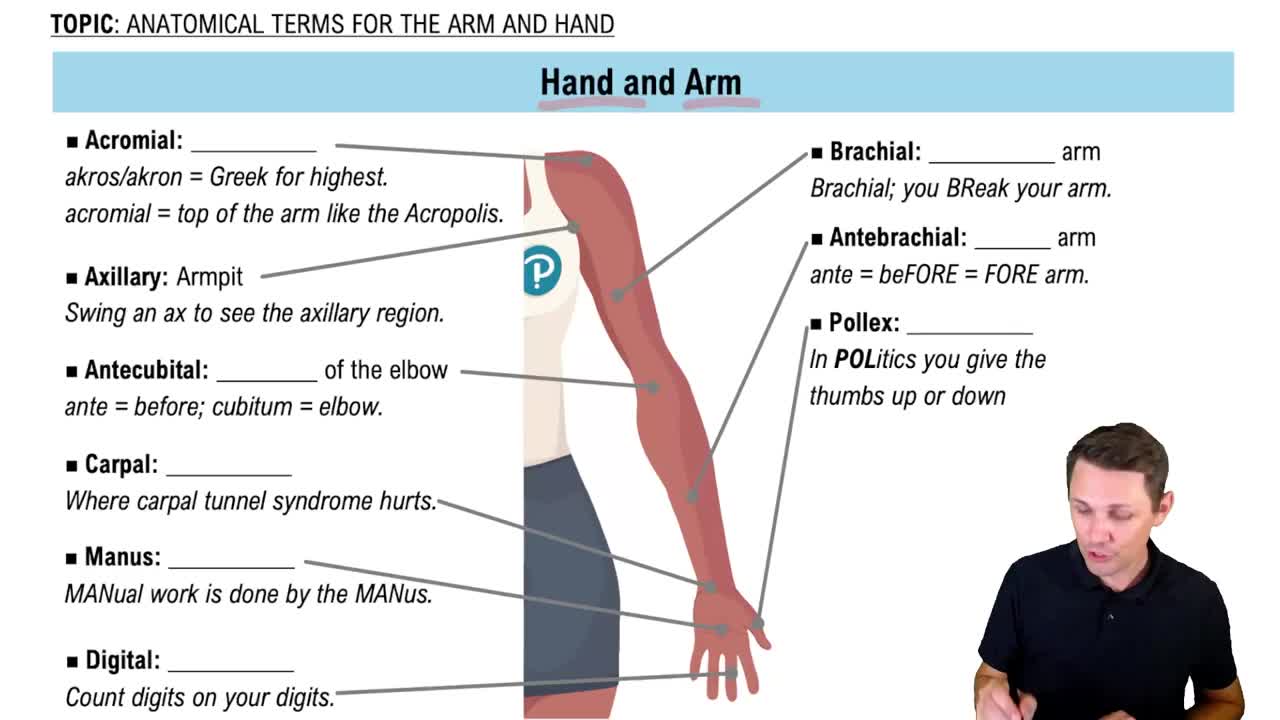
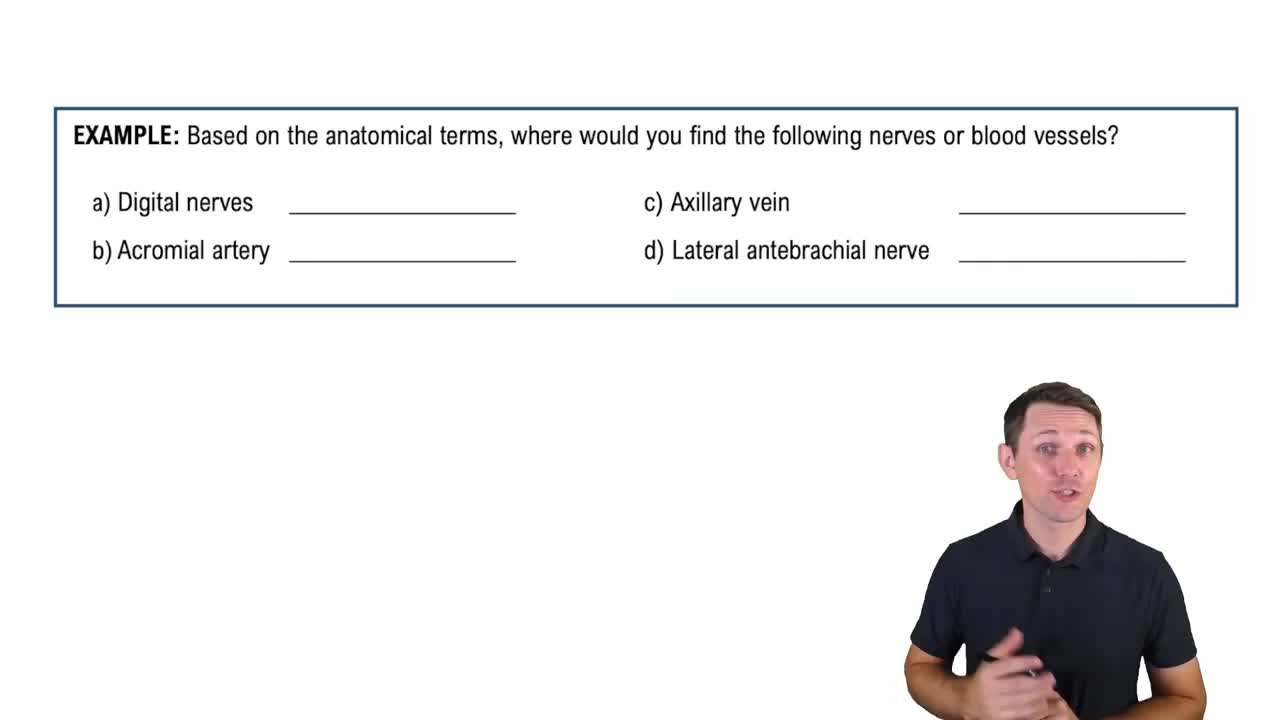
Anatomical Terms for the Arm and Hand Example 1
7125
views
166
rank
03:17
The Arm and Hand
10049
views
209
rank
3
comments
Terms in this set (35)
Hide definitions
Scapula
A flat, triangular bone that forms the posterior part of the shoulder girdle.
Spine of Scapula
A prominent ridge running across the posterior surface of the scapula.
Acromion Process
The lateral extension of the scapular spine that forms the highest point of the shoulder.
Coracoid Process
A hook-like bony projection on the anterior scapula serving as a muscle attachment site.
Superior Angle of Scapula
The uppermost point of the scapula where the medial and superior borders meet.
Inferior Angle of Scapula
The lowest point of the scapula where the medial and lateral borders meet.
Axillary (Lateral) Border of Scapula
The thick edge of the scapula closest to the armpit.
Vertebral (Medial) Border of Scapula
The edge of the scapula closest to the vertebral column.
Glenoid Cavity
A shallow socket on the scapula that articulates with the head of the humerus.
Supraspinous Fossa
A depression above the scapular spine that houses the supraspinatus muscle.
Infraspinous Fossa
A large depression below the scapular spine for the infraspinatus muscle.
Subscapular Fossa
A broad concave surface on the anterior scapula for the subscapularis muscle.
Clavicle
The collarbone connecting the scapula to the sternum.
Sternal End of Clavicle
The medial end of the clavicle that articulates with the sternum.
Acromial End of Clavicle
The lateral end of the clavicle that articulates with the acromion of the scapula.
Humerus Head
The rounded proximal end of the humerus that fits into the glenoid cavity.
Anatomical Neck of Humerus
The slight constriction just below the head of the humerus.
Surgical Neck of Humerus
The narrowed region below the tubercles, common site of fractures.
Greater Tubercle of Humerus
A large lateral projection for muscle attachment.
Lesser Tubercle of Humerus
A smaller anterior projection for muscle attachment.
Intertubercular Groove
A groove between the greater and lesser tubercles that guides the biceps tendon.
Deltoid Tuberosity
A roughened area on the lateral humerus shaft where the deltoid muscle attaches.
Medial Epicondyle of Humerus
A bony projection on the distal medial humerus for muscle attachment.
Lateral Epicondyle of Humerus
A bony projection on the distal lateral humerus for muscle attachment.
Trochlea
A spool-shaped distal humerus surface that articulates with the ulna.
Capitulum
A rounded distal humerus surface that articulates with the radius.
Olecranon Fossa
A posterior depression on the distal humerus that accommodates the olecranon of the ulna.
Ulna Head
The distal end of the ulna near the wrist.
Olecranon Process
The prominent proximal end of the ulna forming the elbow tip.
Trochlear Notch
A large C-shaped notch on the ulna that articulates with the humerus trochlea.
Radius Head
The disc-shaped proximal end of the radius that articulates with the humerus and ulna.
Radial Tuberosity
A roughened area below the radius head for biceps tendon attachment.
Carpals
Eight small bones forming the wrist: scaphoid, lunate, triquetrum, pisiform, trapezium, trapezoid, capitate, hamate.
Metacarpals
Five bones of the palm numbered 1 to 5 from thumb to little finger.
Phalanges
Bones of the fingers; each finger has proximal, middle, and distal phalanges except the thumb which lacks a middle phalanx.
 BackBack
 02:05