Skip to main content
Anatomy & Physiology
My Course
Learn
Exam Prep
AI Tutor
Study Guides
Textbook Solutions
Flashcards
Explore
Try the app
My Course
Learn
Exam Prep
AI Tutor
Study Guides
Textbook Solutions
Flashcards
Explore
Try the app
Back
Articulations and Body Movements
You can tap to flip the card.
What type of joint is the intervertebral disc?
You can tap to flip the card.
👆
What type of joint is the intervertebral disc?
The intervertebral disc is a cartilaginous joint, specifically a symphysis, allowing slight movement and acting as a shock absorber between vertebrae.
Track progress
Control buttons has been changed to "navigation" mode.
1/21
Recommended videos
Guided course
04:06
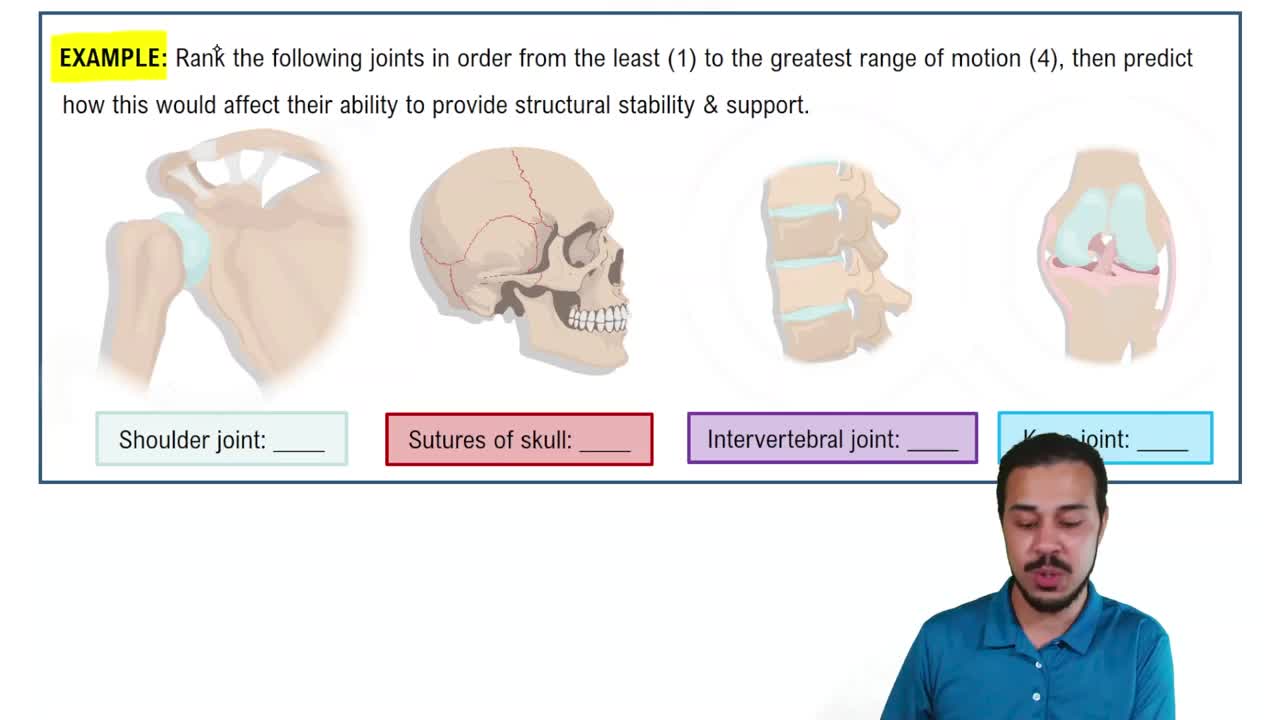
Introduction to Joints Example 1
11988
views
269
rank
Guided course
05:29
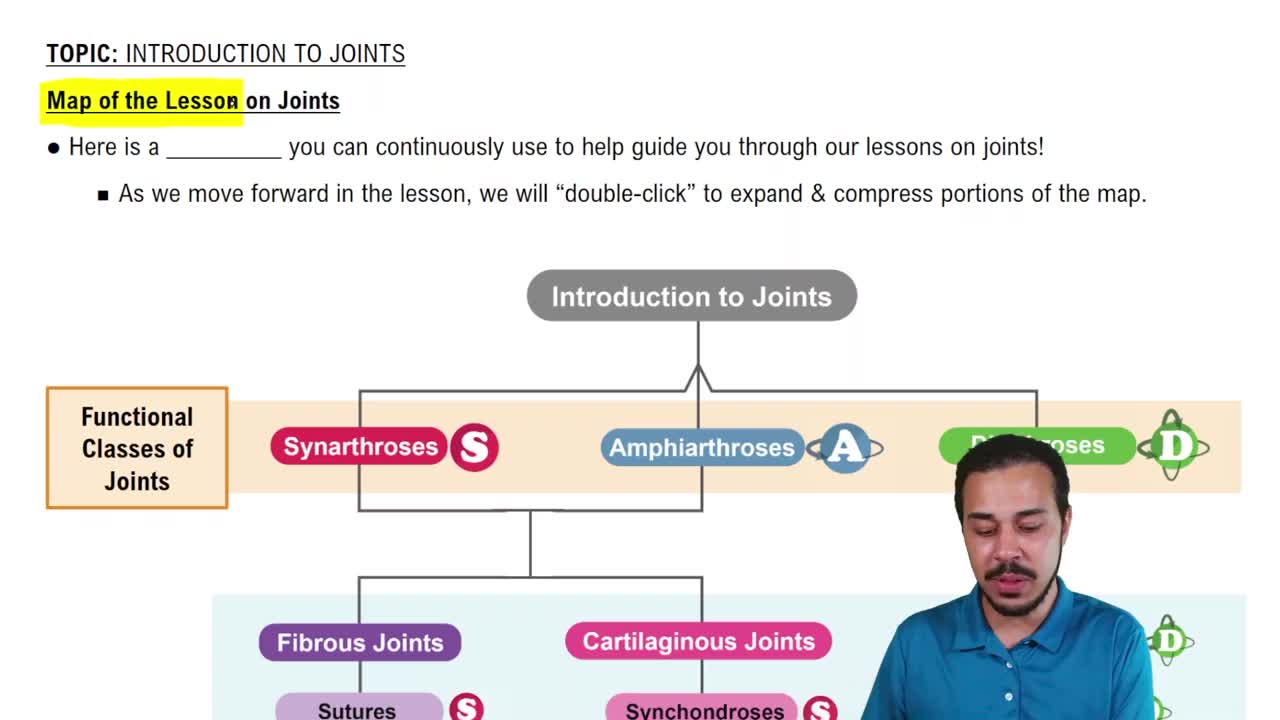
Map of the Lesson on Joints
12513
views
264
rank
1
comments
Guided course
05:39
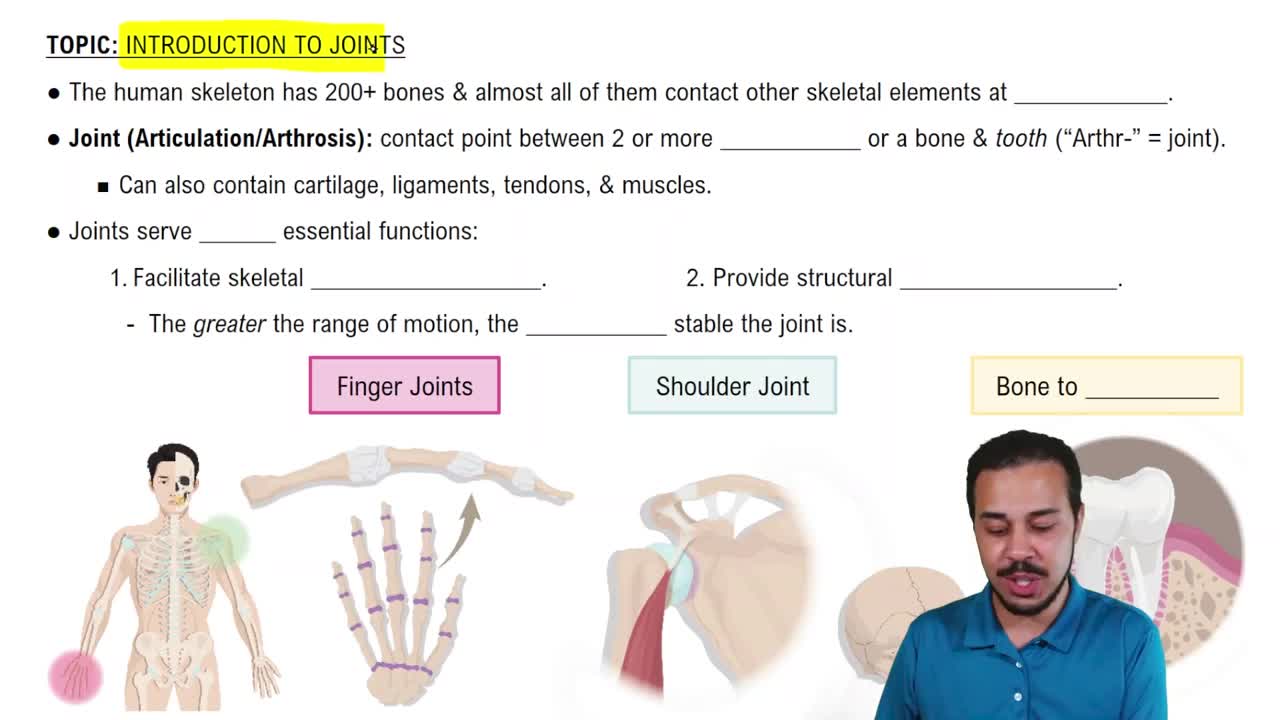
Introduction to Joints
16794
views
431
rank
Terms in this set (21)
Hide definitions
What type of joint is the intervertebral disc?
The intervertebral disc is a cartilaginous joint, specifically a symphysis, allowing slight movement and acting as a shock absorber between vertebrae.
What type of joint is the pubic symphysis?
The pubic symphysis is a cartilaginous symphysis joint that connects the two pubic bones with fibrocartilage, allowing limited movement.
What type of joint is the tibiofemoral (knee) joint?
The tibiofemoral joint is a synovial hinge joint that allows flexion and extension with some rotation.
What is the function of the lateral meniscus in the knee?
The lateral meniscus acts as a shock absorber and stabilizer between the femur and tibia on the outer side of the knee.
What is the function of the medial meniscus in the knee?
The medial meniscus cushions and stabilizes the inner side of the knee joint between the femur and tibia.
What role does the tibial ligament play in the knee joint?
The tibial ligament stabilizes the medial side of the knee, preventing excessive side-to-side movement.
What role does the fibular ligament play in the knee joint?
The fibular ligament stabilizes the lateral side of the knee, limiting lateral displacement.
What is the function of the anterior cruciate ligament (ACL)?
The ACL prevents the tibia from sliding forward relative to the femur and provides rotational stability.
What is the function of the posterior cruciate ligament (PCL)?
The PCL prevents the tibia from sliding backward relative to the femur.
Define flexion in joint movements.
Flexion is a movement that decreases the angle between two bones, typically bending a joint.
Define extension in joint movements.
Extension is a movement that increases the angle between two bones, straightening a joint.
What is abduction in terms of body movement?
Abduction is the movement of a limb away from the midline of the body.
What is adduction in terms of body movement?
Adduction is the movement of a limb toward the midline of the body.
What does rotation mean in joint movement?
Rotation is the movement of a bone around its longitudinal axis.
What is circumduction?
Circumduction is a circular movement that combines flexion, extension, abduction, and adduction.
Define pronation.
Pronation is the rotation of the forearm so the palm faces downward or backward.
Define supination.
Supination is the rotation of the forearm so the palm faces upward or forward.
What is inversion of the foot?
Inversion is the movement of the sole of the foot inward toward the midline.
What is eversion of the foot?
Eversion is the movement of the sole of the foot outward away from the midline.
Define dorsiflexion.
Dorsiflexion is the movement that decreases the angle between the dorsum (top) of the foot and the leg.
Define plantar flexion.
Plantar flexion is the movement that increases the angle between the dorsum of the foot and the leg, pointing the toes downward.
 BackBack
 04:06