Skip to main content
Anatomy & Physiology
My Course
Learn
Exam Prep
AI Tutor
Study Guides
Textbook Solutions
Flashcards
Explore
Try the app
My Course
Learn
Exam Prep
AI Tutor
Study Guides
Textbook Solutions
Flashcards
Explore
Try the app
Back
Atoms and Elements in Anatomy & Physiology
You can tap to flip the card.
What are the three main subatomic particles in an atom?
You can tap to flip the card.
👆
What are the three main subatomic particles in an atom?
Protons
(positive charge, in nucleus),
Neutrons
(no charge, in nucleus), and
Electrons
(negative charge, in electron shells).
Track progress
Control buttons has been changed to "navigation" mode.
1/20
Recommended videos
Guided course
02:13
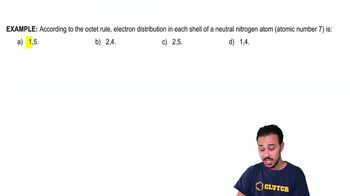
Atoms- Smallest Unit of Matter Example 1
30788
views
794
rank
Guided course
03:51
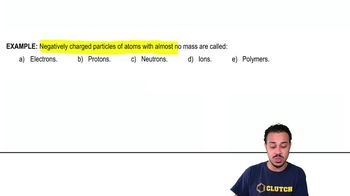
Atoms- Smallest Unit of Matter Example 3
20040
views
426
rank
Guided course
09:44
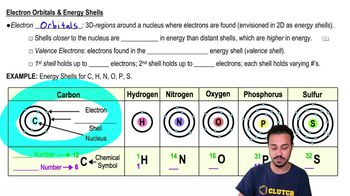
Electron Orbitals & Energy Shells
27848
views
590
rank
5
comments
Terms in this set (20)
Hide definitions
What are the three main subatomic particles in an atom?
Protons
(positive charge, in nucleus),
Neutrons
(no charge, in nucleus), and
Electrons
(negative charge, in electron shells).
What determines the identity of an element?
The
number of protons
in the nucleus, also called the
atomic number
.
What is the difference between atomic number and mass number?
Atomic number
= number of protons;
Mass number
= protons + neutrons.
What are isotopes?
Atoms of the same element with the same number of protons but different numbers of neutrons.
Why are some isotopes radioactive?
Some isotopes are
unstable
and undergo
radioactive decay
.
What is the role of valence electrons?
Valence electrons are in the outermost shell and determine how an atom interacts or bonds with other atoms.
How many electrons can the first three electron shells hold?
1st shell holds up to 2 electrons, 2nd shell up to 8 electrons, 3rd shell up to 8 electrons (for our purposes).
What makes an atom stable?
Having a
full outer electron shell
makes an atom stable and less likely to react.
What happens when an atom has an incomplete outer shell?
Atoms with incomplete outer shells tend to interact or bond with other atoms to achieve stability.
What are the four major elements that make up most of the human body?
Oxygen
,
Carbon
,
Hydrogen
, and
Nitrogen
.
What percentage of the human body mass is oxygen?
Oxygen makes up about
65%
of body mass.
What percentage of the human body mass is carbon?
Carbon makes up about
18.5%
of body mass.
What percentage of the human body mass is hydrogen?
Hydrogen makes up about
9.5%
of body mass.
What percentage of the human body mass is nitrogen?
Nitrogen makes up about
3.2%
of body mass.
What other elements are important in the human body besides the four major ones?
Calcium, Phosphorus, Potassium, Sulfur, Sodium, Chlorine, and Magnesium.
How do atoms and molecules make physiology possible?
Atoms form molecules through chemical reactions, which build structures and enable processes essential for physiology.
What is the relationship between minerals, proteins, and bone strength?
Minerals combined with proteins give bones their strength.
How do chemical reactions and enzymes relate to food?
Chemical reactions with enzymes release usable nutrients from food.
How do oxygen and nutrients help cells?
Oxygen and nutrients help cells produce energy.
What is the key takeaway about chemistry in the body?
Every structure and process in the body depends on chemistry.
 BackBack
 02:13