Skip to main content
Anatomy & Physiology
My Course
Learn
Exam Prep
AI Tutor
Study Guides
Textbook Solutions
Flashcards
Explore
Try the app
My Course
Learn
Exam Prep
AI Tutor
Study Guides
Textbook Solutions
Flashcards
Explore
Try the app
Back
Autonomic Nervous System - Anatomy & Physiology
You can tap to flip the card.
What are the two main divisions of the autonomic nervous system (ANS)?
You can tap to flip the card.
👆
What are the two main divisions of the autonomic nervous system (ANS)?
Parasympathetic division
and
Sympathetic division
.
Track progress
Control buttons has been changed to "navigation" mode.
1/20
Recommended videos
1:10
Introduction to the Autonomic Nervous System Example 1
6957
views
159
rank
1:50
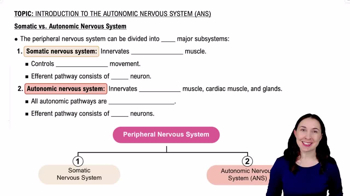
Somatic vs. Autonomic Nervous System
9407
views
185
rank
3:10
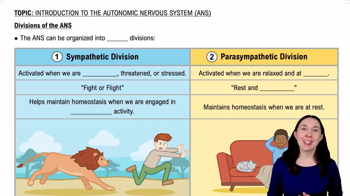
Divisions of the ANS
7399
views
126
rank
Terms in this set (20)
Hide definitions
What are the two main divisions of the autonomic nervous system (ANS)?
Parasympathetic division
and
Sympathetic division
.
What is the primary function of the parasympathetic division?
Promotes maintenance and conserves body energy, often called the "rest and digest" system.
What is the primary function of the sympathetic division?
Mobilizes the body for activity, often called the "fight or flight" system.
What is dual innervation in the ANS?
Both parasympathetic and sympathetic divisions serve the same tissues but produce opposite effects.
Where are parasympathetic postganglionic cell bodies located?
In terminal ganglia near or within the effector organs.
Which cranial nerves supply parasympathetic fibers to the head?
Cranial nerves III, VII, and IX.
What additional tissues does the sympathetic division innervate that the parasympathetic does not?
Sweat glands, arrector pili muscles in hair follicles, and smooth muscles of arteries and veins.
Where are sympathetic preganglionic neuron cell bodies located?
In the lateral horns of the spinal cord gray matter.
What is the role of the adrenal medulla in the sympathetic nervous system?
It acts as a modified sympathetic ganglion that secretes epinephrine and norepinephrine into the blood.
What neurotransmitter is released by all ANS preganglionic fibers?
Acetylcholine (ACh).
Which fibers release norepinephrine (NE) in the ANS?
Most sympathetic postganglionic fibers.
How do parasympathetic and sympathetic effects differ in duration and localization?
Parasympathetic effects are short-lived and highly localized; sympathetic effects are diffuse and long-lasting.
What is sympathetic (vasomotor) tone?
Continuous partial constriction of blood vessels maintained by sympathetic activity.
What is parasympathetic tone?
Parasympathetic dominance that maintains heart rate and smooth muscle activity in digestive and urinary tracts.
What brain region is the integrative center for autonomic control?
The hypothalamus.
Which part of the hypothalamus directs parasympathetic activity?
The anterior hypothalamus.
Which part of the hypothalamus directs sympathetic activity?
The posterior hypothalamus.
What is a visceral reflex arc?
A reflex involving visceral sensory neurons that monitor chemical changes, stretch, temperature, or irritation.
Name a disorder caused by overactive sympathetic vasoconstriction.
Hypertension (high blood pressure).
What is autonomic dysreflexia?
Uncontrolled activation of autonomic neurons causing dangerous spikes in blood pressure, often in spinal cord injury patients.
 BackBack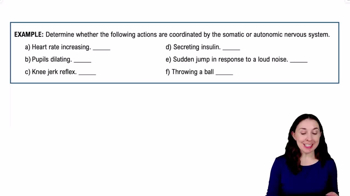
 1:10
1:10