Skip to main content
Anatomy & Physiology
My Course
Learn
Exam Prep
AI Tutor
Study Guides
Textbook Solutions
Flashcards
Explore
Try the app
My Course
Learn
Exam Prep
AI Tutor
Study Guides
Textbook Solutions
Flashcards
Explore
Try the app
Back
Basic Cell Structure and Function in Anatomy & Physiology
You can tap to flip the card.
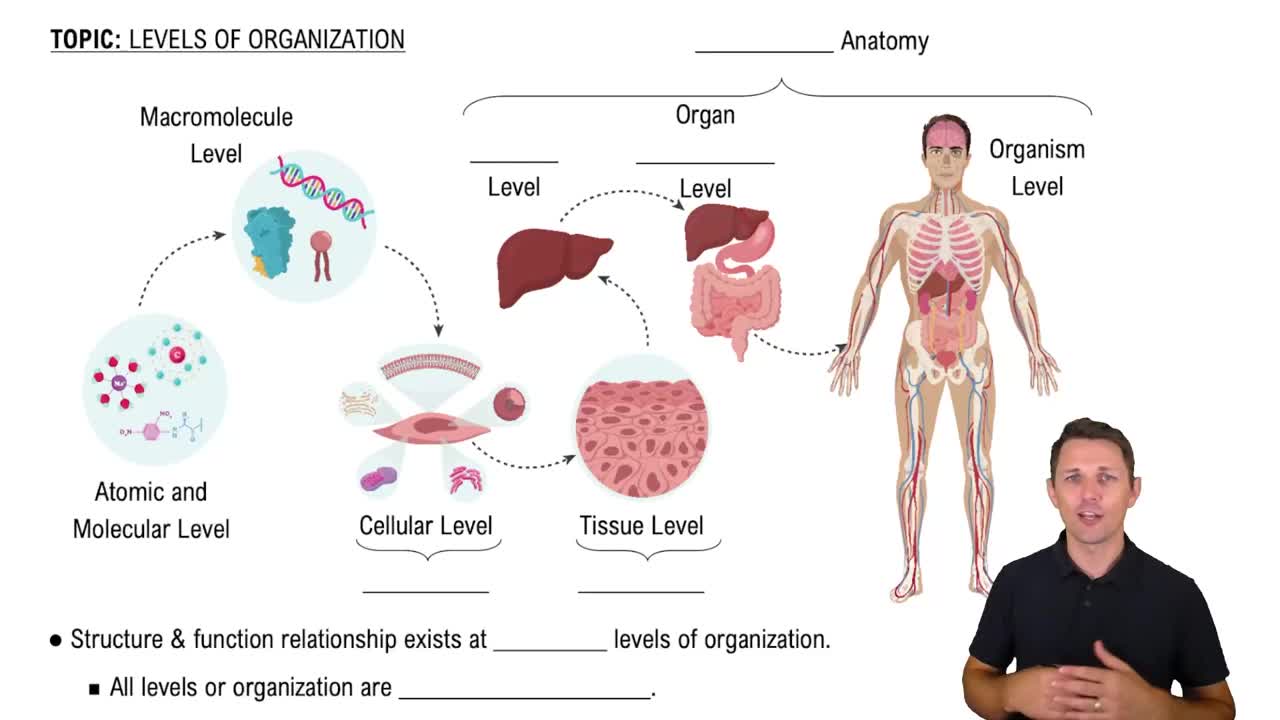
What are the main levels of biological organization?
You can tap to flip the card.
👆
What are the main levels of biological organization?
Cellular
,
Tissue
,
Organ
,
Organ system
, and
Organismal
levels.
Track progress
Control buttons has been changed to "navigation" mode.
1/20
Recommended videos
Guided course
05:04
The Levels of Organization
49273
views
1463
rank
5
comments
Guided course
02:22
Levels of Organization Example 1
27736
views
594
rank
2
comments
Terms in this set (20)
Hide definitions
What are the main levels of biological organization?
Cellular
,
Tissue
,
Organ
,
Organ system
, and
Organismal
levels.
What is the basic unit of life?
The
cell
is the basic structural and functional unit of life.
What distinguishes prokaryotic cells from eukaryotic cells?
Prokaryotic
cells lack a nucleus and membrane-bound organelles;
eukaryotic
cells have a nucleus and organelles.
What is the plasma membrane also called?
The plasma membrane is also called the
cell membrane
or
plasmalemma
.
Name three main functions of the cell membrane.
Acts as a
boundary
, a
semipermeable barrier
, and enables
communication via receptors
.
What are the main components of the cytoskeleton?
The cytoskeleton consists of
microtubules
,
microfilaments
, and
intermediate filaments
.
What is the function of the cytoskeleton?
It maintains
cell integrity
and provides
motility
.
What are inclusions in the cytoplasm?
Inclusions are
storage products
such as
glycogen
and
melanin
.
Where is the cell wall found and what is its function?
The cell wall is a
rigid structure
surrounding the cell membrane in
plants, fungi, algae, and bacteria
, but not in animals or protozoa.
What is the role of the smooth endoplasmic reticulum in the cell?
The smooth ER is involved in
lipid synthesis
and
detoxification
.
What is the function of the rough endoplasmic reticulum?
The rough ER has
ribosomes
and is involved in
protein synthesis
.
What is the function of mitochondria?
Mitochondria produce
ATP
through cellular respiration, providing energy for the cell.
What is the function of lysosomes?
Lysosomes contain
digestive enzymes
to break down waste and cellular debris.
What is the role of the Golgi complex?
The Golgi complex
modifies, sorts, and packages proteins
for secretion or use within the cell.
What is the cytoplasm composed of?
The cytoplasm includes the
cytosol
and the
organelles
suspended within it.
What is the function of microvilli on the cell surface?
Microvilli increase the
surface area
for absorption.
What is the function of cilia on the cell surface?
Cilia help in
movement
of substances across the cell surface.
What is the function of centrioles?
Centrioles play a role in
cell division
by organizing the mitotic spindle.
What is the function of the nucleolus?
The nucleolus is responsible for
ribosomal RNA synthesis
and ribosome assembly.
What is the function of glycogen inclusions?
Glycogen inclusions serve as a
storage form of glucose
in cells.
 BackBack
 05:04