 Back
Basic Chemistry Concepts for Anatomy & Physiology
 02:13

Terms in this set (20)
Matter is anything that takes up space and has mass. It exists in three states: gases, liquids, and solids.
An element consists of atoms of the same type. A compound is made of different kinds of atoms chemically combined.
An atom is the smallest stable unit of an element that retains its chemical properties.
Protons: positive charge, large and heavy.
Neutrons: no charge, large and heavy.
Electrons: negative charge, very small.
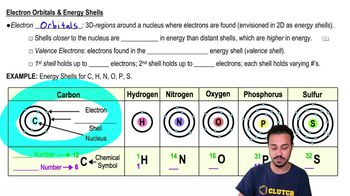
Protons and neutrons are in the nucleus at the center; electrons orbit in shells around the nucleus.
The atomic number equals the number of protons in the nucleus and defines the element's identity.
Atomic mass is the average weight of an atom, mainly determined by the number of protons and neutrons.
Number of neutrons = rounded atomic mass number minus atomic number.
Isotopes are different forms of the same element with the same number of protons but different numbers of neutrons.
Radioactive isotopes have unstable nuclei that spontaneously break down, releasing energy and particles.
They are used to detect organ functions, biological processes, and disease states for diagnosis and treatment.
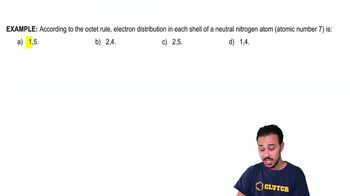
2 electrons in the innermost shell, up to 8 in the second, and up to 8 in the third shell.
Stable atoms are not very reactive; unstable atoms are reactive and form chemical bonds to create molecules.
A molecule is two or more atoms held together by chemical bonds, either of the same or different types.
Ionic bonds form when electrons are given up or accepted. Covalent bonds form when electrons are shared between atoms.
Ions are charged atoms or groups of atoms formed by losing or gaining electrons.
Electrolytes are ions that conduct electrical currents in the body, such as sodium, potassium, and calcium.
A polar covalent bond shares electrons unequally, creating partial charges on atoms.
A hydrogen bond is a weak electrical attraction between polar groups, either between molecules or within different parts of one molecule.
Water is a universal solvent, has a high heat capacity, and forms hydrogen bonds, making it crucial for life and physiological processes.