 Back
BackBasic Chemistry Concepts in Anatomy & Physiology
 02:13
02:13
Terms in this set (21)
Matter is anything that has mass and occupies space. It can be seen, smelled, or felt.
Solid: definite shape and volume.
Liquid: changeable shape, definite volume.
Gas: changeable shape and volume.
Energy is the capacity to do work or put matter into motion.
Kinetic energy: energy in action.
Potential energy: stored energy.
Carbon (C), Oxygen (O), Hydrogen (H), and Nitrogen (N) make up 96% of the human body.
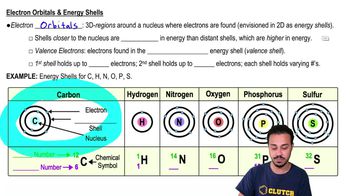
Atoms consist of a nucleus containing protons (+) and neutrons (0), with electrons (-) orbiting around the nucleus.
The planetary model shows electrons in fixed orbits; the orbital model shows electrons in probable regions called electron clouds.
Atomic number: number of protons in the nucleus.
Mass number: total number of protons and neutrons.
Atoms with the same number of protons but different numbers of neutrons.
Molecule: two or more atoms bonded together.
Compound: molecule with two or more different kinds of atoms.
Solutions: homogeneous, solute particles do not settle.
Colloids: heterogeneous, larger particles do not settle.
Suspensions: heterogeneous, large particles settle out.
Atoms tend to gain, lose, or share electrons to achieve 8 electrons in their valence shell for stability.
Inert elements have complete valence shells and are nonreactive.
Reactive elements have incomplete valence shells and tend to form bonds.
Formed by the transfer of electrons from one atom to another, creating ions that attract each other (e.g., NaCl).
Formed by sharing electrons between atoms.
Nonpolar covalent: equal sharing.
Polar covalent: unequal sharing creating dipoles.
Weak attractions between a hydrogen atom and an electronegative atom, important in water and biological molecules.
Synthesis: combine to form larger molecules.
Decomposition: break down molecules.
Exchange: bonds made and broken.
Redox: electron transfer.
Temperature, concentration, particle size, and catalysts (enzymes).
Water is the most abundant inorganic compound, with properties like high heat capacity, solvent ability, reactivity, and cushioning.
Salts are ionic compounds that dissociate in water to form electrolytes, vital for nerve impulses, muscle contraction, and water balance.
Acids: proton donors releasing H+ (pH < 7).
Bases: proton acceptors releasing OH– (pH > 7).
pH scale: measures H+ concentration from 0 to 14.
Substances that resist changes in pH, important for maintaining homeostasis.